
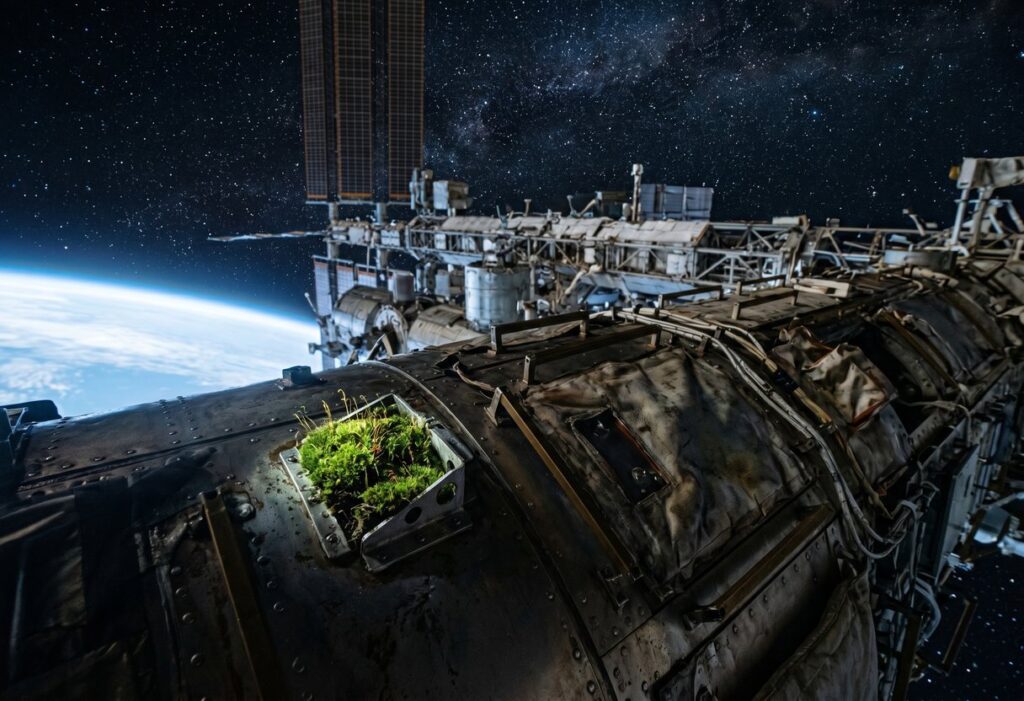
For 283 days, a humble moss clung to the skin of the ISS and refused to die. If a patch of green can outlast vacuum, radiation, and wild temperature swings, what else about life in space are we underestimating?
Clinging to the outside of the International Space Station, a tuft of Physcomitrium patens spent 283 days taking space like a punch to the face: radiation, vacuum, wild temperature swings. Then it came home and, in eight cases out of ten, got back to growing and reproducing. The result nudges a sci-fi fantasy toward testable biology, and gives fresh weight to ideas about life hitchhiking across the cosmos. It also hints at a practical toolkit for future explorers who may want to pack seeds, not just circuits.
Moss experiment on ISS opens new doors for greening other worlds
Some space stories feel almost intimate, like a window fogged by our own breath. This is the case with a tiny pioneer: a patch of moss that spent 283 days outside the International Space Station. Exposed to vacuum, radiation, and wild temperature swings, it held on. The results, now shared by the research team, hint at how simple plants might help us push farther into space.
A mossy mission aboard the ISS
Researchers mounted a resilient moss species on hardware affixed to the ISS exterior, letting space have its way with it. No cozy lab module, no greenhouse, just the raw environment in low Earth orbit. The goal was direct and bold: test whether terrestrial plant life can survive the unfiltered extremes that future exploration will inevitably bring.
Why moss? Exploring the experiment’s roots
Tardigrades often claim the spotlight for space survival, but plants underpin any long-term human presence beyond Earth. Scientists selected Physcomitrium patens, prized for adaptability in deserts and cold regions on Earth, to probe plant endurance against cosmic radiation, vacuum, microgravity, and severe thermal cycling. By placing spores beyond pressurized protection, the team could study true exposure rather than simulated stress.
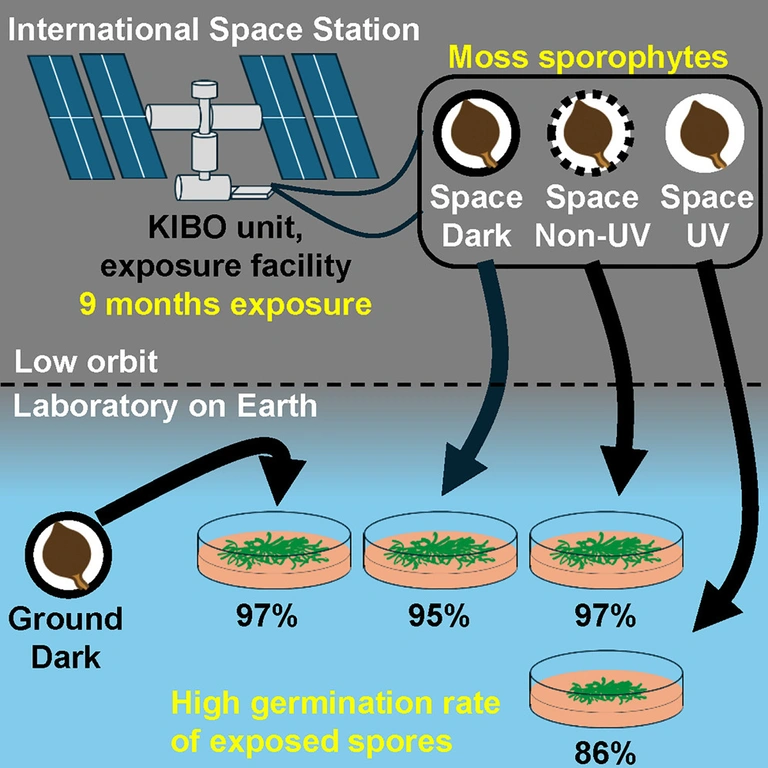 Graphic summary of the study © iScience
Unexpected resilience under stress
The outcome surprised even cautious optimists. Over 80% of the moss spores survived the ordeal, then regenerated and reproduced back on Earth. According to this study, with minimal shielding, the spores could potentially endure up to 15 years in space. Such longevity speaks to potent DNA repair systems and naturally protective spore structures, a kind of biological armor against extreme damage.
What this means for space exploration
The implications stretch beyond botany. The survival window supports discussions around panspermia, the idea that life might hitch rides on rocks between worlds. In addition to big-picture origins, there are practical payoffs: hardy plants could assist future crews with life support, resource cycling, and habitat conditioning on the Moon or Mars. Even partial greening could supply oxygen, moisture retention, and psychological benefits for astronauts.
Potential applications: life-support loops, radiation-tolerant biofilms, soil formation starters, and compact food or nutrient systems.
Imagining greener horizons
We are not planting forests on Mars tomorrow, yet this modest moss suggests a path. With targeted protection and smart habitat design, simple plants may become quiet partners in exploration. Indeed, the study’s message feels both humble and bold: small, sturdy life can do big work. That resilience, patient and persistent, might help turn distant stations into livable outposts.