
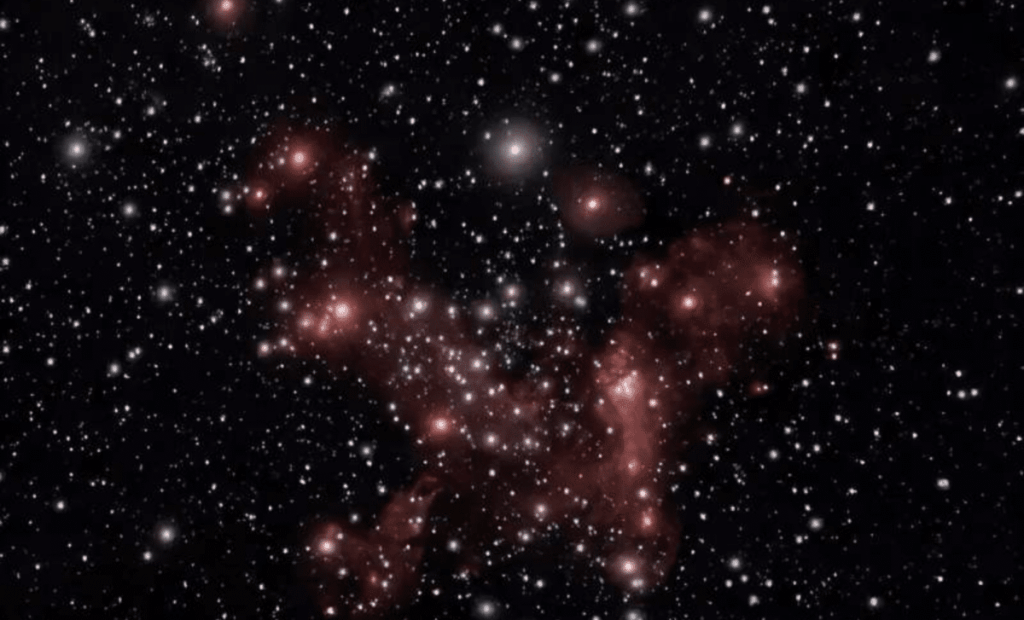
A long-standing mystery at the heart of our galaxy may finally have an answer. New findings published in Astronomy & Astrophysics reveal that a massive binary star system is likely responsible for producing the enigmatic gas clouds observed near Sagittarius A*, the Milky Way’s supermassive black hole. This discovery reshapes how astronomers understand the flow of matter in one of the most extreme environments in the universe.
The Chaotic Heart Of The Milky Way
The region surrounding Sagittarius A* is one of the most extreme environments known, packed with dense stars, turbulent gas, and intense gravitational forces. For decades, astronomers have studied this region as a natural laboratory to understand how black holes interact with their surroundings. Among the most intriguing features observed are compact gas clouds, small, dense clumps of ionized gas moving on highly elongated orbits toward the black hole.
These clouds, first detected through infrared observations, have puzzled scientists due to their unusual properties. They appear too compact to be simple gas structures, yet too diffuse to behave like stars. Their motion suggests they are gradually being stretched and pulled apart by tidal forces as they approach the black hole, making them key tracers of how matter flows inward.
Understanding their origin has been critical. Without knowing where these clouds come from, it has been nearly impossible to explain how Sagittarius A* maintains its current level of activity, which depends on a steady supply of material.
The G-Cloud Family And A Growing Puzzle
The mystery deepened with the discovery of multiple related objects. The first, known as G2, was identified in 2012 as a compact gas cloud with a mass comparable to a few Earths. It was soon followed by the recognition of G1, an earlier object moving along a similar orbit, and a trailing structure known as G2t.
Further observations revealed that these were not isolated phenomena but part of a larger, coherent structure, a streamer of gas now informally referred to as the G1–2–3 system. Each component follows nearly identical orbital paths, strongly suggesting a shared origin.
This alignment posed a statistical improbability. The likelihood that multiple independent clouds would naturally fall into such similar orbits is extremely low. This realization pushed researchers to search for a single, unified source capable of producing these clumps in a continuous stream.
The implications are significant. Calculations indicate that even a modest infall rate, roughly one Earth mass per decade, could sustain the black hole’s observed activity. These clouds may represent a direct feeding mechanism, linking small-scale gas dynamics to large-scale galactic processes.
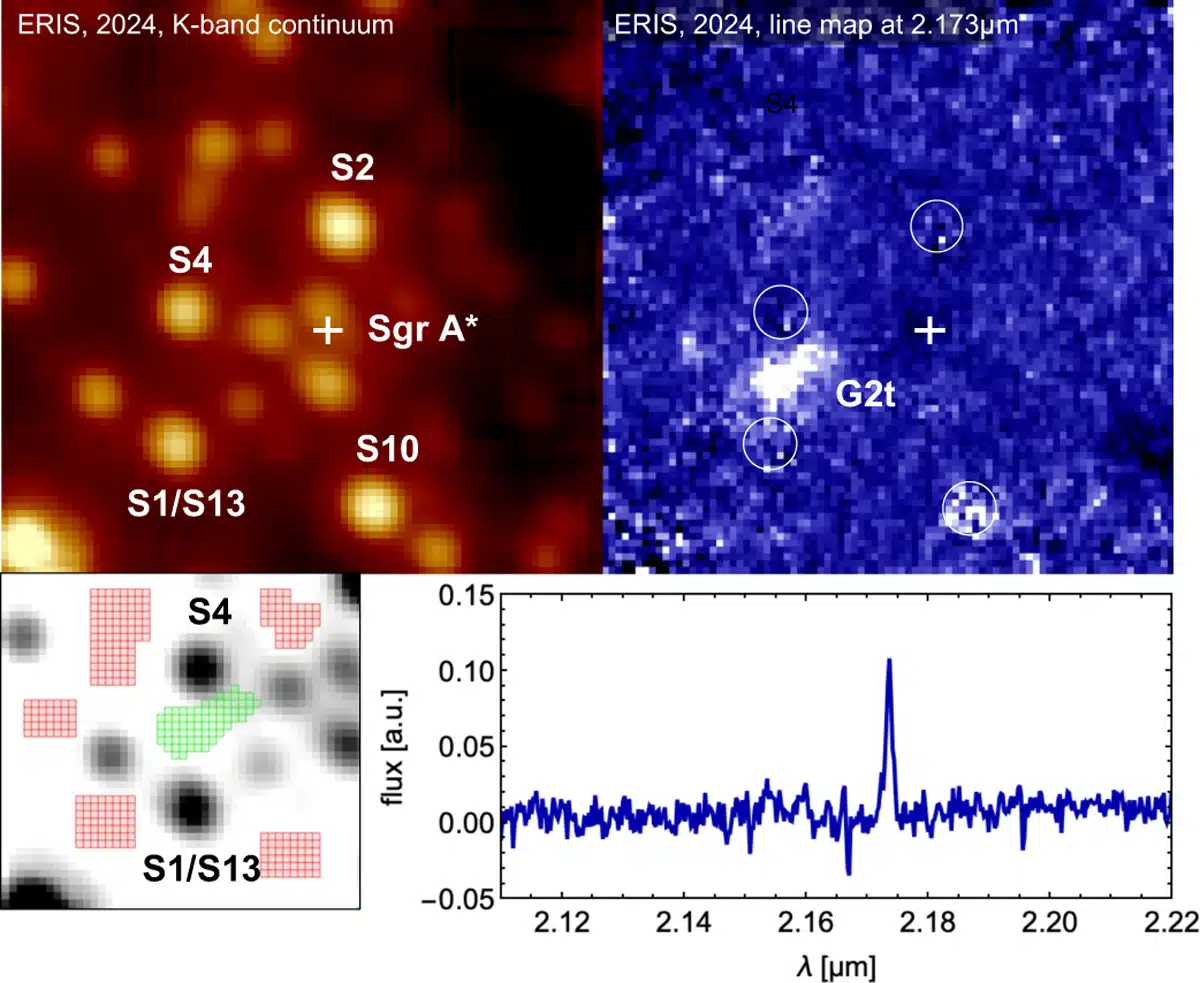 G2t in the ERIS integral-field data from June/July 2024. Top left: continuum image showing the S-stars. Top right: Background-subtracted line map centered at 2.173 µm, corresponding to Brackett-γ + 1000 km/s. G2t stands out. Bottom left: example of a pixel selection (on – green, off – red) for extracting the G2t spectrum overlaid on the continuum map. Bottom right: Resulting spectrum showing a strong emission line at 2.173 µm.
Credit: Astronomy & Astrophysics
A Binary Star System Emerges As The Source
The breakthrough came when researchers traced the motion of these gas clouds backward through space and time. Using advanced instruments like SINFONI and ERIS, they reconstructed the clouds’ trajectories with remarkable precision by analyzing infrared emission, particularly the Brackett-γ spectral line.
Their analysis pointed to a compelling source: IRS 16SW, a massive contact binary star system located within a disk of young stars orbiting the galactic center. This system consists of two closely orbiting stars whose powerful stellar winds collide at high speed, creating shock fronts where gas can accumulate and compress.
Hydrodynamical simulations support this scenario. They show that the interaction between the stellar winds and the surrounding medium can produce dense pockets of gas. Over time, these pockets detach and are flung inward, forming the very clumps observed as G1, G2, and their successors.
Subtle differences in the clouds’ orbits can be explained by the orbital motion of the binary itself, adding further weight to this model. What once appeared as random, isolated phenomena now fits into a coherent and dynamic system driven by stellar physics.
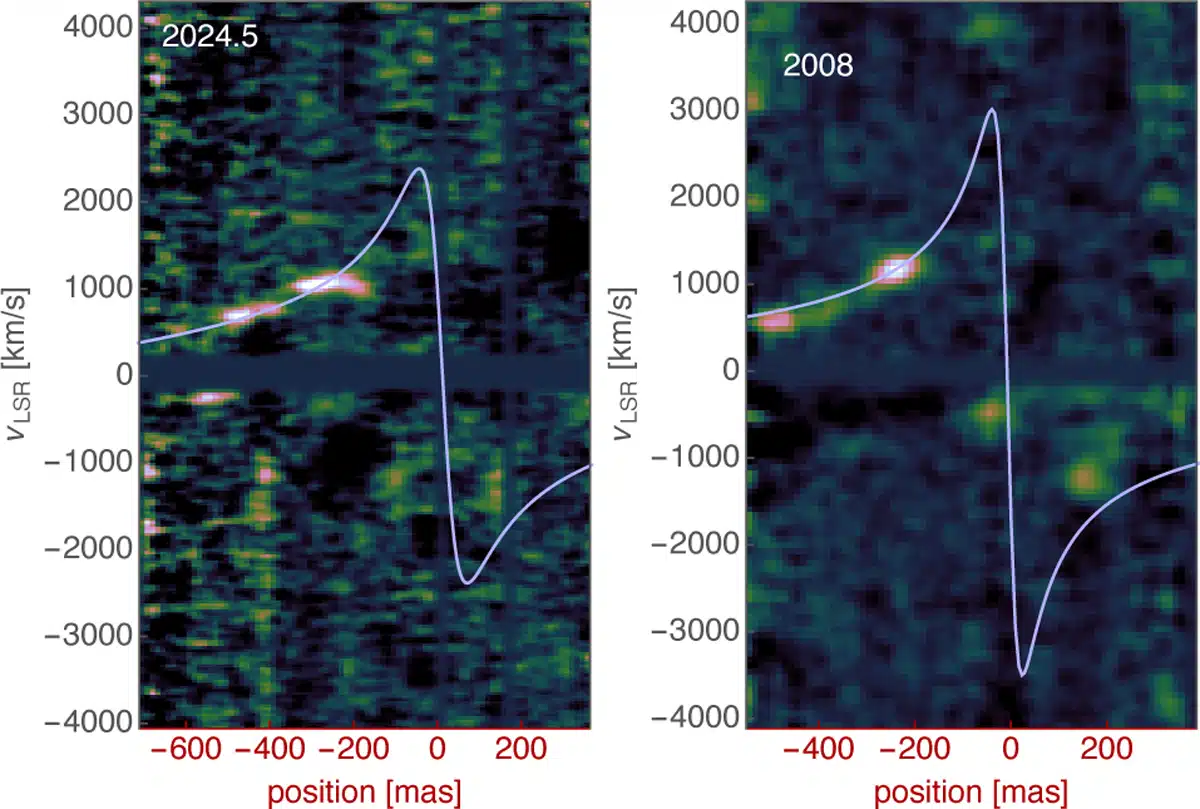 Left: position–velocity diagram extracted from the June/July-2024 data cube, using a curved slit along the orbital trace of G2t. The emission of G2t is concentrated around (−300 mas, +1000km/s). Similar to G2, G2t seems to be followed by a tail, indicative of even more material flowing along the G1–2–3 path. Right: same diagram for G2 extracted from the 2008 data cube (from Gillessen et al. 2019) for comparison. Credit: Astronomy & Astrophysics
A New Link Between Stars And Black Hole Growth
This discovery offers more than just an explanation for mysterious gas clouds, it provides a missing link between stellar evolution and black hole feeding. Massive stars like those in IRS 16SW are not just passive inhabitants of the galactic center; they actively shape its environment and contribute to the growth of the central black hole.
The findings, published in Astronomy and Astrophysics, suggest that stellar winds from massive binaries can act as a continuous supply chain, delivering material inward in discrete, observable clumps. This mechanism may operate not only in the Milky Way but also in other galaxies, offering a broader framework for understanding how black holes are fueled across the universe.
By connecting the lifecycle of stars with the behavior of gas and the growth of black holes, this research paints a more unified picture of galactic ecosystems. The once-enigmatic gas clouds are no longer anomalies, they are part of an ongoing process that quietly sustains one of the most powerful objects in our galaxy.