
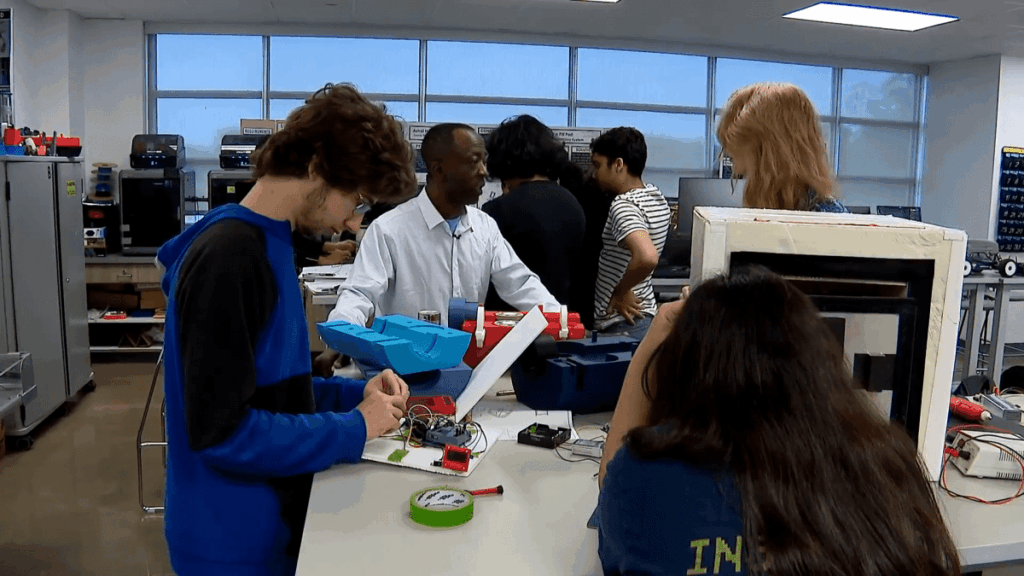
The latest version of NASA researchers is studying how to help astronauts live and work better in outer space. The research is happening here in North Texas and the scientists doing that work are coming from someplace you probably wouldn’t expect, a high school.
David Berry is part project manager, part educator, the teacher at Ranchview High School in Carrollton-Farmers Branch ISD is helping guide his top seniors through research and experiments assigned by NASA.
“They’re actually missions; there’s no simulation in this. And we have high school students working on actual NASA projects to further space, the first, to further the space program,” said Berry.
NASA calls it HUNCH: High Schools United to Create Hardware. The real-life space explorers give real-life problems to hundreds of high schools across the country and ask them to spend time working on solutions.
Joelle Tiao and Jonas Scott have been working together on a box that resembles a microwave.
“So it’s kind of the opposite. It cools instead of heats,” said Joelle Tiao. “But the problem is that it’s really cold outside, it’s like way too cold for the food, so this kind of regulates it more.”
On the other side of the lab, Arnav Sangle is trying to find a better way for rovers to collect clean samples from the moon, he found success when they work in unison.
“It’s like a drone show like you see, like the drones they coordinate and they make all these cool shapes in the sky. That’s basically wherever they’re going,” said Sangle.
The kids presented their ideas in the beginning of the year and NASA chose them out of a hundred around the country to move forward and keep researching and presenting.
Their budget is smaller than their big brains allow, so they turned to Dallas’ Mark Cuban and asked for help, he donated cash so they could keep putting their ideas to the test.
On Monday, the team heads to Houston to present a school year’s worth of resources to the experts at the Johnson Space Center.
“It was really awesome seeing that we made it to the national and the international stage,” said Sangle. “I think we’ll be awesome. I think the judges will eat up what we have to give them.”
The students are eating up the opportunity in what is really early training to be the next great engineers and scientists.
“This is workforce development for the space program,” said Berry.