
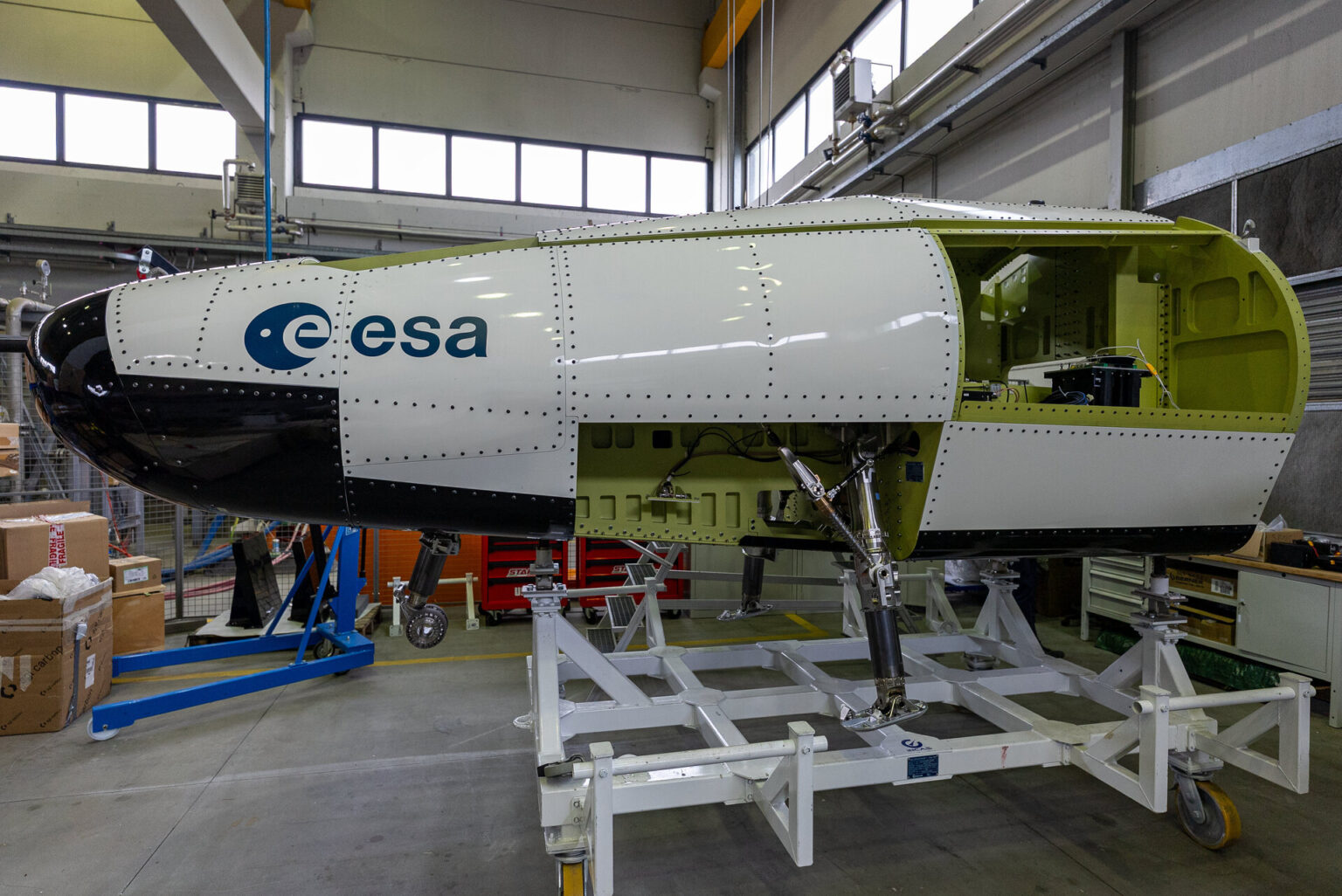
Engineers have completed a full-size test model of ESA’s Space Rider at the Italian Aerospace Research Centre in Capua. This year, a helicopter will carry it to 3 kilometres above a Sardinian test range and release it. The parafoil has to open. There is no backup.
Space Rider will be Europe’s first reusable, uncrewed spacecraft. It will orbit for roughly two months, running experiments from its pressurised cargo bay. When the mission ends, the reentry module enters the atmosphere. It then glides under a parafoil to a runway landing. These drop tests rehearse that approach in full.
A Landing Method No Spacecraft Has Tried Before
No operational spacecraft has ever used a parafoil to reach a targeted runway. That makes these trials unlike anything Europe has attempted.
The parafoil is enormous: 27 metres long, 10 metres wide. It needs to be. The reentry module weighs 2,950 kg, roughly ten times the load a human paraglider carries. Engineers spent three weeks folding and packing it using a purpose-built machine. Two winches control the steering lines. The spacecraft’s avionics drive them entirely. No human touches the controls during descent.
Get the deployment wrong, and Space Rider hits the ground hard.
Built in Romania, Tested Over Sardinia
Romania’s National Institute for Aerospace Research ‘Elie Carafoli’ (INCAS) built the drop-test model in Craiova. Engineers shipped it to the Italian Aerospace Research Centre (CIRA) in Capua. CIRA leads the design, integration and execution of the test campaign.
The model is a full-scale replica of the 4.6-metre reentry module, about the size of a mini-van. In the second week of March, engineers installed the Guidance, Navigation and Control avionics. This system reads wind conditions in real time and adjusts the parafoil accordingly. The landing gear stays fixed open on this model; the deployment mechanism falls outside these trials.
ESA will run multiple drops over the Salto di Quirra test range in Sardinia later this year.
“The teams have been working years on this project,” said Aldo Scaccia, ESA’s Space Rider Space Segment manager. “It looks and weighs much like the real thing.” Thales Alenia Space Italy leads the test campaign, with Avio as co-prime.
 Published by Kerry Harrison
Kerry’s been writing professionally for over 14 years, after graduating with a First Class Honours Degree in Multimedia Journalism from Canterbury Christ Church University. She joined Orbital Today in 2022. She covers everything from UK launch updates to how the wider space ecosystem is evolving. She enjoys digging into the detail and explaining complex topics in a way that feels straightforward. Before writing about space, Kerry spent years working with cybersecurity companies. She’s written a lot about threat intelligence, data protection, and how cyber and space are increasingly overlapping, whether that’s satellite security or national defence. With a strong background in tech writing, she’s used to making tricky, technical subjects more approachable. That mix of innovation, complexity, and real-world impact is what keeps her interested in the space sector.