
 Credit: NASA/Joel Kowsky
The European Space Agency has provided additional detail in response to claims made by NASA Administrator Jared Isaacman regarding the condition of Gateway space station modules already delivered to the agency, offering a clearer picture of the state of these key elements and the potential impact on the programme’s schedule.
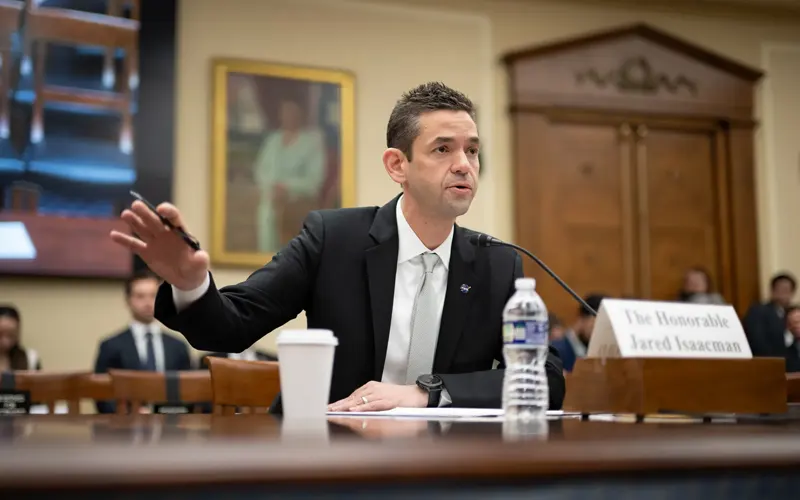
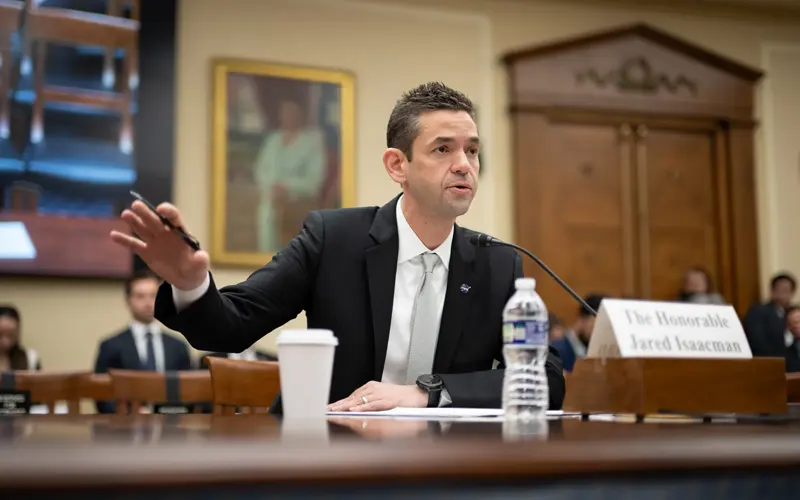
During a hearing before the US House Science Committee on 22 April, Administrator Isaacman testified on the status of elements of NASA’s Gateway space station, stating, “The only two habitable volumes that were delivered both were corroded.” He added that this issue would have delayed the programme “beyond 2030.” While Isaacman did not specify which modules he was referring to, commentary surrounding the Administrator’s testimony suggested he was referring to the Habitation and Logistics Outpost (HALO) and the International Habitation Module (I-HAB).
While HALO was part of NASA’s contribution to the station, with its construction led by Northrop Grumman, its primary structure was manufactured in Italy by Thales Alenia Space. The company has several decades of experience producing pressurised structures, including the Columbus laboratory and Harmony module of the International Space Station, as well as pressurised cargo modules for the Cygnus spacecraft.
The I-HAB module forms part of ESA’s contribution to the station, with JAXA providing key life support and environmental control systems. In October 2020, the European Space Agency awarded Thales Alenia Space the contract to develop and manufacture the Lunar I-HAB module.
In response to questions from European Spaceflight, ESA confirmed that the HALO module, which had been delivered to Northrop Grumman in April 2025 for final outfitting before being handed over to NASA, had arrived with signs of corrosion. While the agency confirmed that I-HAB had a similar but less severe issue, it clarified that the module had not yet been shipped to NASA.
“Following the identification of corrosion on HALO, a comprehensive investigation was promptly initiated,” explained an ESA spokesperson. “Preliminary findings indicate that the issue likely results from a combination of factors, including aspects of the forging process, surface treatment, and material properties. A dedicated tiger team was established for I-Hab under the guidance of ESA to solve this issue. Based on the investigation and available data, the corrosion issue was understood to be technically manageable and did not constitute a showstopper for I-Hab, which was, in any case, in better condition than HALO from a corrosion point of view.”
In addition to clarifying the status of the HALO and I-HAB modules, the agency said these elements were far from the only factors contributing to delays in the station’s development.
“Based on programme information shared by NASA, other elements provided by the US supply chain, such as the life support system and the thermal control pump, were also experiencing notable delays and technical complexity,” the ESA spokesperson said.
In his testimony, Administrator Jared Isaacman said that NASA was exploring the potential repurposing of Gateway elements for the agency’s planned surface base. It remains unclear whether this includes HALO and I-HAB, and whether efforts to restore these elements of the station will continue.
Keep European Spaceflight Independent
Your donation will help European Spaceflight to continue digging into the stories others miss. Every euro keeps our reporting alive.