
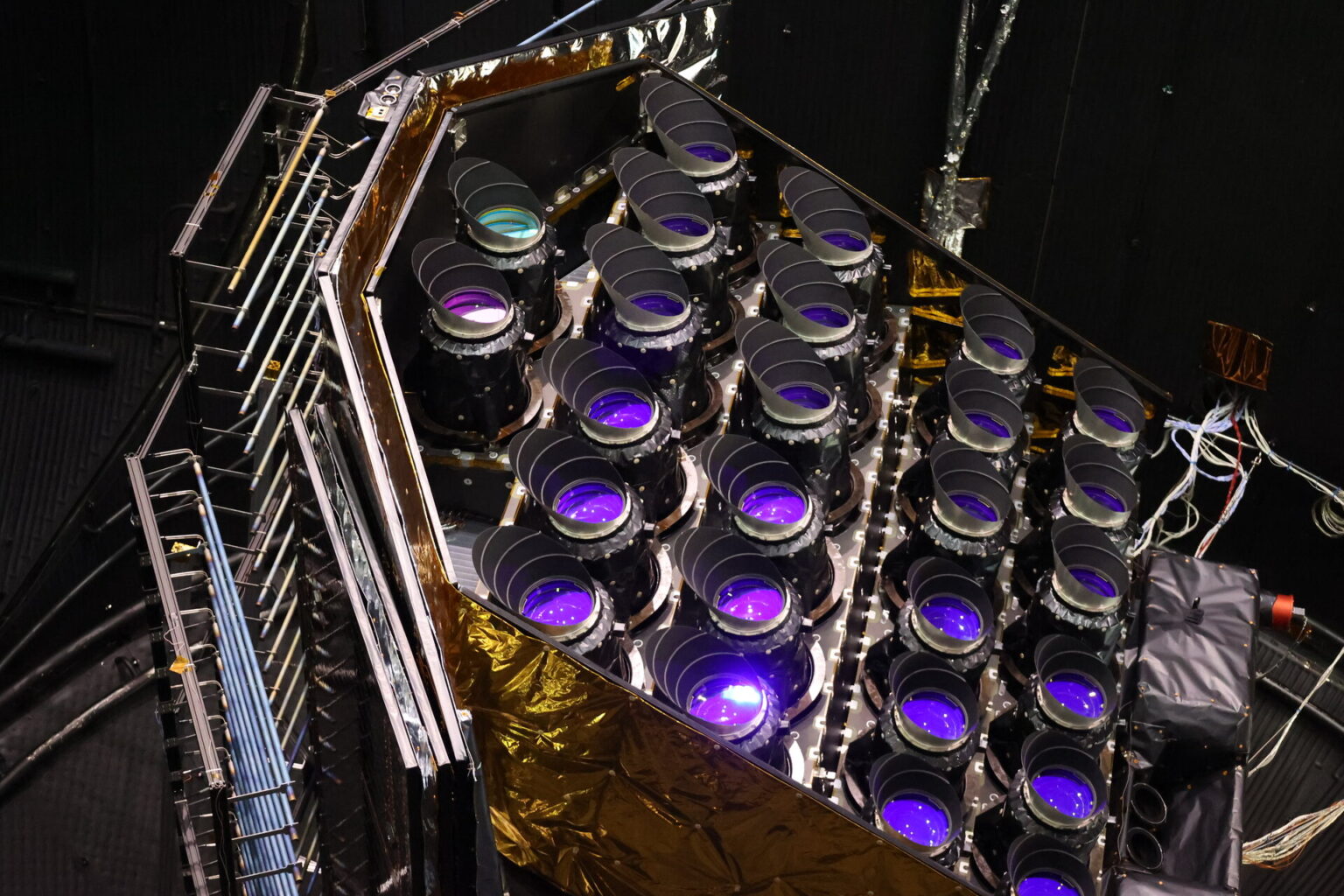
The European Space Agency’s (ESA) PLATO space telescope (PLAnetary Transits and Oscillations of stars) has successfully completed a series of tests in conditions simulating outer space and has been confirmed ready for launch. The launch is scheduled for January 2027 aboard the Ariane 6 rocket.
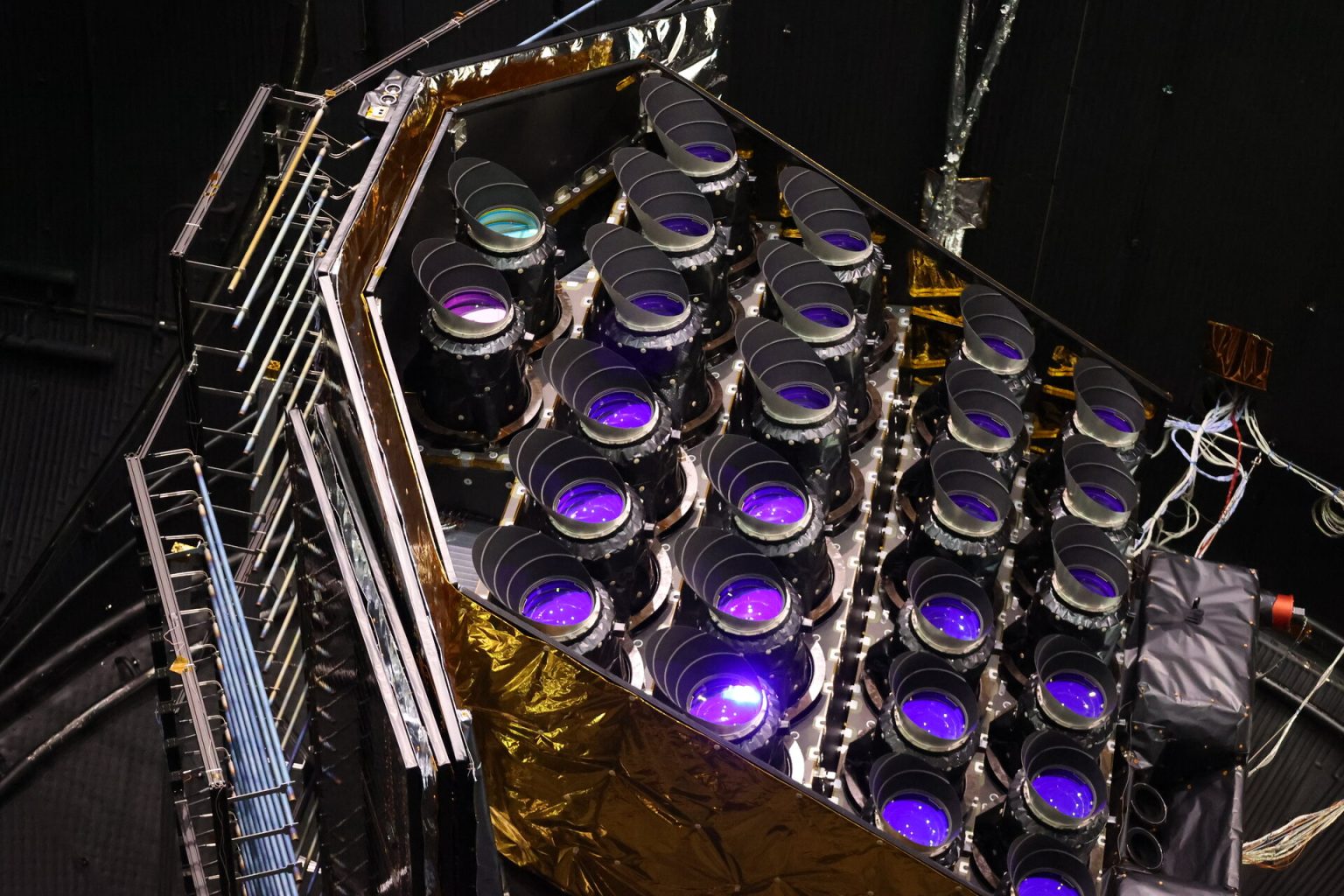 A photo of the PLATO instrument inside the Large Space Simulator (LSS) at ESA’s Test Center, where a series of tests under near-space conditions recently concluded. The image was taken from the top of the chamber after it was depressurized—it shows all 26 of the instrument’s highly sensitive cameras. Source: esa.int
Tests in an “artificial space”
The tests were conducted in the Large Space Simulator (LSS)—a special chamber at ESA’s Test Center. In early March, the hatches were hermetically sealed, powerful pumps extracted the air until a vacuum was created—a billion times less dense than Earth’s atmosphere—and liquid nitrogen cooled the chamber walls to the temperatures of outer space.
Individual heating elements inside simulated the effect of our star’s radiation on the spacecraft’s solar panels and shield. During the “hot phase,” all systems were operating at full capacity, and the side with the panels heated up to 150 °C. At the same time, the 26 cameras, shielded from the Sun, were kept within a range of –70 to –90 °C.
During the “cold phase,” the temperature was lowered throughout the entire housing, and the onboard heaters were designed to prevent the optics from becoming too cold. This allowed the telescope to be tested under two extreme conditions.
Ultra-high-resolution cameras
PLATO’s main objective is to detect Earth-like exoplanets orbiting Sun-like stars by detecting the faint, brief dimming of the star as the planet passes in front of it.
“To detect and characterize such planets, we need to detect changes in a star’s brightness of less than 80 parts per million,” explains Ana Heras, the PLATO mission’s scientific lead at the European Space Agency.
According to her, this is why it is extremely important to control the cameras’ response with exceptional precision. The sharpness of the images depends on the temperature of the optical tubes, which is adjusted through precise calibration.
Analysis of the data collected during the device’s stay in the simulator will continue for several more months. The results will help refine the thermal models and provide a more detailed prediction of the cameras’ behavior during actual flight. The launch is expected in early 2027.
According to esa.int