
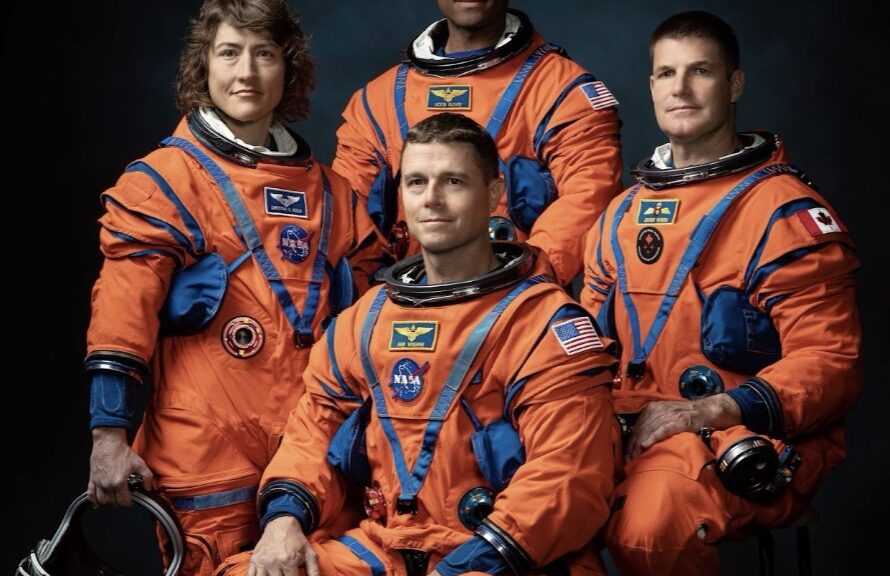
 Official crew portrait for Artemis II (Photo courtesy of NASA’S Josh Valcarcel via Wikimedia Commons)
Last week, the members of Artemis II returned home, making them the first crew of people to fly by the moon in over 50 years. Victor Glover, one of the four astronauts, became the first Black person to reach the moon. The Artemis II mission is part of NASA’s Artemis program, which aims to land American astronauts on every surface of the moon and continue exploration and discovery.
Artemis II is NASA’s first crew to do a lunar fly-by since Apollo 17 in 1972. According to NASA, the Artemis II crew took off on April 1 at 6:35 p.m. EDT from the Kennedy Space Center in Florida, and splashed down on April 10 at 8:07 p.m. EDT in the Pacific Ocean off the coast of San Diego. The nine-day trip marked NASA’s path to establishing a long-term presence at the moon for science and exploration, and future missions to Mars through the Artemis Program.
Howard University professor and former dean of the College of Engineering and Architecture, Achille Messac explained that the five-decade gap between Apollo 17 and Artemis II represents a transition from short-term exploration to building the foundation for continuous human activity beyond Earth. Along with the desire for a long-term presence in space, the mission’s goal is to verify modern human capabilities in deep space exploration.
“It is not simply a repetition of Apollo — it requires more advanced technology, higher safety standards and a long-term vision that includes sustained presence and eventual missions to Mars,” Messac said. “Artemis II is the first crewed mission in a new era of deep space exploration.”
According to NASA, the crew put the spacecraft through various planned tests to evaluate systems procedures and performance in deep space. Artemis II set historic records, flying 694,481 miles in total, surpassing the previous record set in 1970.
Along with these aerospace achievements, Victor Glover carved his own place in history. Glover, a California native, graduated from California Polytechnic State University in 1999 with a Bachelor of Science in general engineering. He is also a member of Phi Beta Sigma Fraternity, Inc. Glover was selected as a NASA astronaut in 2013.
Following the return of Artemis II, the crew was celebrated by family and other NASA employees at the Johnson Space Center in Houston. In his first public remarks following the mission, Glover was seemingly at a loss for words.
“I have not processed what we just did, and I’m afraid to even start trying,” Glover said, reflecting on the mission. “We are fortunate to be in this agency, at this time, together.”
For Messac, Glover’s role in Artemis II hits close to home. As one of the first Black graduates of Aerospace and Engineering at the Massachusetts Institute of Technology (MIT), Messeac said that Glover’s historical feat was both personal and profoundly historical.
“To see that journey now extend to a mission traveling to the Moon is a powerful moment — it reflects not only individual achievement, but generational progress,” Messac said.
In reflecting on the Artemis II, Messac also believes that it has both immediate and long-term impact on the future of aerospace.
“What these astronauts have done is move us forward in a significant way toward a future where space travel, lunar habitation and eventually missions to Mars become part of the human experience,” Messac said.
Copy edited by Kennedi Bryant