
Topline
A comet is now visible in the predawn sky across the Northern Hemisphere — and Tuesday, April 13, brings the best opportunity yet to track it down before it fades. Comet C/2025 R3 (Pan-STARRS) doubled in brightness over the weekend, though it remains a subtle target that rewards careful timing, a clear horizon and a pair of binoculars. Remember to check my feed for a daily comet tracker with sky-charts and tips for viewing comet Pan-STARRS throughout its visit this week.
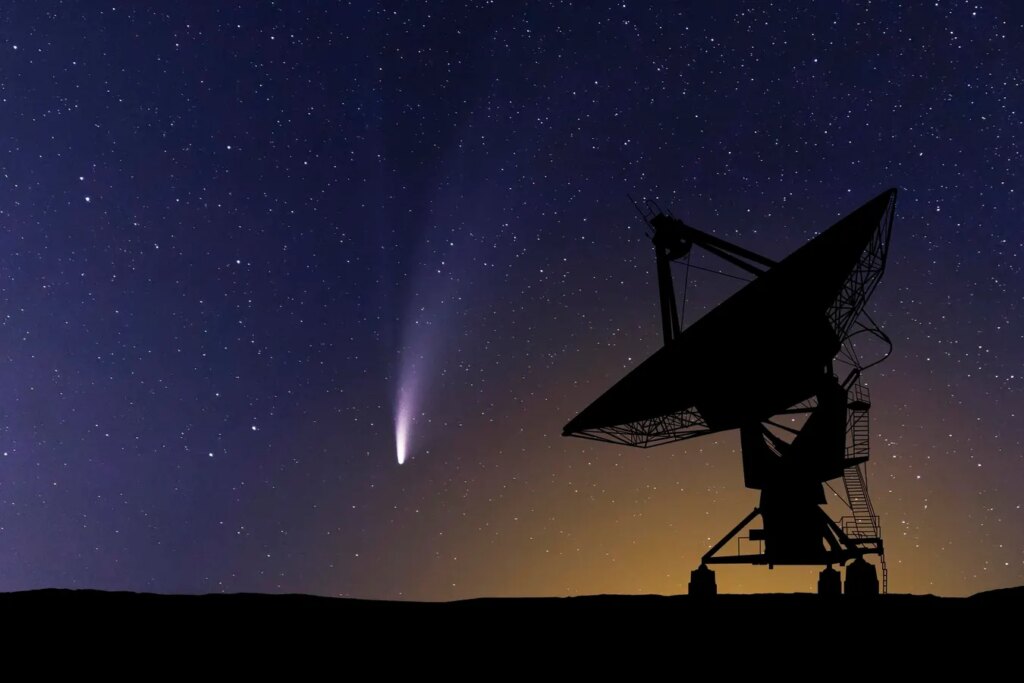
Comet Pan-STARRS, also known as comet C/2025 R3 (Pan-STARRS), is now visible before sunrise. (Image shows Comet C/2022 E3 (ZTF)).
gettyKey Facts
On April 14, the comet remains in Pegasus, just below the Great Square, sitting closest to the star Markab, but now firmly within the square.
Comet C/2025 R3 (Pan-STARRS) is visible from about 90 minutes before sunrise until the weekend, when it will fade into the glare of the sun. An unobstructed view of the eastern horizon is crucial.
On Tuesday, April 14, it will appear close to a 12%-lit waning crescent moon, with Mercury nearby and Mars just visible below in very clear conditions.
According to the Comet OBServation database, the comet is currently shining at around magnitude +4.5 — technically a naked-eye object in very dark skies. However, it will likely require binoculars for most observers until it brightens further later this week.
It was discovered by the Pan-STARRS survey in Hawaii in September 2025 and is thought to orbit the sun roughly every 170,000 years.
The comet will reach perihelion on April 19, passing the sun at a safe distance of about 0.5 AU. The comet will make its closest approach to Earth on Monday, April 27 (though by then it will be impossible to see from the Northern Hemisphere).
Observers in the Southern Hemisphere will be able to spot the comet from late April, after the comet passes perihelion, just after sunset on the western horizon.
Comet Tracker For Tuesday, April 14
On April 14, the comet lies roughly 0.78 AU (117 million kilometers) from Earth and 0.52 AU (78 million kilometers) from the sun, its increasing solar heating beginning to drive more activity ahead of perihelion (the closest it gets to the sun).
Comet Pan-STARRS is currently shining at around magnitude +5 and sits low in the eastern sky in the constellation Pegasus, close to the Great Square of Pegasus. To see the comet in the Great Square of Pegasus, a clear, unobstructed horizon is essential. Sky maps can be viewed and downloaded from The Sky Live and In-The-Sky.com.
The position of comet C/2025 R3 (Pan-STARRS) 90 minutes before sunrise on April 14, 2026.
StellariumHow To Find Comet Pan-Starrs
For now, the comet appears as a faint, diffuse glow — easy to miss in twilight, but steadily brightening as it approaches the sun.
Go outside about 90 minutes before sunrise where you are and look low in the eastern sky. The key is to first locate the Great Square of Pegasus rising due east — a large, diamond-shaped pattern of four stars. Look to the right of Markab, one of the square’s four brightest stars, for a small, misty patch of light within the Great Square of Pegasus. A pair of 10×50 binoculars will make it much easier to locate.What Else To Look For In The Dawn Sky
Tuesday morning adds an extra layer of interest. Look low in the southeast about an hour before sunrise for a delicate waning crescent moon, now just 12%-illuminated and only a few days from new. If the sky is clear, you may notice Earthshine — the ghostly glow on the moon’s dark side caused by sunlight reflecting off Earth and back onto the lunar surface.
As the comet fades from view, the planets will emerge — just. The easiest to find will be Mercury, while Mars may be visible lower still if conditions are exceptionally clear. Saturn is also returning to the dawn sky, though it remains difficult to detect for now. If you do use binoculars, abandon them well before sunrise where you are.
As the comet C/2025 R3 (Pan-STARRS) fades and sunrise approaches on April 14, 2026, Mercury will become apparent close to the horizon — and possibly Mars (though the latter will be very faint).
StellariumHow To Photograph A Comet
Capturing a comet is often easier than seeing it. Even if it appears faint to the naked eye, a camera — including a smartphone — can reveal far more detail. Mount your device on a tripod and use night or manual mode to take exposures of around 5-20 seconds. A DSLR or mirrorless camera with a wide-angle lens (around f/2.8) and ISO 800–3200 will typically show the comet as a small, greenish glow with a faint tail. Focus on a bright star first, then reframe, and experiment as the sky brightens — conditions will change very quickly as dawn approaches. However, even a short exposure can turn a barely visible smudge into something unmistakably comet-like.
How Comets Become Visible
Comets are often described as “dirty snowballs,” but their dramatic appearance comes from a simple process. As a comet approaches the sun, heat causes frozen gases inside it to turn directly into vapor — a process called sublimation. This releases gas and dust into space, forming a glowing cloud called a coma around the nucleus. Sunlight and the solar wind then sweep this material into a tail that can stretch for millions of miles.
Check my feed for a daily “comet tracker” with sky charts and tips for finding Comet Pan-STARRS.
Further reading
Forbes‘Comet Of The Year’ Vaporized — But Another Will Peak Late AprilBy Jamie CarterForbesHow To Photograph The Green Comets This Weekend, According To ExpertsBy Jamie CarterForbesAstronauts Share Spectacular Earth Images From Halfway To The MoonBy Jamie CarterForbesArtemis Astronauts See Earthrise, Earthset And A Total Solar EclipseBy Jamie CarterForbes11,000 Asteroids Have Just Been Found — 33 Are Near-Earth ObjectsBy Jamie CarterForbesAstronauts Share Spectacular Earth Images From Halfway To The MoonBy Jamie Carter