
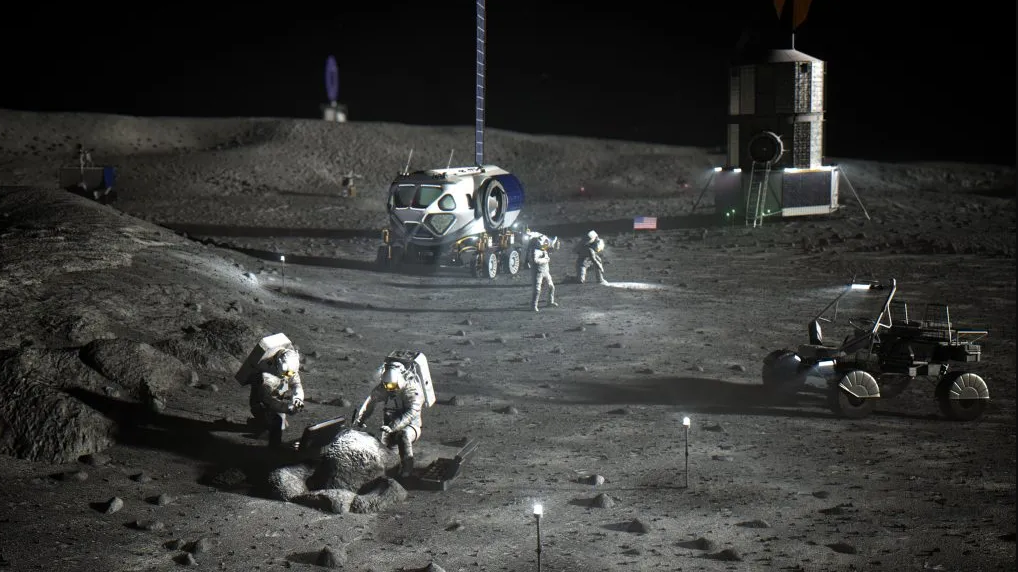
 Illustration of NASA astronauts on the lunar South Pole. Credit: NASA
NASA Administrator Jared Isaacman announced on March 24, 2026 that the Lunar Gateway is officially “paused” and a lunar base will be constructed instead. This marks a significant shift from NASA and the Trump Administration, one that means the United States will have a long-term presence on the lunar surface and skip the intermediate Gateway step.
Although the term “Artemis Base Camp” was not used in NASA’s press release regarding this shift in the Artemis program, the idea has been floated before. In fact, the base camp was always a goal of the Artemis program, what shifted was the roadmap. With Gateway removed from the equation, the lunar base will be the focus.
The moon base will be rolled out in three phases: 1. Expansion of lunar landings and an increase of lunar activities. 2. A “semi-habitable” infrastructure will be built and support astronaut operations on the surface. 3. A permanent base to facilitate lunar operations.
The backbone of NASA’s lunar strategy relies on commercial partners such as Blue Origin with its Blue Moon lander, SpaceX’s Starship HLS. Partner nation contributions were announced in the press release, namely JAXA, the Italian Space Agency and the Canadian Space Agency (all of which had a part in Lunar Gateway); however, further organizations, namely ESA, will provide assistance in various ways.
Although perhaps not surprising, one major outlier in the Artemis program is Russia. Despite having been an integral part of the International Space Station, Russia has signed on as a member of the Chinese lunar push.
The Chinese Moon Base initiative, officially known as the International Lunar Research Station (ILRS), is a lunar exploration program led by China and Russia, alongside a growing coalition of international partners. The ILRS aims to establish a sustained robotic, and eventually crewed, presence primarily focused on the lunar south pole. Much like the Artemis Base Camp, ILRS will be rolled out in phases.
There is indeed a rush to the moon and with the Artemis missions in full swing, it appears the United States and partners have the advantage. Although China and Russia have been active on the moon with their Chang’e 6 and Luna 25 spacecraft (the Luna 25 mission was not successful), they are still far away in terms of landing a human on the Moon in comparison to Artemis. With that being said, China has stated that they want to land Taikonauts on the moon by 2030.

Carter Palmer has long held a keen interest in military matters and aviation. As a FI’s space systems analyst he is responsible for updating the reports and analyses within the Space Systems Forecast – Launch Vehicles & Manned Platforms and Space Systems Forecast – Satellites & Spacecraft products.