
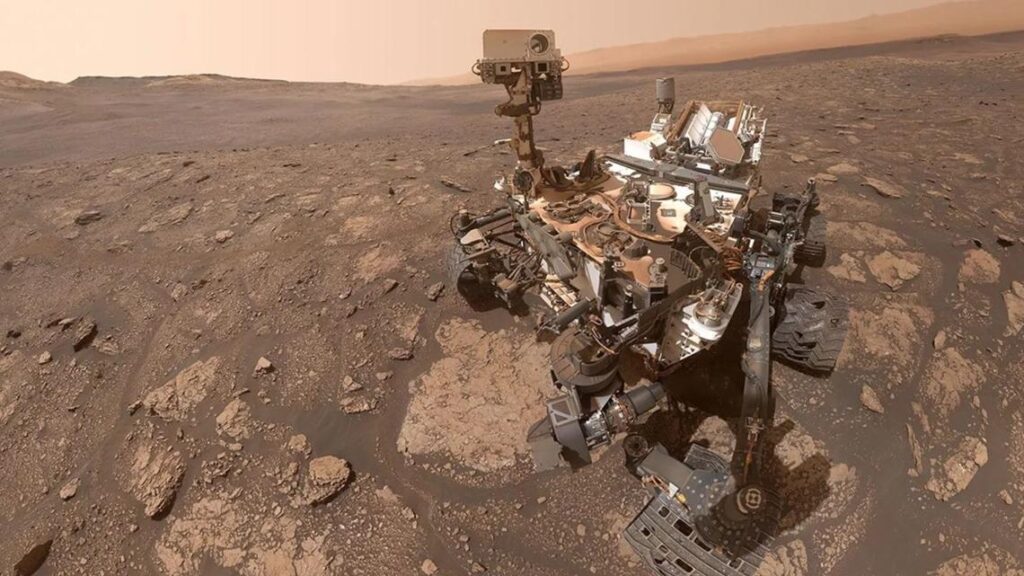
Seven compounds were detected for the first time on the red planet, including a possible precursor to DNA.
WASHINGTON — A NASA rover drilling into Martian rock has turned up the biggest and most varied batch of carbon-based molecules ever found on Mars — including some that, on Earth, are considered key building blocks of life.
The findings, published Tuesday in the journal “Nature Communications,” are based on a rock sample the Curiosity rover drilled in 2020. Scientists spent years analyzing the results in the lab before going public with what they found: 21 organic molecules, seven of which have never been detected on Mars before.
Organic molecules are carbon-containing compounds found throughout the universe. They’re not proof of life on their own — they can form through natural geological processes — but they are the basic ingredients life needs to get started.
What scientists found
One of the most exciting discoveries is a type of molecule called a nitrogen heterocycle. On Earth, these structures help form RNA and DNA, the molecules that carry genetic information in every living thing.
“That detection is pretty profound,” said Amy Williams, the study’s lead author and a scientist at the University of Florida. She noted these types of molecules have never been found on the Martian surface before.
Scientists also found a sulfur-bearing molecule called benzothiophene, which has previously turned up in meteorites — space rocks that some researchers believe might have helped spark the chemistry that eventually led to life across the early solar system.
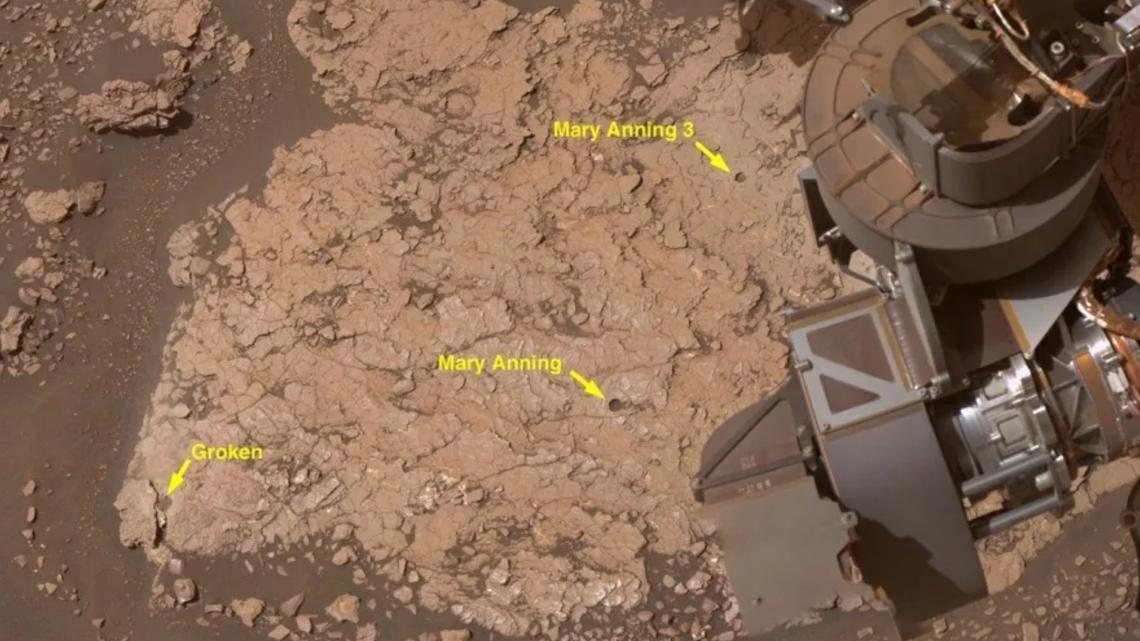
The rock, nicknamed “Mary Anning 3” after a famous 19th-century fossil hunter, was collected from the base of a Martian mountain called Mount Sharp. Billions of years ago, that area was covered in lakes and streams. Over time, as those bodies of water dried up, they left behind clay minerals — which turns out to be very good at preserving organic molecules for billions of years.
That’s part of why these molecules survived at all. Mars is constantly bombarded by radiation that breaks down organic compounds, so finding them intact this long after the planet’s watery period ended is itself a significant result.
Scientists are careful to point out that these molecules could have formed through chemistry alone, with no living organisms involved. But they do show that ancient Mars had the right conditions to support life if it existed.
“This collection of organic molecules once again increases the prospect that Mars offered a home for life in the ancient past,” said Ashwin Vasavada, the mission’s lead scientist at NASA’s Jet Propulsion Laboratory in Southern California.
Curiosity’s chemistry lab
The rover carries a miniature chemistry lab in its body called SAM — short for Sample Analysis at Mars. After Curiosity drills into a rock and grinds it to powder, SAM heats the material and analyzes the gases released to figure out what the rock is made of.
For this particular sample, scientists used a special liquid solution to break apart large, complex molecules that would otherwise be impossible to identify. It was the first time that technique had ever been used on Mars.
Curiosity recently used the same technique on a second rock sample, and scientists are still analyzing those results. The findings from this mission are helping NASA and the European Space Agency design better tools for future Mars rovers and even for a planned mission to one of Saturn’s moons, where scientists believe conditions might also be favorable for life.
Curiosity has been exploring Mars since 2012.