
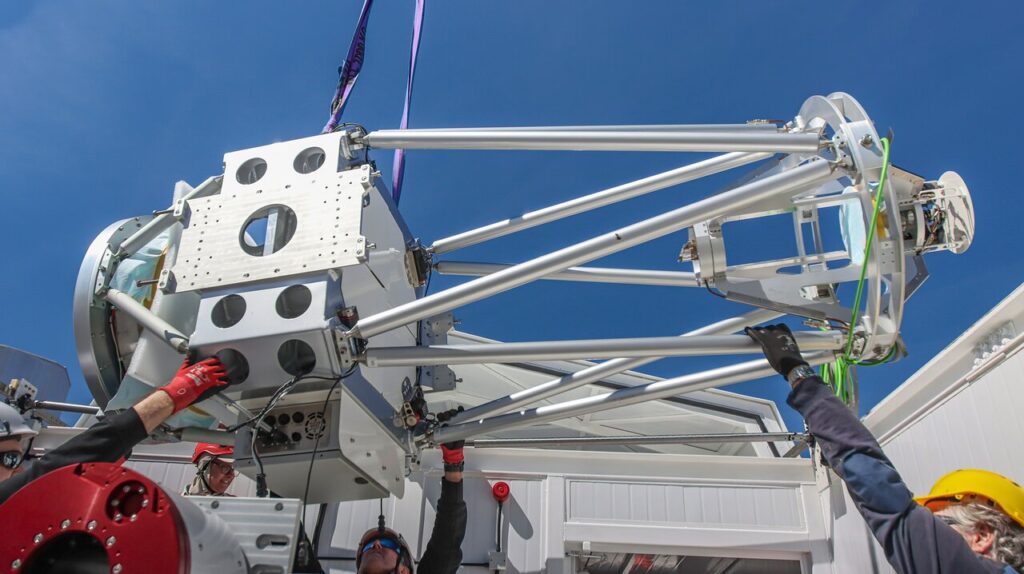
The PoET telescope, installed on ESO (European Southern Observatory) on the Paranal Plateau in Chile, has successfully completed its first observations, the European Southern Observatory announced in April 2026.
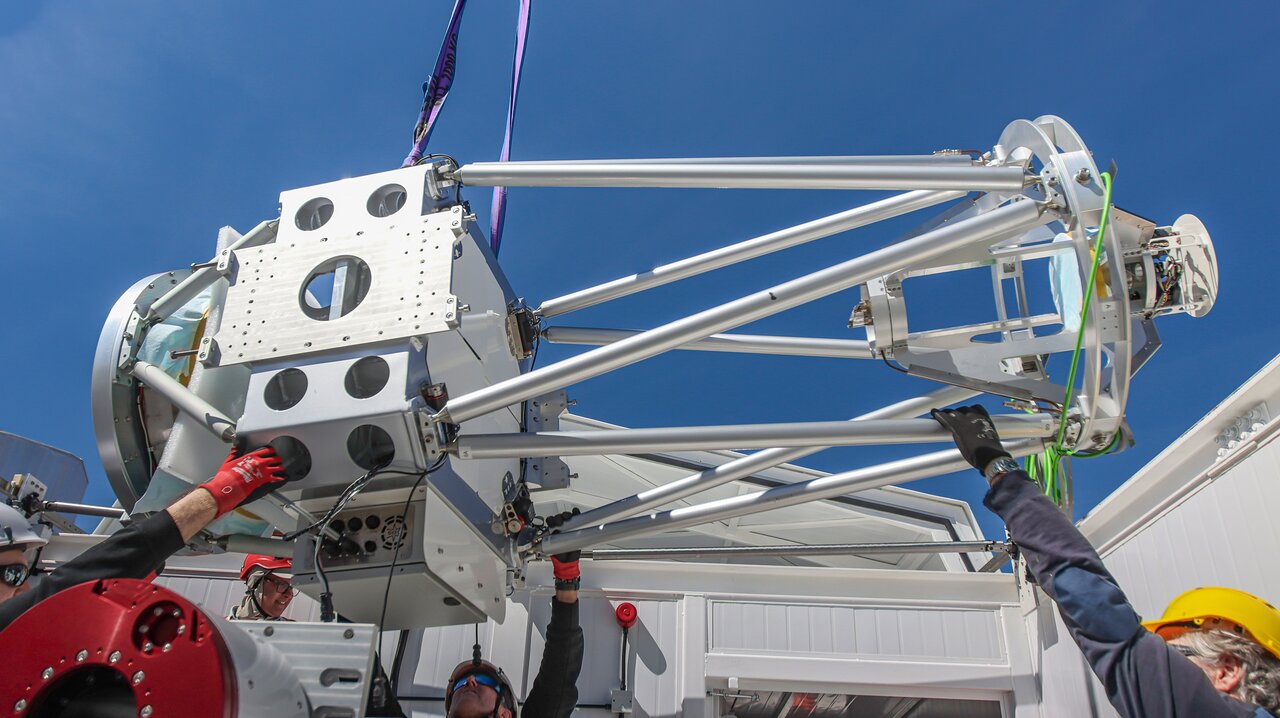 Installation of the PoET (Paranal solar ESPRESSO Telescope) at ESO’s Paranal Observatory in Chile. Credit: ESO/L. Calçada. Source: eso.org
Problem of stellar noise
The instrument was created to help astronomers distinguish signals from exoplanets from the “noise” of the stars, which scientists are observing.
Most exoplanets are detected by analyzing the radiation from their host star—that is, its light, broken down by wavelength. However, activity on the star’s surface—such as sunspots, flares, and convective movements—distorts the measurement results. Such effects can either mask the signal from the planet or even mimic it.
“One of the greatest challenges for the detection of other Earths orbiting other Suns is the astrophysical ‘noise’ coming from the host stars,” explains Nuno Santos, the project’s principal investigator at the University of Porto.
How PoET works
The name stands for Paranal Solar ESPRESSO Telescope. The main telescope, equipped with a 60-centimeter-diameter mirror, is capable of studying specific regions of the solar disk—including individual sunspots. At the same time, a smaller telescope records the total light from the entire visible disk of the Sun.
By observing both sources simultaneously, scientists will be able to determine exactly how surface activity alters the spectrum. This information will serve as a template for filtering out data from distant stars.
Day and night
The data collected by PoET is processed by the ESPRESSO spectrograph on the Very Large Telescope (VLT) at the same observatory. ESPRESSO usually operates at night, searching for planets orbiting distant stars. However, now it will analyze solar spectra during the day.
“By switching from the VLT at night to PoET during the day, we maximise the usage of this instrument,” notes ESO astronomer Alain Smet. The climate of the Atacama Desert gives us reason to hope that the number of days suitable for solar observations will be comparable to the number of clear nights.
PoET was developed and built by Portuguese researchers with funding from the European Research Council. Following the successful “first light,” the team is finalizing the system’s calibration, and regular scientific data collection will begin in the coming weeks. All results will be made available to the global scientific community through the ESO archive.
According to www.eso.org