
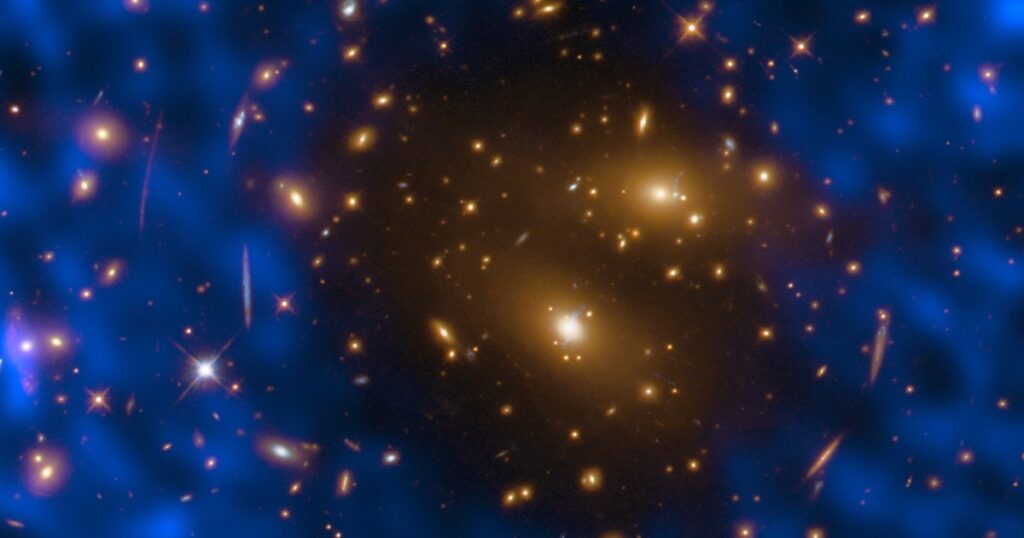
If you take everything we know of and can directly observe in the Universe — stars, stellar remnants, galaxies, gas, dust, plasma, and black holes — we find that it’s insufficient to explain what we see on the grandest of all cosmic scales. Unless you hypothesize some novel form of matter, something that’s not included in the Standard Model of elementary particles, you cannot explain a whole suite of evidence. This includes:
the abundances of the light elements and isotopes found in the most pristine environments,
the temperature (and polarization) fluctuation patterns found in the cosmic microwave background,
the correlations between distant galaxies imprinted in the Universe’s large-scale structure,
and astrophysical systems, like colliding galaxies and galaxy clusters at high speeds, where gravitational effects are observed to separate from the locations of normal matter.
Luckily, there’s a single addition (or modification) to the Universe’s contents that we can make to explain all of these and more: dark matter. However, dark matter has yet to be directly detected through the experimental attempts we know how to conduct. Even though its properties may ultimately render it fundamentally undetectable via those means, many use this as evidence against dark matter’s existence, instead promoting a gravity-modifying alternative idea that typically fails (unless a dark matter-mimicking effect is also introduced) on scales larger than individual galaxies: MOND.
For the first time, a completely new test of dark matter vs. MOND has been conducted: one using the kinetic Sunyaev-Zel’dovich effect. The results are in, and what we observe agrees with dark matter while significantly departing from MOND’s predictions. Here’s what it means, and what the evidence shows.
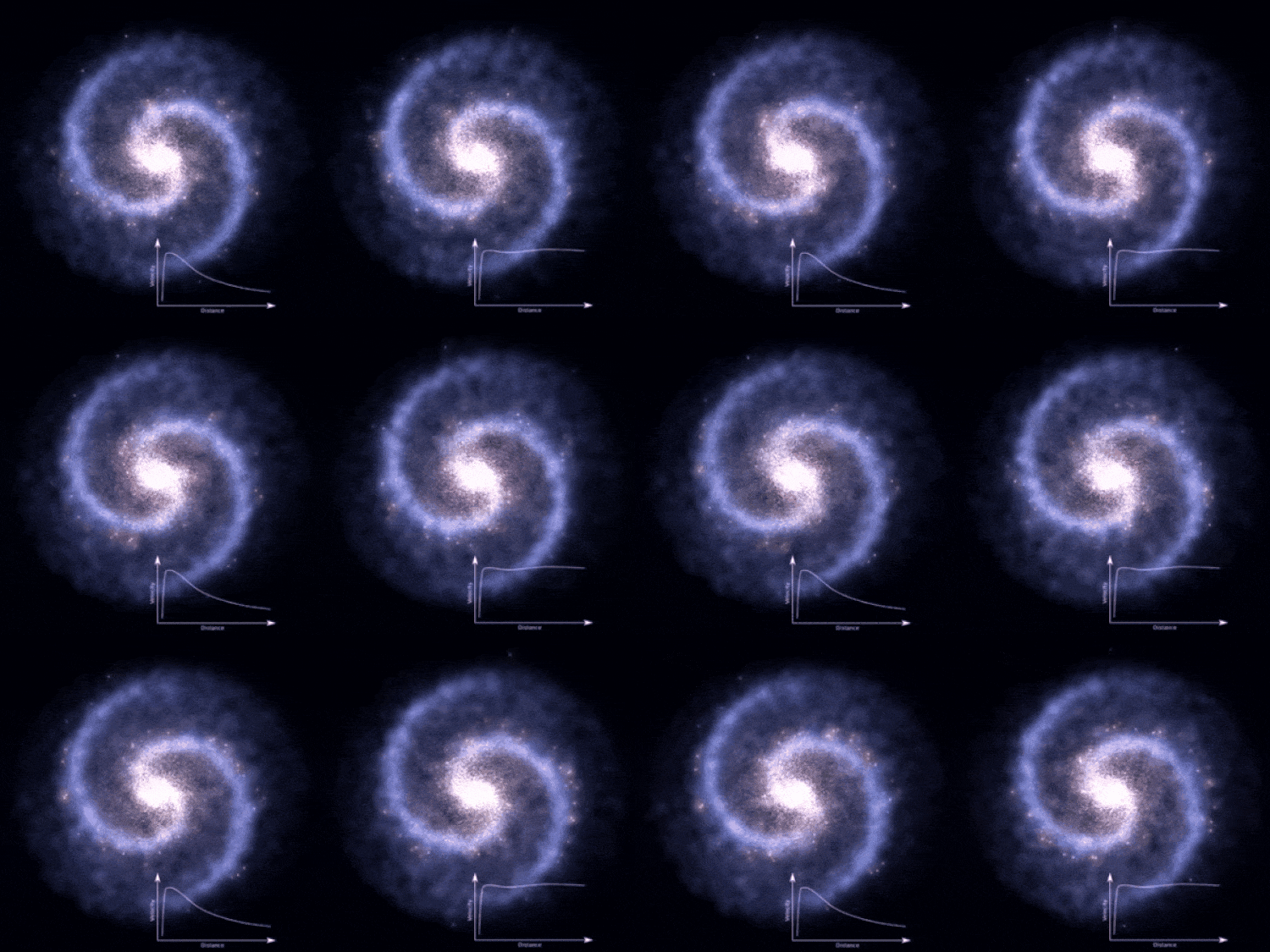
A galaxy that was governed by normal matter alone (left) would display much lower rotational speeds in the outskirts than toward the center, similar to how planets in the Solar System move. However, observations indicate that rotational speeds are largely independent of radius (right) from the galactic center, leading to the inference that a large amount of invisible, or dark, matter must be present. These types of observations were revolutionary in helping astronomers understand the necessity for dark matter in the Universe, and also explain the shapes and behavior of matter located within a galaxy’s spiral arms.
Credit: Ingo Berg/Wikimedia Commons; Acknowledgement: E. Siegel
Let’s start by understanding the dichotomy between the two main approaches to cosmology: adding the ingredient of dark matter or adding a modification of gravity consistent with MOND. In the dark matter scenario, Einstein’s General Relativity, the established law of gravity across the Universe, remains unchanged, but a new ingredient is added: dark matter. This ingredient outmasses the full sum total of all normal matter by about a 5-to-1 ratio, clumps and clusters like (slow-moving) matter does, but doesn’t interact with normal matter or light in any measurable way. All it does is gravitate, and those gravitational effects should show up across a wide variety of cosmological tests.
On the other hand, modifying gravity — according to the MOND prescription — introduces a new fundamental acceleration scale that shows up importantly at small cosmic accelerations. This should be unmeasurable within the Solar System, but should show up profoundly on larger scales, like the scales of individual galaxies. MOND describes the internal behavior of most (but not all) individual galaxies very well, but cannot explain many phenomena seen on larger cosmic scales (colliding galaxy clusters, fluctuations in the CMB, the large-scale structure of the Universe) at all, unless an additional ingredient or modification, one identical to including dark matter, is added.
People have looked for “natural laboratories” (in space) to directly test dark matter’s predictions against MOND’s, but the ones they’ve found so far, like the tests on wide binary star systems, suffer from selection effects and underlying assumptions; results cannot be uniformly reproduced by independent teams.
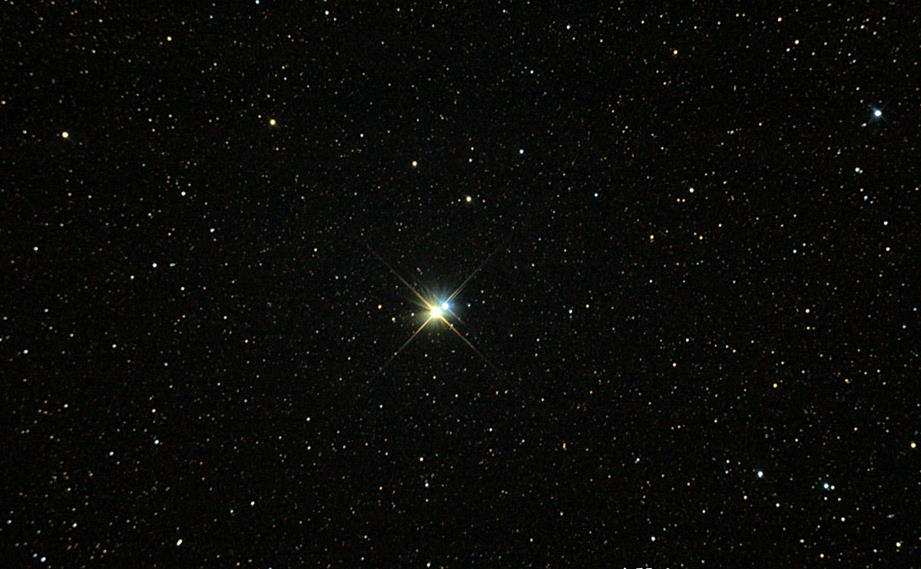
The star Albireo, recognizable by its position at the base of the “northern cross” within the asterism known as the Summer Triangle, is easily resolvable into two components with a small telescope or binoculars. The brighter yellow star has a temperature of around 4400 K, but the fainter blue star is much hotter, at about 13000 K, with the color difference arising due to the temperature differences among the stars. Albireo is thought to be a wide binary, but even though it’s been known to be composed of two stars for centuries, whether it’s gravitationally bound or not is still sometimes debated.
Credit: Jared Smith/flickr
But the kinetic Sunyaev-Zel’dovich effect is a little bit different, and a lot more compelling. When you have a background source of light that passes through an intervening cloud of ionized matter, the properties of that light can be altered by that matter as it travels along its line-of-sight on its way to your eyes and instruments.
Normally, the focus is on what we call the thermal Sunyaev-Zel’dovich effect: where the intervening normal matter is hot and ionized, and photons passing through that region get boosted — via interactions with those charged particles — to higher energies. This means that if you look at a background of radiation (like the CMB) that’s largely uniform in a certain temperature range, the thermal Sunyaev-Zel’dovich effect will create an observed deficit (or cold spot) in your radiation at the expected wavelengths, because those photons have instead been excited to higher temperatures and energies: where you would find a photon excess (or hot spot) if you looked at those shorter wavelengths instead.
But there’s also a kinetic (sometimes called kinematic) component to the Sunyaev-Zel’dovich effect: where the electrons, whether part of a hot or cold population of matter, are also in motion. As the photons interact with the moving electrons, they also get boosted (or, potentially de-boosted) due to those interactions as well.
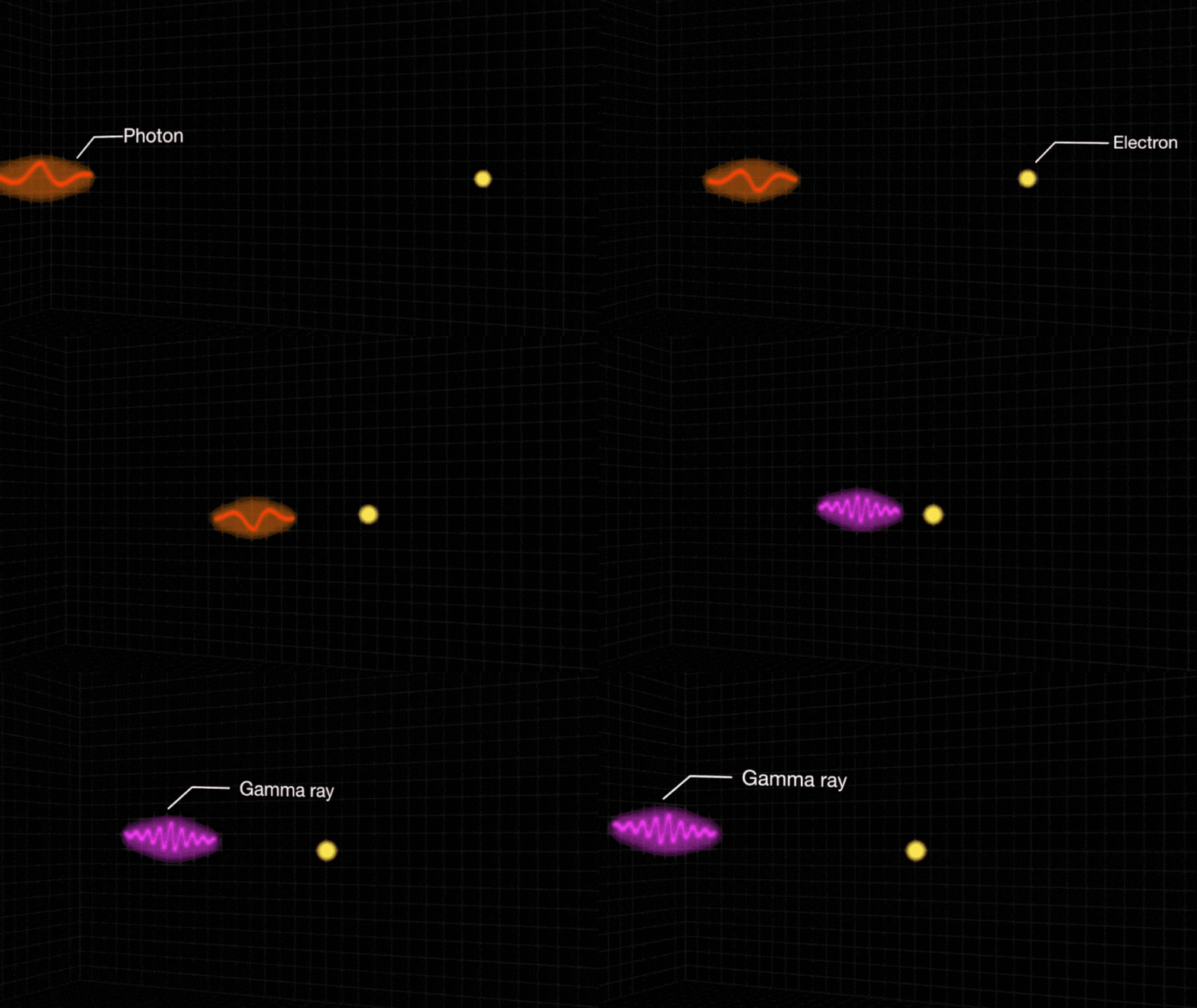
Energetic charged particles can interact even low-energy photons, such as from the CMB, and and boost it to higher energies. While boosting to gamma-rays (as labeled) requires ultra-relativistic electrons, the phenomenon, known as inverse Compton scattering, happens wherever photons interact with free electrons. When the CMB light passes through the ionized medium found in galaxy clusters, this boosting will occur due to the combination of both thermal (from the temperature of the electrons) and kinetic (from the overall motions of and within the cluster) effects.
Credits: NASA’s Goddard Space Flight Center
(To avoid writing “Sunyaev-Zel’dovich effect” so many times, we’re going to abbreviate it from hereon out the same way professional cosmologists do: as the SZ effect.)
While the thermal SZ effect is usually much larger than the kinetic SZ effect, it typically is only useful when studying galaxy clusters. Many galaxy clusters have a large population of internal, ionized matter within them, as was first revealed through studying their X-ray emissions. If you know enough about X-rays and gases/plasmas, you can determine what fraction of the cluster’s total mass is present in the form of this ionized state. Then, if you add in thermal SZ data, you can construct a temperature profile and the thermal structure of the cluster, and use it to learn a variety of cosmic lessons. Similarly, the thermal SZ effect is usually the dominant effect in creating some of the observed “cold spots” in the CMB: the ones that line up with these plasma-rich galaxy clusters.
However, galaxy clusters aren’t exclusively found “at rest” with respect to the Hubble flow. Even though these objects represent large collections of mass, they are also influenced by the distribution of matter around them: both overdense (cluster-rich) regions and underdense (void-dominated) regions. This can lead to galaxy cluster speeds that move at hundreds or even thousands of km/s relative to the Hubble flow. Typically, in order to extract the kinetic SZ effect and its imprint on observed CMB temperatures, you need to understand and separate out the thermal effects first. In the post-Planck era of cosmology, this has been measured directly for many individual galaxy clusters.
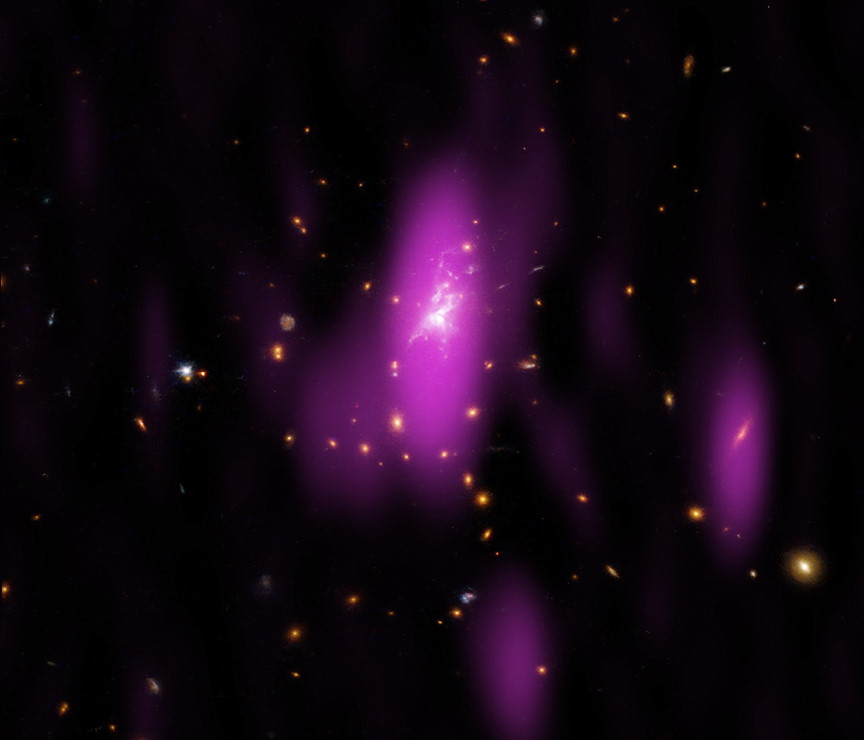
This optical/radio composite of the Phoenix Cluster shows the enormous, bright galaxy at its core, as well as other X-ray sources nearby, from black hole emissions and the heated gas within the cluster. Spanning 2.2 million light-years across for its stellar extent, the central galaxy is even larger when measured by its radio emissions. Hot gas within galaxy clusters not only leads to X-ray emissions, but also a “boost” to the energy of background light due to the thermal Sunyaev-Zel’dovich effect.
Credit: Optical: NASA/STScI; Radio: TIFR/GMRT
In fact, measuring the SZ effect is so powerful that you can actually take a CMB map and look for signs of the presence of galaxy clusters that would leave an SZ imprint on the data. Ground-based CMB telescopes like the Atacama Cosmology Telescope and the South Pole Telescope led to the first detection of the kinetic SZ effect in an individual object back in 2012, and the subsequent discovery of hundreds of new galaxy clusters via the SZ effect. Looking at the CMB in gory detail, particularly at small angular scales, provides an outstanding natural laboratory for finding, measuring, and quantifying both the thermal and kinetic SZ effects.
In theory, you could also use the kinetic SZ effect for a cosmic purpose: to test the effects of gravitation on large scales, and to see whether the observed effect is consistent with dark matter’s predictions or MOND’s predictions, which should differ significantly on distance scales separating galaxy clusters. The reason is simple: when you have two galaxy clusters in close proximity to each other, they gravitationally attract one another. If you have a good enough map of the large-scale structure in this region of the Universe, you can know how far away these clusters are from you, and also from each other. And then, if you can tease out enough information about the kinetic SZ effect, you can constrain the gravitational acceleration between them. That’s where the critical test lies.
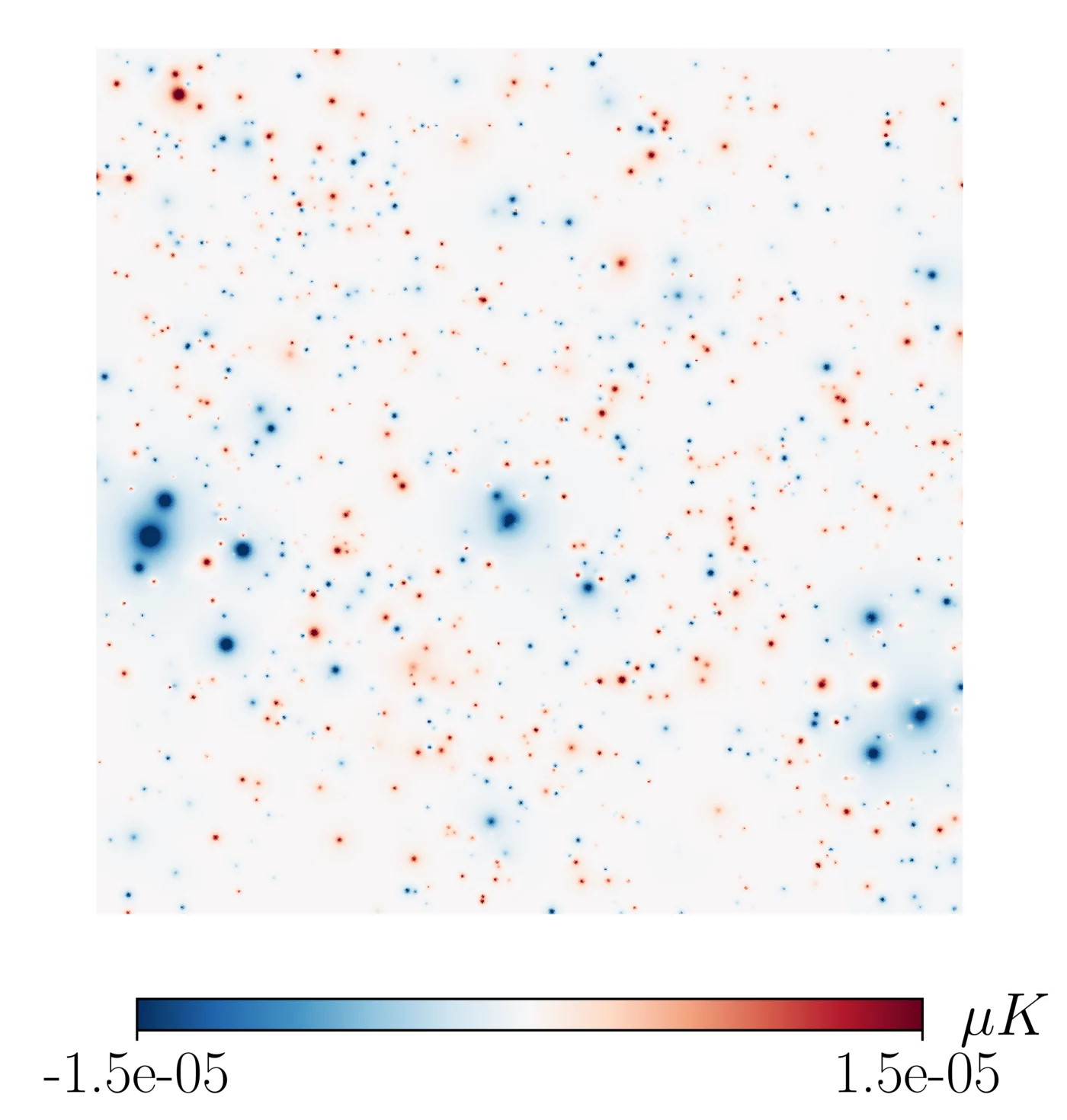
The Planck satellite’s measurements of the CMB temperature on small angular scales can reveal enhancements or suppressions of temperature by up to tens of microkelvin induced by the motions of objects: the kinetic Sunyaev-Zel’dovich effect. We can measure this for individual galaxy clusters as well as colliding clusters, and determine the motion of matter within them: by cross-correlating CMB data with large-scale structure survey data.
Credit: Websky Simulations
Think about this for a moment. In the Solar System, it’s very, very difficult to measure extremely small accelerations, owing to the fact that we have a large number of massive objects that it’s very difficult to get far away from. The Sun, in particular, is extremely massive; even at the orbital distance of Pluto, acceleration due to the Sun’s gravity is somewhere around a few microns-per-second². You’d have to go all the way out into the Oort cloud, far beyond any spacecraft we’ve ever launched (even the ones that have left the Solar System), to have the acceleration drop to values below the MOND scale: of just 0.12 nanometers-per-second².
If you go beyond the Solar System and look at the spaces between stars, you can sometimes get those vast separations, which is what makes wide binary star systems such an interesting laboratory for study: at very large separation distances, the predicted accelerations drop below that critical value, enabling us to test MOND’s predictions. But, despite what its proponents assert, these systems cannot be well-measured individually. We do not know their orbital trajectories, whether these are bound systems or just passing stars, or whether there are more than two stars present inside of them. It would take thousands of years to determine this for any individual system, and therefore, it’s very difficult to draw conclusions. (Indeed, every new study on this topic has yielded a new answer.)
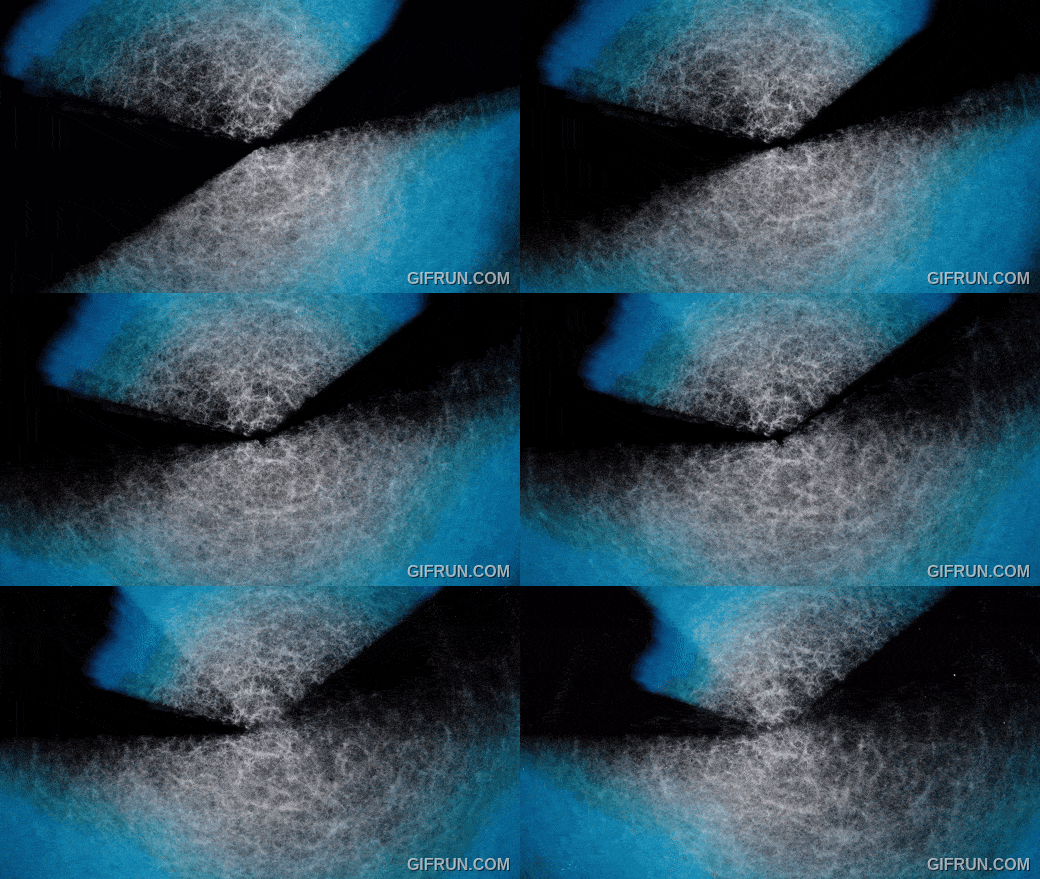
This animation of DESI’s 3D map of the large-scale structure in the Universe, the largest such map to date, was created with the intention of studying dark energy and its possible evolution. However, these spectroscopic surveys of large-scale structure can also be used to measure a variety of correlated properties between the galaxies within the survey, giving them broad applications to studies of the kinetic Sunyaev-Zel’dovich effect, galaxy clustering, and pairwise velocities.
Credit: DESI Collaboration/DOE/KPNO/NOIRLab/NSF/AURA/R. Proctor
But on extremely large cosmic scales — on scales of the separation of galaxy clusters — the tests we can perform are a lot cleaner, and a lot less ambiguous. If you take two galaxy clusters in proximity to one another (but that haven’t collided or merged), they’re still going to be separated by large distances: megaparsecs at least, where one megaparsec is a little over 3 million light-years. In reality, these clusters may be tens or even hundreds of megaparsecs away from one another: typical of the separation distances we find in our local Universe between the Virgo, Coma, Fornax, Leo, and Antlia clusters, for example.
Even though these galaxy clusters are incredibly massive, often weighing in at hundreds of trillions (or more) of solar masses apiece, containing thousands of times the mass of a Milky Way-like galaxy, they’re separated by vast cosmic distances: tens or hundreds of million of light-years. At these expansive distances, the expected accelerations between two nearby galaxy clusters is tiny, even with these incredibly large masses. This is important, because:
In a Universe governed by Einstein’s General Relativity where dark matter is present, the gravitational force law at large and small distances, and at large and small accelerations, is Newtonian: behaving as a 1/r² force law.
But in a Universe governed by a MOND-compatible law of gravity, the gravitational force law only Newtonian-like at small distances where the acceleration is larger than that critical value set by the MOND scale; at larger distances (and smaller accelerations), the force law behaves as 1/r, not as 1/r².
In other words, we should be able to tell these two scenarios apart with sufficiently good data.
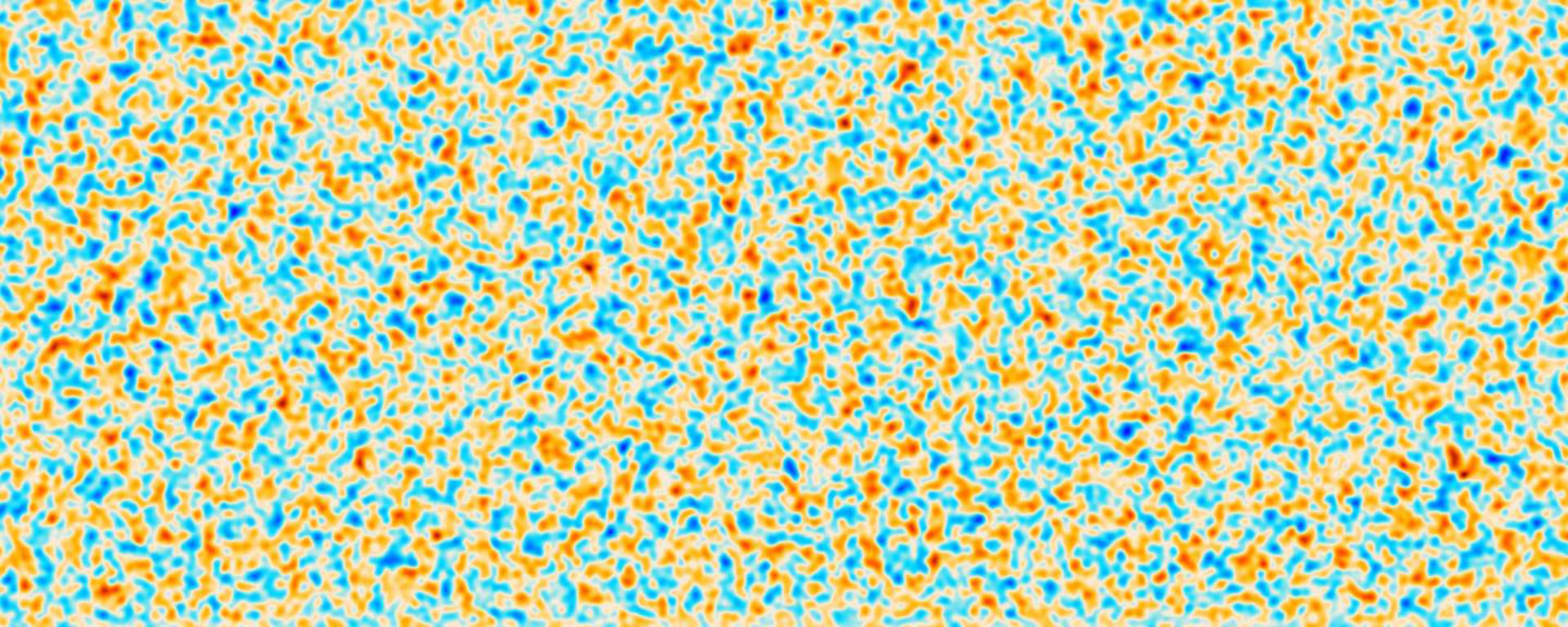
The fluctuations in the E-mode polarization data seen in the Cosmic Microwave Background, particularly on small angular scales, encode a tremendous amount of information about the contents and history of the Universe. Here, fluctuations from a large region of sky are shown, constructed from data taken with the Atacama Cosmology Telescope. This was from the collaboration’s fourth data release, which represented the best data set of the CMB on small angular scales ever obtained at the time.
Credit: ACT Collaboration DR4
The method for conducting this test is as follows.
You conduct a large survey of galaxies and galaxy clusters spectroscopically: so that you can measure the positions and line-of-sight velocities of a large number of galaxies across a wide volume of space very accurately.
You then compute a pairwise velocity inference from the galaxy-galaxy correlation function: where you infer, for any two galaxies in your sample, how quickly they’re moving either towards or away from each other, and “bin” large numbers of these galaxies as a function of separation distance to make your data points.
Then, independently, you conduct a CMB experiment to measure temperature variations as a function of distance and redshift, and then use those variations (and a physical understanding of the relationship between momentum and pairwise velocity) to infer the magnitude and sign of the effects of the kinetic SZ effect.
While there are many other details that go into such an analysis — selecting the objects you’re using in order to minimize biases and uncertainties, for example, or restricting your CMB maps to a single frequency — this is precisely how the April 2026 study, led by astrophysicist Patricio Gallardo, proceeded.
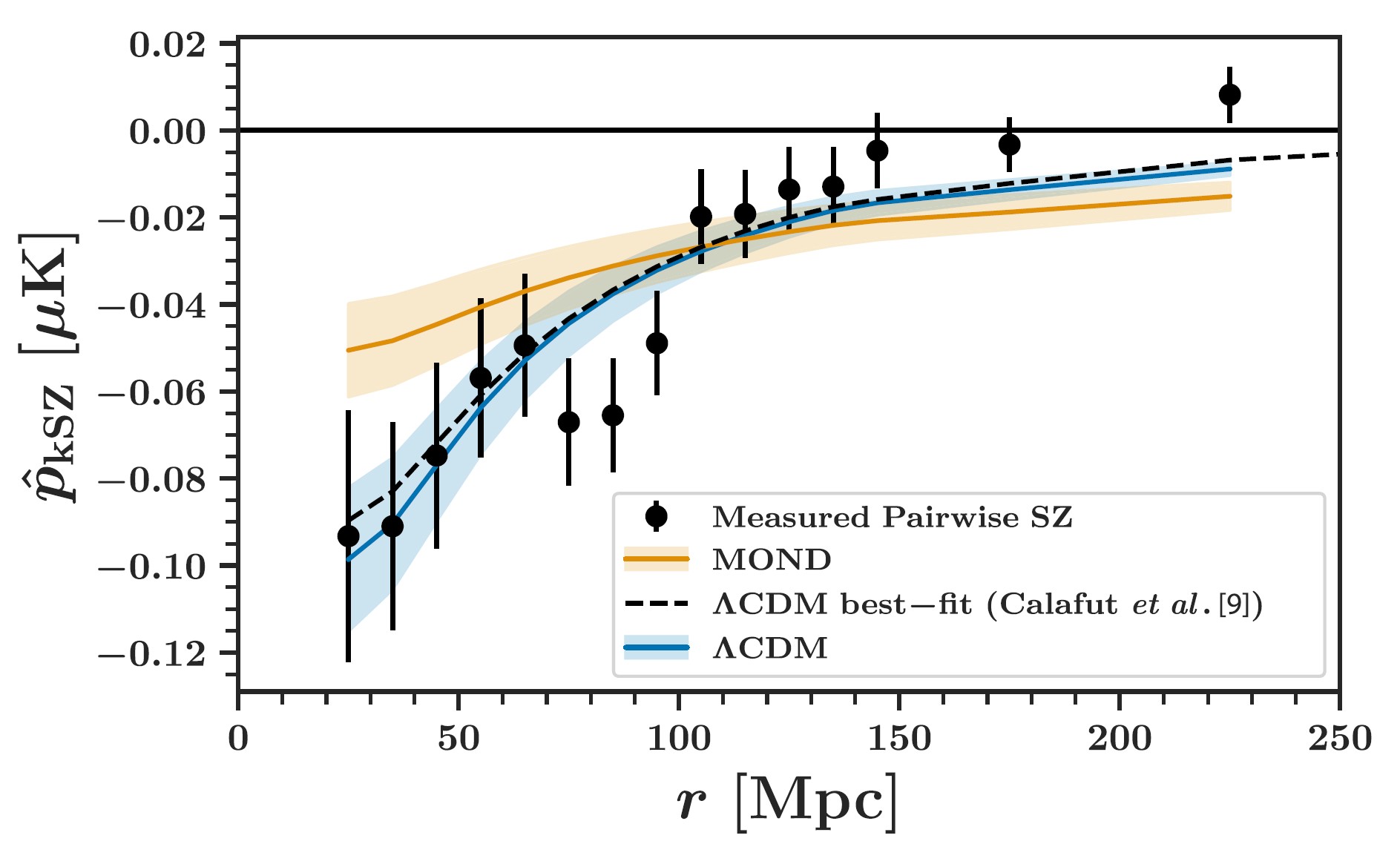
This graph shows the strength of the kinetic SZ effect (y-axis) as a function of the separation distance between a variety of cosmic scales (x-axis) as inferred from a combination of large-scale clustering data and CMB data. The blue line shows the best fit to a Newtonian/GR cosmology, while the yellow line shows the predictions of a MOND-like theory of gravity.
Credit: P. Gallardo et al., Physical Review Letters, 2026
The graph above, which represents the most important plot from Gallardo’s paper, showcases the measured pairwise kinetic SZ effect, which only shows up, overall, at the level of hundredths of microkelvin in the CMB data. (For comparison, the CMB’s overall temperature is about 2.7 K, or 100 million times greater.) The black points represent the measured kinetic SZ effect as a function of separation distance between galaxies (or, equivalently, on the separation scales of the objects in the CMB at a particular distance away from us), while the black dotted line is the best fit in a dark matter-and-dark energy dominated Universe from a previous, related study.
The blue band represents the predictions from a dark matter-and-dark energy dominated Universe that follows the rules of Einstein’s General Relativity, while the yellow band represents the predictions from a dark matter-free Universe that follows the rules of MOND: modified Newtonian dynamics. As the study clearly shows, the data is in strong agreement with the dark matter-and-dark energy prediction (and the Newtonian notion of a 1/r² force law at all scales), and strongly disagrees with the MOND-ian notion that there’s ever a transition, even at large distances or low accelerations, away from that: to a 1/r force law instead.
In fact, there’s another figure in the paper (shown below) where they directly test these results against different values of the exponent in the gravitational force law.
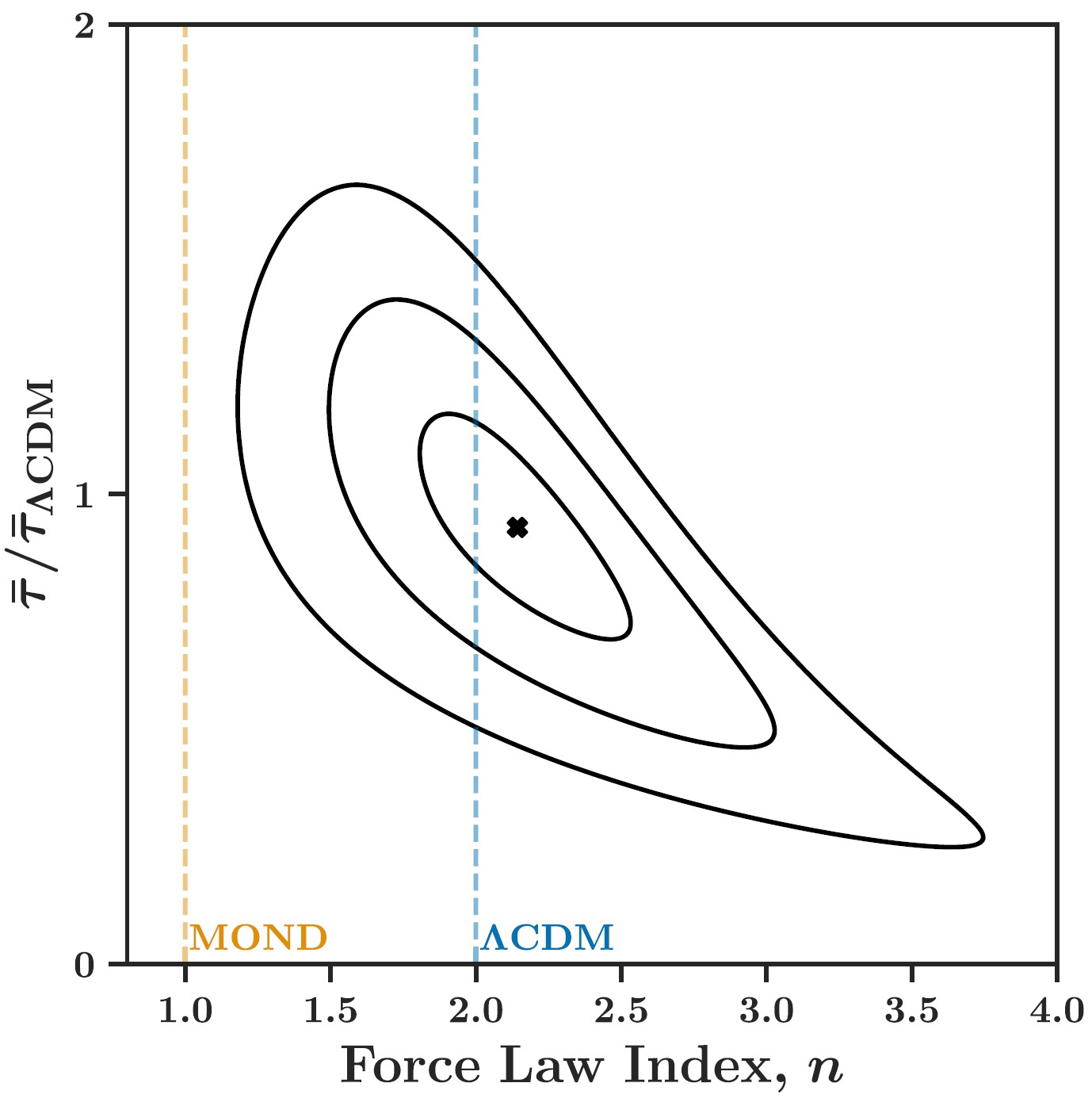
This graph shows the force law index (the exponent “n” in a generalized 1/r^n force law) inferred from the ACT 150 GHz map for the pairwise kinetic SZ measurement. The y-axis shows the average optical depth as a function of the standard cosmological optical depth, where 1 is the consensus value. Note the strong agreement with a dark matter-containing cosmology that obeys the gravitational rules of Einstein (and Newton), and the disagreement with MOND’s prediction that, on these scales, n = 1, rather than the standard n = 2.
Credit: P. Gallardo et al., Physical Review Letters, 2026
To date, this represents the largest-scale direct test of MOND, with scales ranging between 30 Mpc (about 100 million light-years) to 230 Mpc (about 750 million light-years). Leveraging this method has long been awaited by cosmologists, but only in recent years has data for both the CMB and for large-scale structure surveys become robust enough to yield a meaningful result like this.
In the future, optical spectroscopic surveys that provide large galaxy catalogues — including DESI, Euclid, Rubin, SPHEREx, and Roman — will far surpass what Sloan Digital Sky Survey data has delivered here, while next-generation CMB observatories, such as Simons Observatory or the Japan-led LiteBIRD mission, will improve our estimates of the kinetic SZ effect while reducing errors and uncertainties.
Today, this first analysis rules out MOND on these large cosmic scales by a modest 3.3σ: strongly suggestive, but still far from the 5σ “gold standard” of significance demanded by modern astrophysics and cosmology. However, the future surveys that are already planned forecast the ability to rule out MOND (and the n=1 force law scaling) on cosmic scales by a whopping 10σ significance. While no one can be sure that, ultimately, our current understanding of gravity as a manifestation of Einstein’s General Relativity won’t need modification, this study clearly shows that attempting to do away with dark matter and replacing Einstein’s laws with a modification to Newtonian gravity simply doesn’t match our observable reality.