
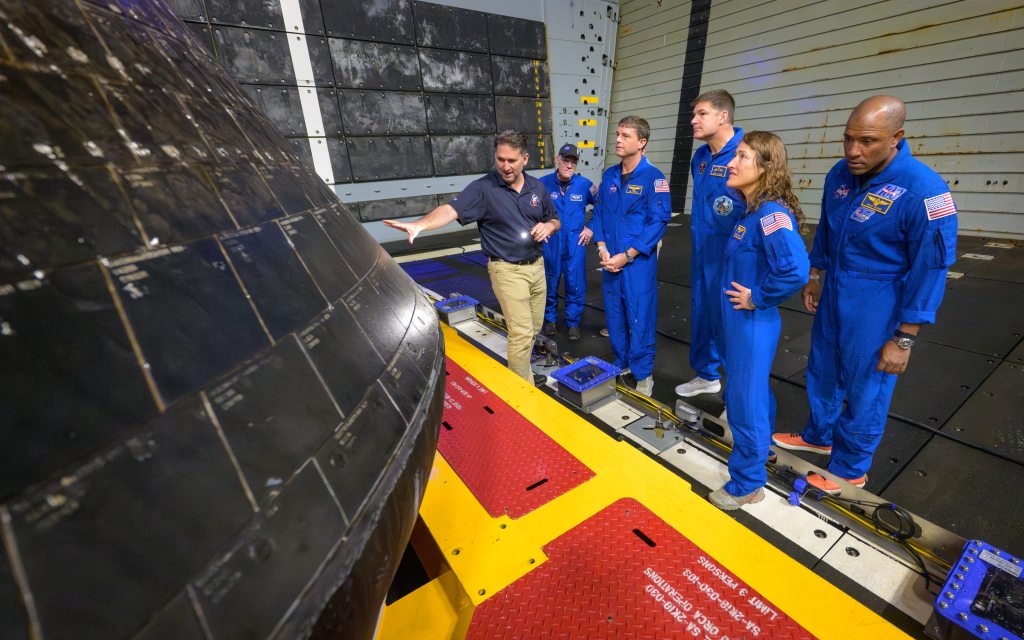
Early inspections of the Artemis II Orion heat shield show it held up as expected despite some signs of damage during its reentry, according to NASA.
NASA astronauts Reid Wiseman, Victor Glover and Christina Koch along with Canadian Space Agency astronaut Jeremy Hansen put their trust in the heat shield to bring them home safe after their historic 10-day lunar flyby mission splashing down in the Pacific on April 10.
“We came in fast. We came in hot. And I will tell you, looking out the window that whole way in, it was a smooth ride. It was a very smooth ride,” Wiseman said during a post-landing press conference.
NASA had previously stated the reentry speed would hit 23,742 mph, or about 31 times the speed of sound, during which temperatures could range up to 5,000 degrees Fahrenheit. On Artemis I, the uncrewed flight of Orion, NASA had opted for a longer reentry trajectory that featured the spacecraft dipping in and out of the atmosphere like a skipping rock to help it slow its speed before landing.
The end result, though, was unexpected char on the protective coating covering the heat shield, which showed fist-size chunks broken away in some places. While the coating is meant to melt away on reentry, the state of the coating forced delays in the target launch date of Artemis II while NASA worked out whether they should replace the heat shield altogether. In the end, NASA opted to instead take a more direct landing trajectory.
“I think (Glover) and I maybe saw two moments of a touch of char loss,” Wiseman said.
He noted all four were able to check out Orion after it had been brought on board the recovery ship, the USS John P. Murtha. He said they could see a little bit of char loss on the shoulder of the heat shield, where it meets the structure of the cone shape of the spacecraft.
“But the bottom, we leaned under and looked at the bottom,” he said. “For four humans just looking at the heat shield. It looked wonderful to us. It looked great.”
 This image taken by U.S. Navy divers shows the Orion heat shield shortly after Artemis II splashdown on Friday, April 10, 2026, (Courtesy/U.S. Navy)
NASA on Monday released an update on the heat shield, including imagery taken by U.S. Navy divers immediately after splashdown.
“Great imagery. We were all extremely interested right after splashdown. Grateful to the Navy divers who supported Artemis II”, NASA Administrator Jared Isaacman posted on X.
A NASA press release stated that imagery and further inspections once it was out of the water showed the char loss behavior seen on Artemis I “as significantly reduced, both in terms of quantity and size.”
It also stated its performance was consistent with tests that had been done ahead of launch. NASA will still pore over imagery taken from aircraft during Orion’s descent.
“This imagery will provide insight into the timing of when minimal char loss occurred, as well as other heat shield data,” NASA stated.
And more examination will be done when the spacecraft returns to Kennedy Space Center this month at the Multi-Payload Processing Facility. The heat shield will be transported to NASA’s Marshall Space Flight Center in Huntsville, Alabama, over the summer, where teams will extract samples and perform x-ray scans.
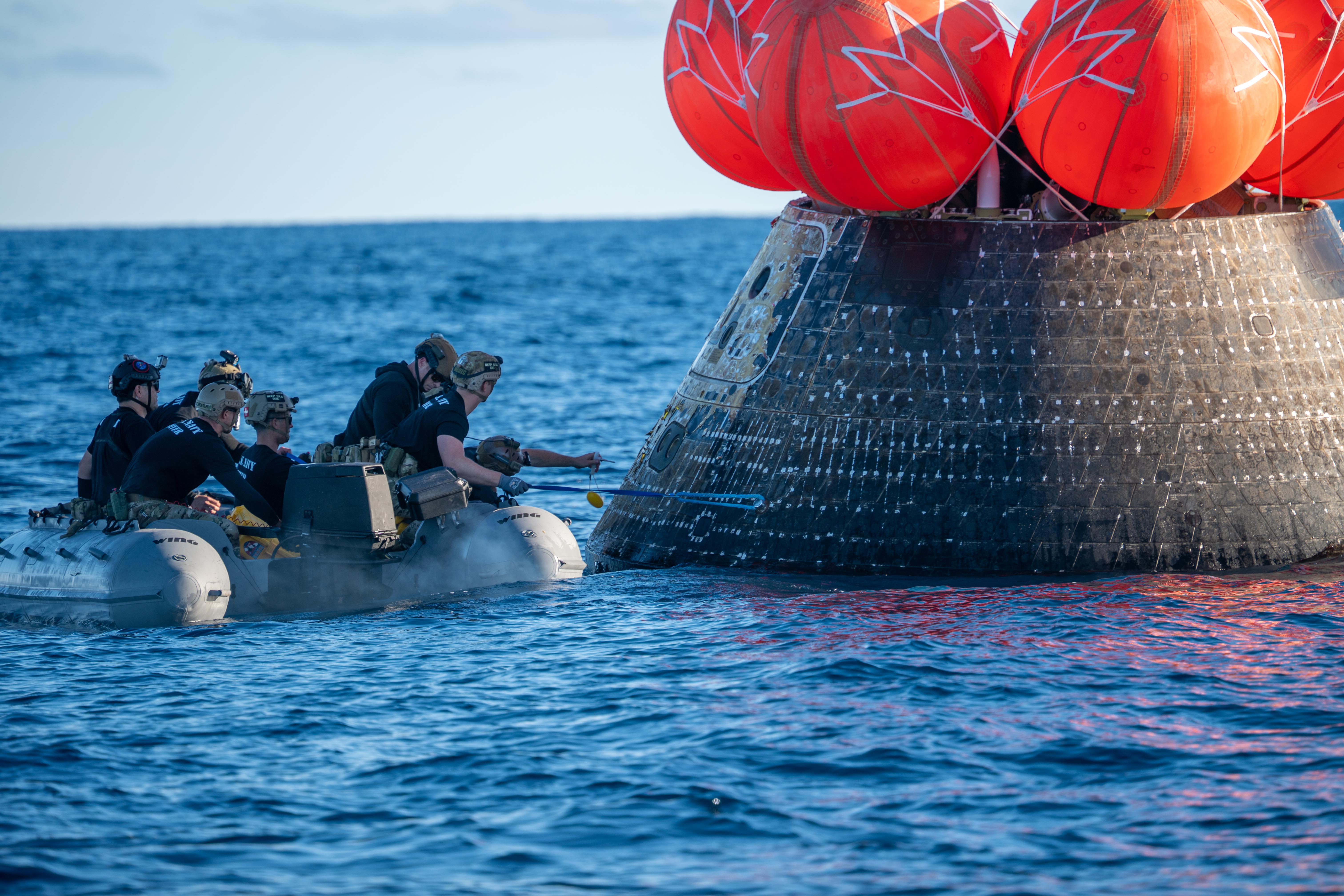
NASA’s Landing and Recovery team, along with U.S. Navy personnel aboard an inflatable raft approach the Orion spacecraft carrying Artemis II astronauts Reid Wiseman, Victor Glover, Christina Koch and Jeremy Hansen, following the spacecraft’s splashdown in the Pacific Ocean near San Diego on Friday, April 10, 2026. (Kevin Davis/NASA)

NASA’s Landing and Recovery team and U.S. Navy personnel tow and secure the Orion spacecraft in the well deck of the USS John P. Murtha following splashdown in the Pacific Ocean near San Diego, California on Friday, April 10, 2026 after the Artemis II test flight. (Kevin Davis/NASA)
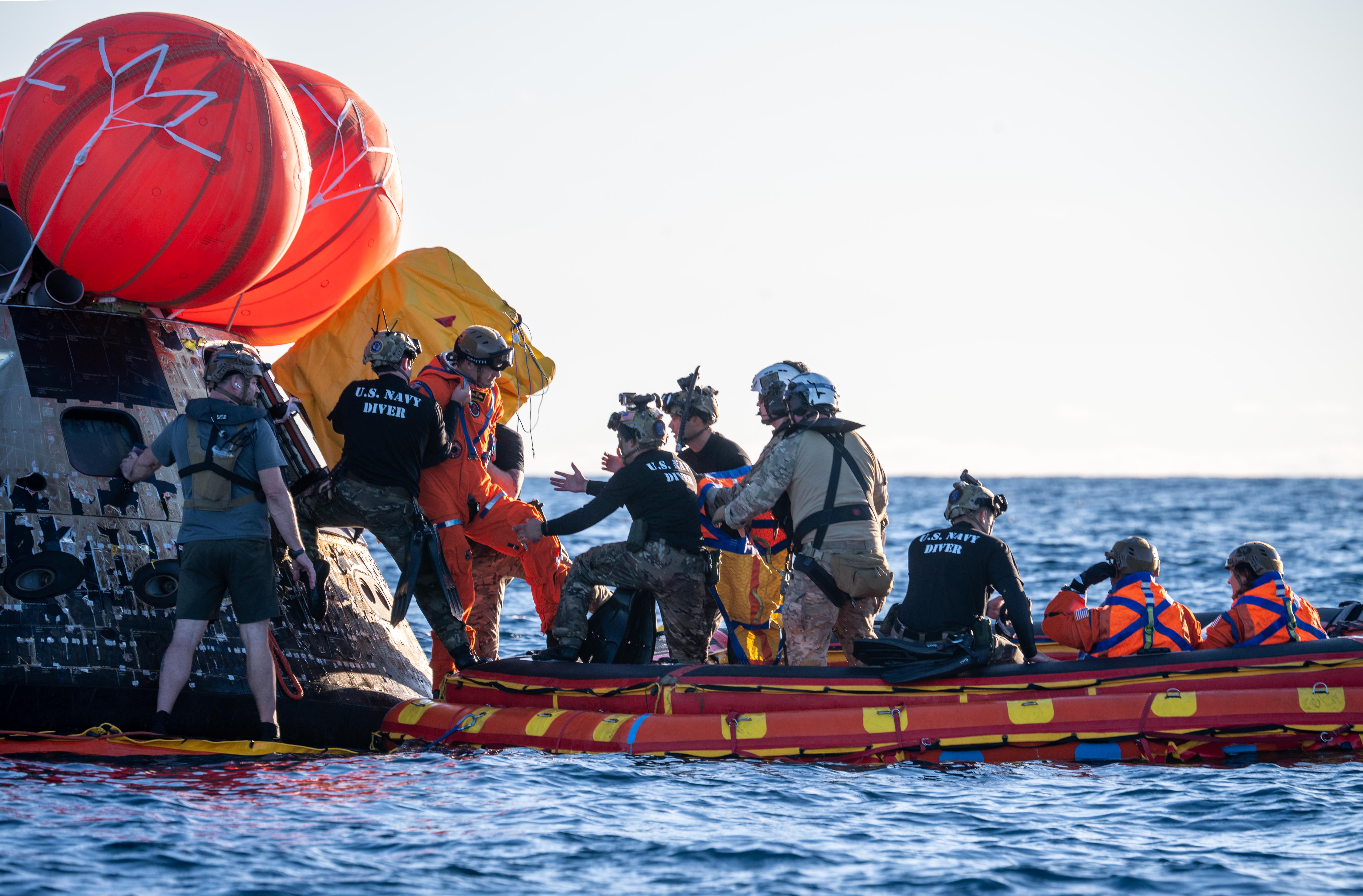
Artemis II astronaut Jeremy Hansen of the Canadian Space Agency is extracted from NASA’s Orion spacecraft and loaded onto an inflatable raft, called the front porch, following splashdown in the Pacific Ocean near San Diego on Friday, April 10, 2026. (Kevin Davis/NASA)
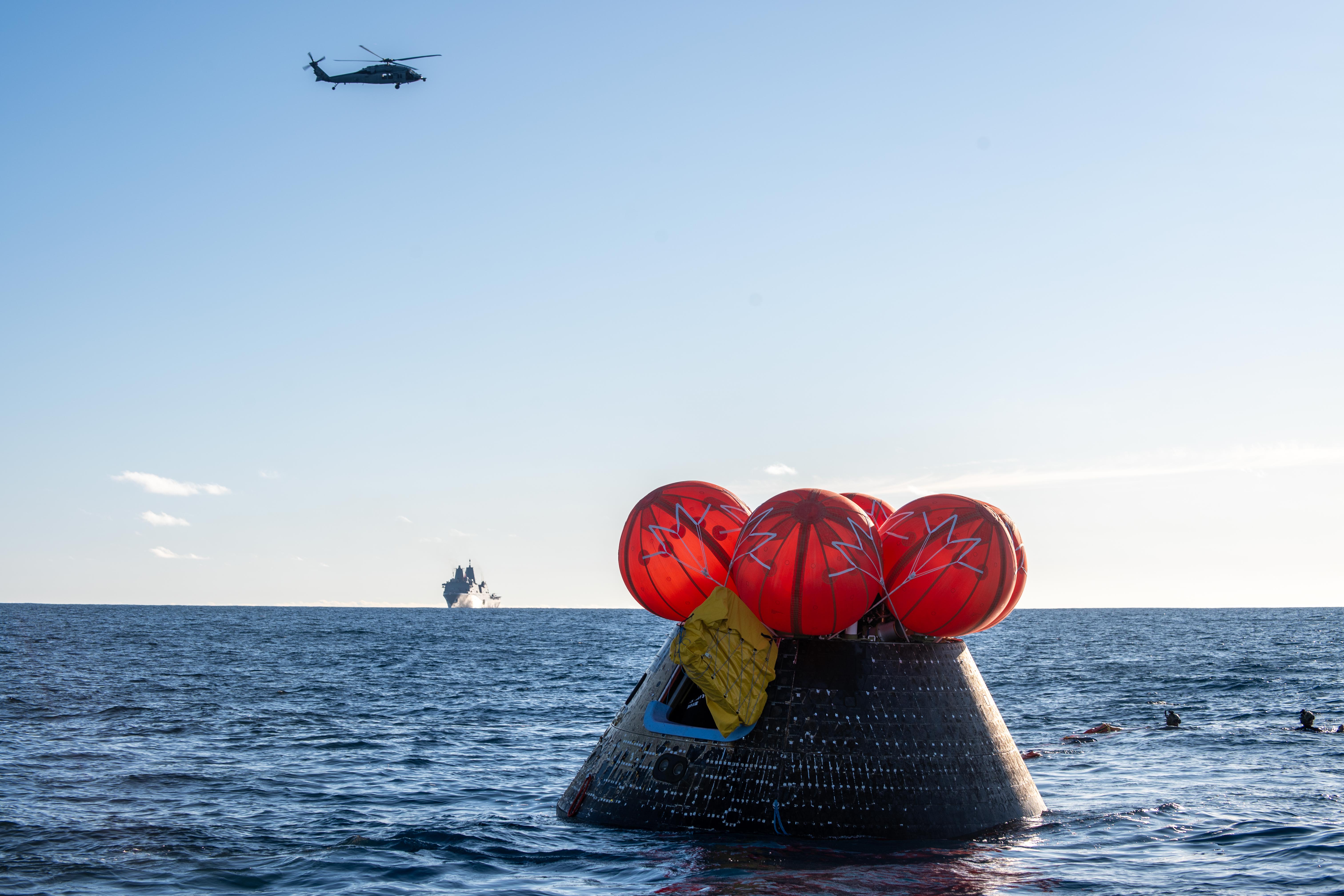
NASA’s Orion spacecraft carrying Artemis II astronauts Reid Wiseman, Victor Glover, Christina Koch and Jeremy Hansen, floats in the Pacific Ocean near San Diego on Friday, April 10, 2026. NASA’s Landing and Recovery team and U.S. Navy personnel aboard an inflatable raft, called the front porch, helped extract the crew along with an H60-S Seahawk helicopter seen hovering above to communicate Orion’s location back to USS John P. Murtha to coordinate efforts to secure the spacecraft in the well deck of the ship. (Kevin Davis/NASA)
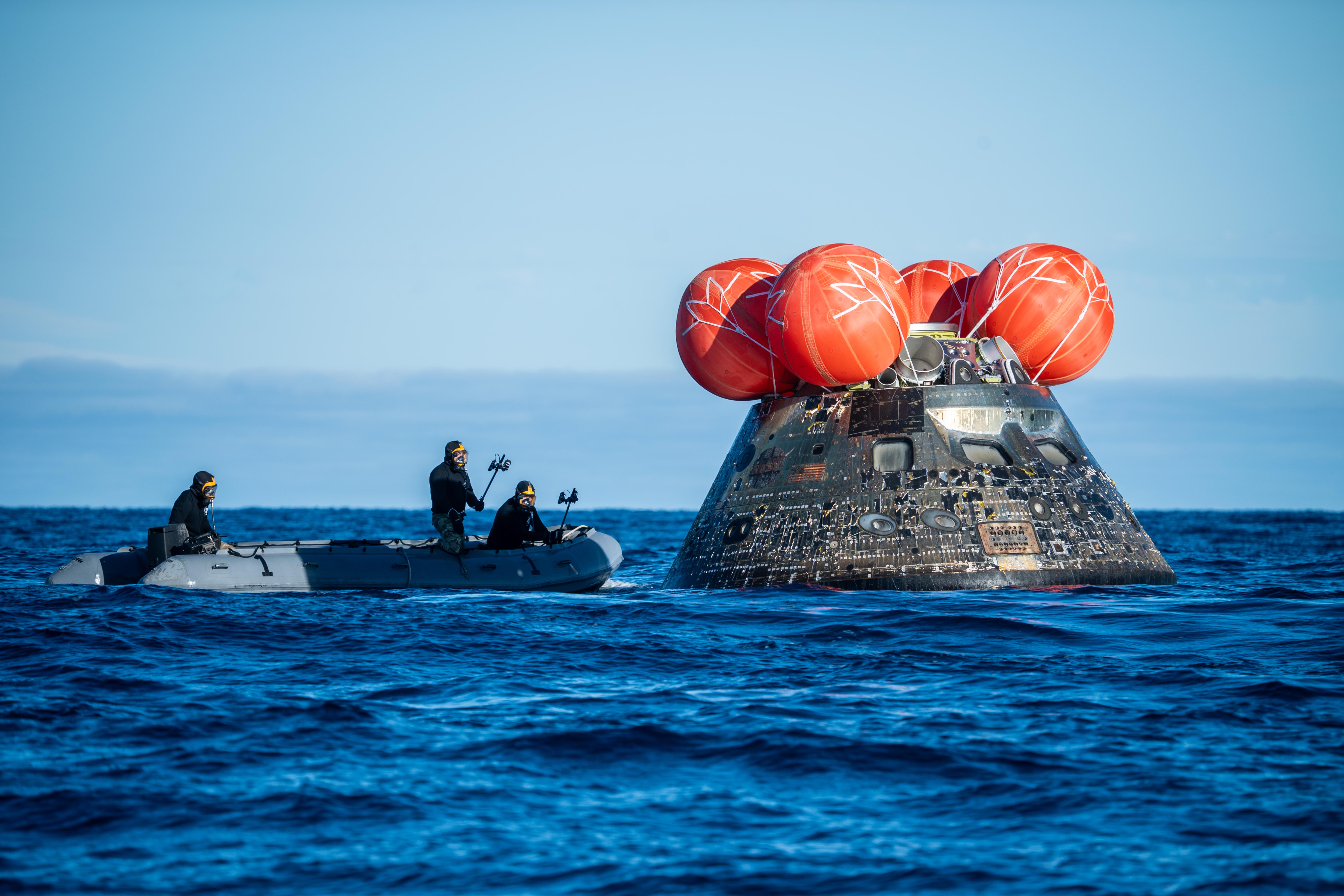
NASA’s Landing and Recovery team, along with U.S. Navy personnel aboard an inflatable raft approach the Orion spacecraft carrying Artemis II astronauts Reid Wiseman, Victor Glover, Christina Koch and Jeremy Hansen, following the spacecraft’s splashdown in the Pacific Ocean near San Diego on Friday, April 10, 2026. (Kevin Davis/NASA)
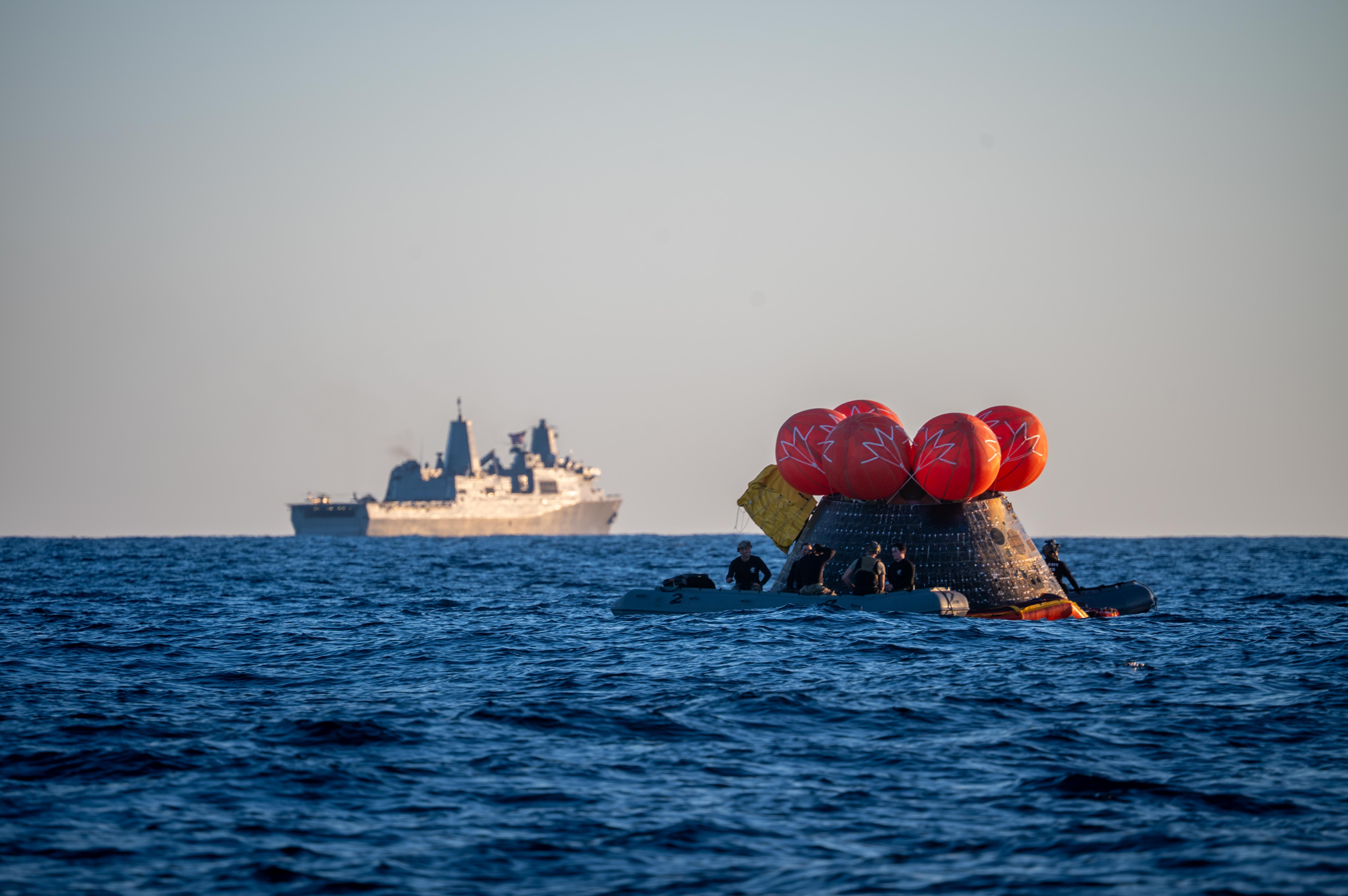
U.S. Navy personnel aboard an inflatable raft, called the front porch, help recover NASA’s Orion spacecraft following its splashdown in the Pacific Ocean near San Diego, California, on Friday, April 10, 2026, after the Artemis II test flight. (Kevin Davis/NASA)
Show Caption
1 of 6
NASA’s Landing and Recovery team, along with U.S. Navy personnel aboard an inflatable raft approach the Orion spacecraft carrying Artemis II astronauts Reid Wiseman, Victor Glover, Christina Koch and Jeremy Hansen, following the spacecraft’s splashdown in the Pacific Ocean near San Diego on Friday, April 10, 2026. (Kevin Davis/NASA)
At this point, NASA said the char loss that did occur would not slow down efforts to launch Artemis III in 2027. That Orion spacecraft will also feature a new heat shield, with what NASA engineer Tim Otterson called “a tweaking of the recipe” for its protective coating.
“It’s more of a refining the recipe versus an entirely new recipe,” he said.
The Artemis III mission will also be crewed, but not fly to the moon. Instead, it will remain close to Earth with a goal of docking with one or both of two moon landers being developed. That would then set up Artemis IV as early as 2028, which aims to return humans to the lunar surface for the first time since Apollo 17 in 1972.
The heat shield won’t be as taxed on speeds and temperatures on Artemis III as it will be for the Artemis IV mission, though.
“We’re looking to have both our ground testing and Artemis III to show that the new recipe is meeting our performance requirements,” Otterson said. “Clearly, if that’s the case, then you know, there shouldn’t be a reason to change going forward. But I would never say never.”
For his part, Glover reveled in what he called “a very intense 13 minutes and 36 seconds,” especially the first jolt of the initial drogue parachutes that slowed Orion to 136 mph ahead of the three main parachutes deploying.
“When the drogues cut away, we went back to freefall … I’ve never been BASE jumping. I’ve never been skydiving, but if you dove off a skyscraper backwards, that’s what it felt like for five seconds, and then the (main parachutes) came out, and it was it was glorious,” he said.
Wiseman said he expects NASA to not let up on the heat shield investigation.
“They are going to do to this heat shield what they did to Artemis I,” he said. “We are going to fine tooth comb every single, not even every molecule, probably every atom, on this heat shield.”