
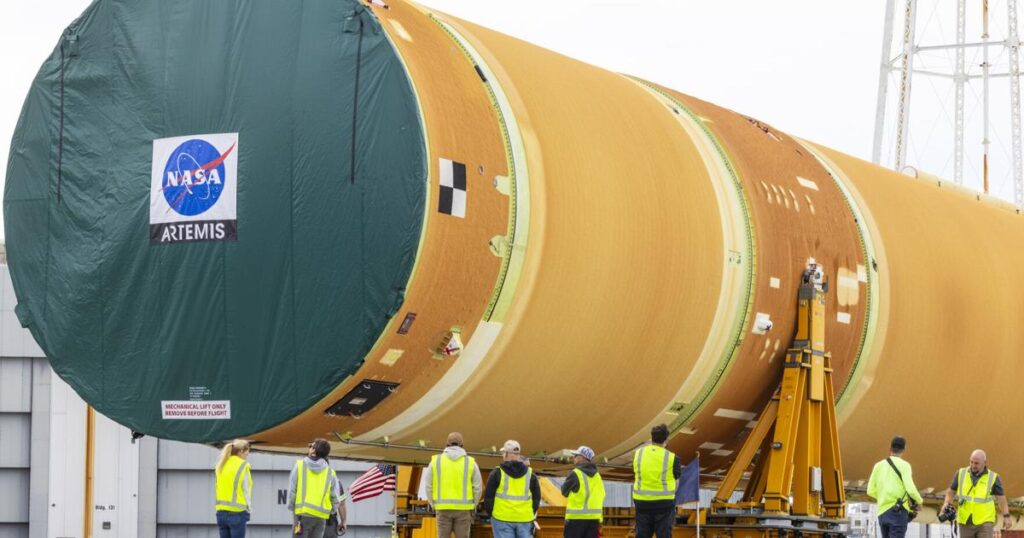
NASA employee Chandler Scheuermann had the Artemis II astronauts on his mind from “liftoff to splash down” of their 10-day mission around the moon earlier this month. But he was paying special attention to the first eight minutes.
Scheuermann is a program manager at the Michoud Assembly Facility in New Orleans, where NASA built the Artemis II rocket’s core stage that powered the astronauts into space on April 1.
Takeoff — the first eight minutes after the countdown clock hits zero — is when the core stage gets put to the test. By all accounts, it was a success.

Crews walk alongside the Artemis III core stage as it is slowly rolled out of the Michoud Assembly Facility in New Orleans on Monday, April 20, 2026. (Photo by Chris Granger, The Times-Picayune)
PHOTO BY CHRIS GRANGER
“It’s just pure excitement, adrenaline. I can’t imagine how the astronauts must feel because watching it on TV and watching it from the Cape is enough to make me sweat,” Scheueurmann said of the launch. “The moment they opened those doors and I saw some smiles getting off the capsule, you can certainly relax.”
NASA is now readying plans for the launch of Artemis III, the next mission on the space agency’s calendar in preparation for a potential moon landing in 2028.
On Monday, Scheurmann and hundreds of other NASA employees at Michoud gathered to watch the rocket they built for that mission begin its long journey from Louisiana to a Florida launch pad.
The Kinfolk Brass Band plays during the rollout of NASA’s Artemis III core stage, top, at Michoud Assembly Facility in New Orleans on Monday, April 20, 2026. (Photo by Chris Granger, The Times-Picayune)
PHOTO BY CHRIS GRANGER
Artemis III, scheduled for next year, will launch astronauts into low Earth orbit where they will test out the docking capabilities of at least one of the two lunar landers from Elon Musk’s SpaceX and Jeff Bezos’ Blue Origin that are competing to ferry people to the moon’s surface.
The tests on Artemis III will be critical to the future missions, NASA officials said Monday.
‘Critical role’
Though the Artemis III rocket will reach speeds of thousands of miles per hour when it blasts off from Cape Canaveral sometime next year, the first part of the orange-hued cylinder’s journey was remarkably slower.
At around 7:30 a.m., the 185-foot-long rocket, weighing just under 200,000 pounds, rolled out of massive vault-like doors at Michoud, moving at less than a mile per hour.
The crawlers carrying the rocket section trundled across the asphalt at the New Orleans East facility. They took a wide hook left onto Venus Boulevard, then a right onto Saturn Boulevard before being loaded onto a special barge called the Pegasus bound for the Kennedy Space Center in Florida.
Whitney Sheppard wore a hat featuring the astronauts for Artemis III as she attends the rollout for the Artemis III core stage at the Michoud Assembly Facility in New Orleans on Monday, April 20, 2026. (Photo by Chris Granger, The Times-Picayune)
PHOTO BY CHRIS GRANGER
Once in Florida, the four engines that form the final part of the core stage will be added to the bottom, bringing its total height to 212 feet and its final weight closer to 230,000 pounds. A polyurethane foam on the exterior keeps the liquid hydrogen and oxygen fuel cool inside and gives it its characteristic orange color.
At Michoud on Monday, a brass band played as the rocket rolled slowly by, and NASA officials described how enthusiastic the nation and the world had become about space travel thanks to Artemis II.
“You all here are playing an absolutely critical role in what we’re going to implement over the next several years,” NASA Artemis Program Manager Lori Glaze told the crowd, which included U.S. Sen. Bill Cassidy and New Orleans Mayor Helena Moreno.
U.S. Senator Bill Cassidy takes photos of the Artemis III core stage as it is rolled out of NASA’s Michoud Assembly Facility in New Orleans on Monday, April 20, 2026. (Photo by Chris Granger, The Times-Picayune)
PHOTO BY CHRIS GRANGER
NASA astronaut Nichole Ayers noted the trust that astronauts place in the people who work at facilities like Michoud.
“You guys triple checked every bolt, you triple-checked every step and made sure that it was safe,” said Ayers.
The huge facility in New Orleans East has been working on missions since the Apollo days and will celebrate its 65th year in September.
NASA officials said the facility will be expected to produce at a high rate in the next few years.
Astronaut Nicole Ayers, right, joins guests at the rollout of NASA’s Artemis III core stage at the Michoud Assembly Center in New Orleans on Monday, April 20, 2026. (Photo by Chris Granger, The Times-Picayune)
PHOTO BY CHRIS GRANGER
Chris Cianciola, a deputy manager of NASA’s Space Launch System, the formal name for the rockets that power Artemis missions into space, said he hopes Michoud will soon be able to make a new rocket core stage every year.
The one that rolled out on Monday took three years, said Scheuermann. The facility is already at work on the later missions. Large segments of the Artemis IV and V rockers were visible during a tour of the facility.
Moreno said NASA has put in a request for information on potential new opportunities that could come to the Michoud facility and her administration has also received inquiries about the number of engineers graduating in New Orleans.
“People are opening their eyes again to Michoud,” she said.
New Orleans Mayor Helena Moreno records herself as she does a social media post for the rollout of NASA’s Artemis III core stage on Monday, April 20, 2026 at the Michoud Assembly Facility in New Orleans. (Photo by Chris Granger, The Times-Picayune)
PHOTO BY CHRIS GRANGER
According to the NASA website, the Michoud facility encompasses 829 acres and employs 3,400 people across 18 federal agencies and private companies.
The core stage’s trip to Florida on the barge will take between seven and nine days. Employees at Michoud also make major components of the Orion capsule, the craft where astronauts live and work in space.