
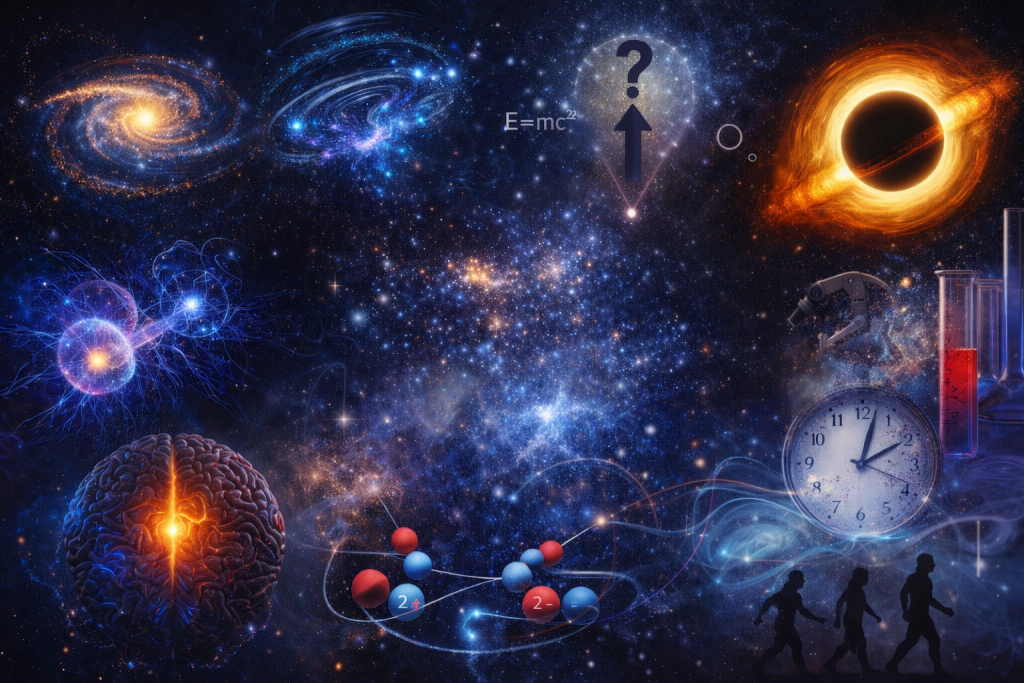
We have never understood the world better — and the list of things science can’t answer has never been longer. Not because our tools are failing — better instruments sharpen the edges of our ignorance. These gaps are genuine scientific mysteries — phenomena we still cannot resolve — pointing at something structurally missing in our fundamental models. Where exactly does knowledge hit a wall? Let’s lay it all out.
Which Questions Can Be Answered by Science?
Anything measurable, testable, and reproducible. Science is extraordinary at the “how” — how a star collapses, how a cell divides. But it hits an absolute wall at the extremes: scales too small, too energetic, or too subjective. Measurement breaks down. These are not mere gaps waiting to be filled by a better telescope. They are structural boundaries, producing the deepest unexplained anomalies today. So, what are the ten limitations of science that matter most? The ten phenomena below have resisted every instrument, model, and theory we possess.
1. Dark Matter and Dark Energy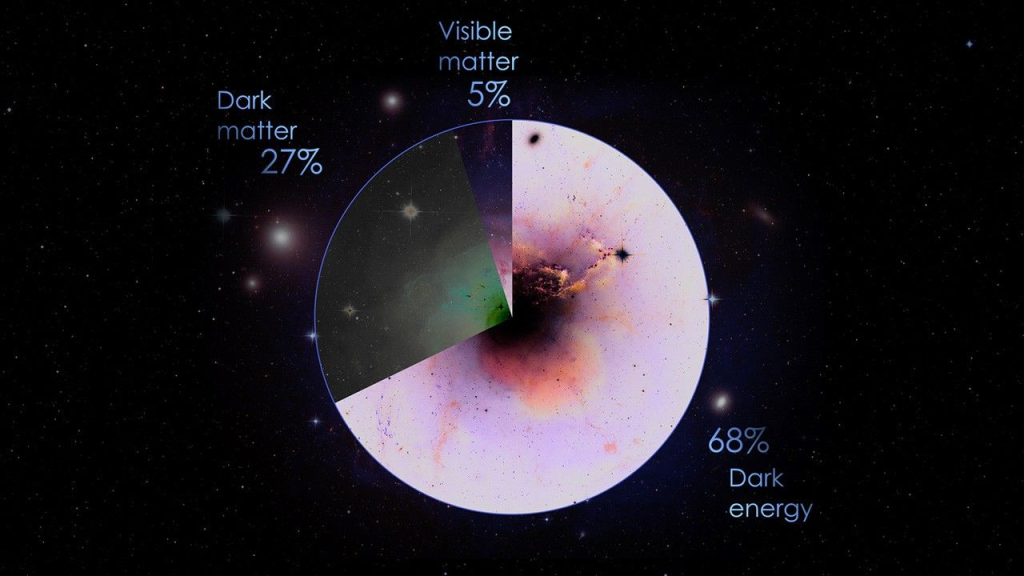 The universe is made up of three components: normal or visible matter (5%), dark matter (27%), and dark energy (68%).Credit: NASA’s Goddard Space Flight Center
Everything ever observed adds up to roughly five percent of what’s out there. The remaining 95% — dark matter and dark energy — has no confirmed description. Dark matter’s gravitational fingerprint shows in galaxy rotation curves — smoothing gravitational anomalies that would otherwise destabilise them — yet no experiment has caught a single unknown particle. In December 2025, LZ delivered 417 live days at record sensitivity. No signal. The search has entered the “neutrino fog”, where solar neutrinos mimic detector signatures. Dark energy accelerates expansion with no identified source. The missing mass problem is one of the things science can’t answer — not for lack of effort, but for lack of a clue.
2. Baryon Asymmetry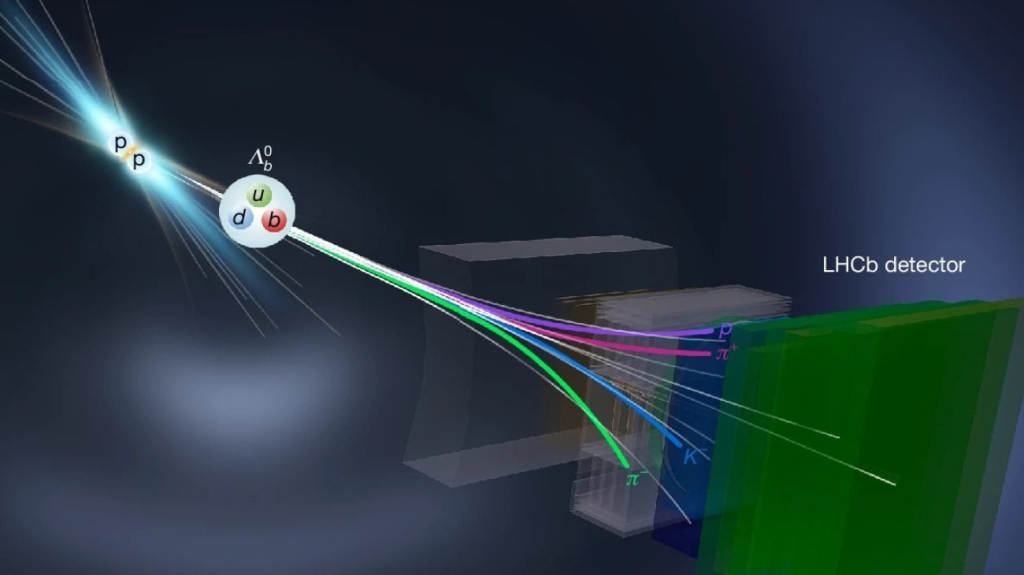 A visualization of a proton-proton collision in the LHCb detector, showing the decay of a Lambda beauty baryon.Credit: CERN / LHCb Collaboration.
By rights, you shouldn’t exist. The Big Bang produced matter and antimatter in equal amounts — and when they meet, they annihilate completely. A matter–antimatter asymmetry of one part in a billion meant matter won. In March 2025, LHCb at CERN reported the first observation of CP violation in baryon decays — findings published in Nature. A landmark result — one that deepens, not resolves, the mystery: the measured asymmetry is orders of magnitude too small to explain why matter dominates. Among the unsolved scientific questions, nothing cuts deeper.
3. The Hubble Tension
The universe is expanding — but nobody agrees on how fast. One method reads the cosmic background radiation, the thermal afterglow of the Big Bang. The other tracks are nearby supernovae. They return different values for H₀, and the gap has only grown. By early 2025, cosmologist Dan Scolnic declared the Hubble Tension a full Crisis: DESI-anchored Coma Cluster data pushed the local value higher, while the Atacama Cosmology Telescope pulled it lower. ESA’s Euclid will deliver a third measurement in 2026. These cosmic anomalies make the Hubble Tension one of the things that science can’t explain without implicating a structural flaw in the LambdaCDM Model.
4. The Vacuum Catastrophe
Quantum field theory predicts the energy density of empty space. The number it returns is 10¹²⁰ times larger than what we actually measure. Not twice. Not a thousand times. 10¹²⁰. Sit with that: the worst numerical prediction in the history of physics. Nobody knows how to fix it. The failure to renormalize zero-point energy reveals how deeply quantum gravity and general relativity resist each other. This is the hardest entry on any list: a scientific anomaly that defies explanation — one that arrives with a number impossible to ignore.
5. Black Holes The first direct image of the black hole M87*, capturing its distinct “shadow” and event horizon. Credit: Event Horizon Telescope Collaboration
In 2019, the Event Horizon Telescope array captured the first-ever image of a black hole. What’s inside a black hole? Past the event horizon, the interior remains physically unknown. At the centre lie singularity: infinite density, undefined spacetime, equations that stop. Quantum mechanics demands information survive a black hole’s evaporation — yet Hawking’s calculation implied it does not, producing the information paradox and, later, the “firewall” debate that has divided theoretical physics for decades. Are there phenomena scientists still cannot explain that cut deeper than this? A unified field theory would resolve both. We don’t have one.
6. Human Consciousness
Neurobiology is great at mapping the brain’s wiring, but it hits a brick wall at the “Explanatory Gap”: how does biological matter actually create a first-person experience (qualia)? There is no equation in physics that requires neural firing to be felt from the inside. We can track every signal in the cortex, yet why this creates a subjective reality — instead of just silent, automated data processing — remains one of the things science can’t explain. Until we can derive sentience from grey matter, our own minds stand among the deepest unanswered questions about the universe.
7. Abiogenesis A conceptual visualization of hydrothermal vents on the prebiotic Earth, a leading candidate for the site of abiogenesis. Credit: NASA / JPL-Caltech.
Evolution makes sense once you actually have a living cell. But the origin of life itself? That’s where physics breaks down. How does dead chemistry spontaneously beat entropy to build a self-replicating cycle? RNA World models are just educated guesses that dodge the real thermodynamic jump from random molecules to a working genetic code. No lab has ever forced inert polymers into a functional genome. That massive, unexplained leap from raw chemistry to biology is exactly why this remains a profound scientific enigma. It’s a stubbornly unsolved scientific question — and firmly on the list of things science can’t answer.
8. Fine-Tuning
Shift any physical constant by a fraction — gravity, electron mass, the cosmological constant — and atoms never form, stars burn out instantly, or the universe collapses before anything begins. The numbers look rigged. Fred Hoyle predicted the precise nuclear energy level of carbon-12 in 1953: it had to exist — or we wouldn’t. Physicists call it the fine-tuning problem — among the deepest mysteries of the universe. Are there scientific enigmas, more fundamental than why the constants landed exactly where they did? Nobody has a clean answer.
9. The Arrow of Time
The fundamental equations of physics are time-symmetric. Yet time moves only one way. You can’t un-shatter a dropped glass. Why the universe began in such an ordered, low-entropy state is one of the most debated theoretical physics paradoxes in cosmology. The “past hypothesis” has no clean fix. A uniquely low-entropy Big Bang defies statistical probability — an outlier where thermodynamics, quantum mechanics, and gravity have yet to speak with one voice.
10. Quantum Entanglement
Einstein called it “spooky action at a distance” and spent years trying to explain it away. He couldn’t. Entangle two particles, separate them by any distance, measure one, and its partner reflects the result instantly. Nothing exceeds the speed of light. The correlation simply exists. Bell’s Inequality violations confirm local realism is incompatible with quantum mechanics — Einstein’s conviction that hidden variables would restore locality was wrong. Entanglement remains without invoking non-locality — at the quantum level, “here” and “there” lose their meaning.
The Next Paradigm
The things that science can’t explain are not dead ends. They are coordinates. Every unexplained space signal, every fast radio burst, every theory that breaks at its own edge — these are the mysteries that challenge modern science, marking where the next century of physics hides. The map isn’t finished. These unanswered questions about the universe — puzzles at the frontier of science — will keep physics moving forward.
References & Additional Information
 Published by Space Expert
Richard is an established commentator with a strong political background and a career that has spanned across the energy sector (oil, gas & renewable energy) as well as the space industry (satellites, launch & telemetry).
He is a self-proclaimed environmental campaigner and is particularly enthusiastic about the role that the Scottish space industry will play in tackling the climate emergency that is happening around the world.