
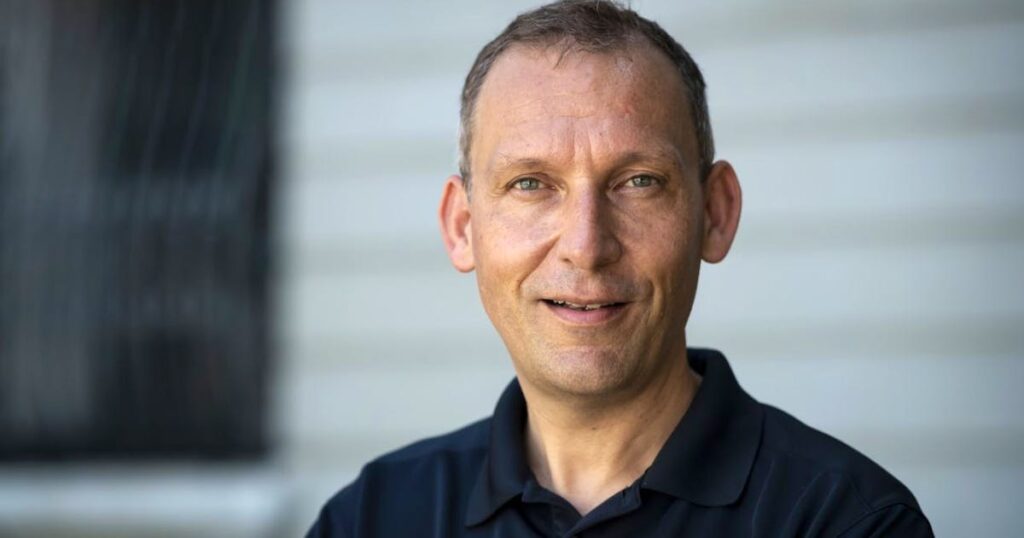

Thomas Zurbuchen used to be the Director of Science at NASA. Today he is at ETH Zurich. (archive picture)
Keystone
Former Nasa Science Director Thomas Zurbuchen believes that geopolitical conflicts are putting a strain on space research. The current division in science is worse than during the Cold War. The joint search for life in space offers hope, he says.
“The race in research is a projection of geopolitical tension onto science,” the astrophysicist, who now works at ETH Zurich, told journalists during a lecture at the Austrian Academy of Sciences (ÖAW) in Vienna.
“The fact is that space today is a place where war is being waged,” said the researcher, who holds Swiss and US citizenship. Space plays a role in wars such as Russia’s war of aggression in Ukraine. But there is also a figurative test of strength between major space-faring nations.
In view of current developments, it is only a matter of time before China overtakes the USA. “This tension in space is dividing science in a way that I honestly find worse than during the Cold War.” His hope is “that we will find our way back to each other,” says Zurbuchen.
Proof of life in the distance sought
According to the Professor of Space Science and Technology at the Swiss Federal Institute of Technology in Zurich (ETH) and head of the ETH Zurich Space initiative, this could perhaps be achieved through the necessary cooperation in the search for life in space.
From 2016 to 2022, Zurbuchen was head of NASA’s science department and thus responsible for well over 100 missions with more than 30 rocket launches. On Zurbuchen’s initiative, a Master’s degree course in “Space Systems” was launched at ETH Zurich in the winter semester of 2024. “We started with 30 and are now at around 50.” At around 100 people, we would probably stop and become more competitive. Demand is very good – and has recently also been very strong from the USA.
Focus on the moon makes sense
As head of NASA, Zurbuchen focused on the search for fossil life on Mars, among other things. Under him, a mission to the Red Planet was also launched, which took the Mars rover “Perseverance” there. The NASA moon missions and the recent success of “Artemis 2”, the manned flight around the Earth’s satellite, seem to be drawing most attention to the moon again at the moment. Yes, says Zurbuchen, that makes sense.
As a passionate skier, he draws a comparison: exploring the moon and Mars are both “kind of like skiing”, but different – much more dangerous. And you really have to be practiced: “And to be honest, before you are dropped off on the mountain by helicopter, you should try a little on the T-bar lift until you can do it.”
We shouldn’t get too comfortable on the moon
His only concern is “that we’ll be comfortable on the moon”. There are many positive things that can be said about the International Space Station over the past three decades, such as international cooperation, thousands of experiments, etc. “The fact is that incredibly little has come out of the Space Station scientifically or technologically in the last ten years.” He hoped that the moon would be successfully explored, that a lot would be learned there and that things would then move forward.
The expert, who was born in 1968, had “the privilege” of being in space when Artemis was invented as a program. As a witness to the recent success, he said: “I am one of the oldest people who has no memory of the Apollo program. And it was the first time I saw humans near the moon. And what excited me was just the international resonance of the fact that we could do something together.”