
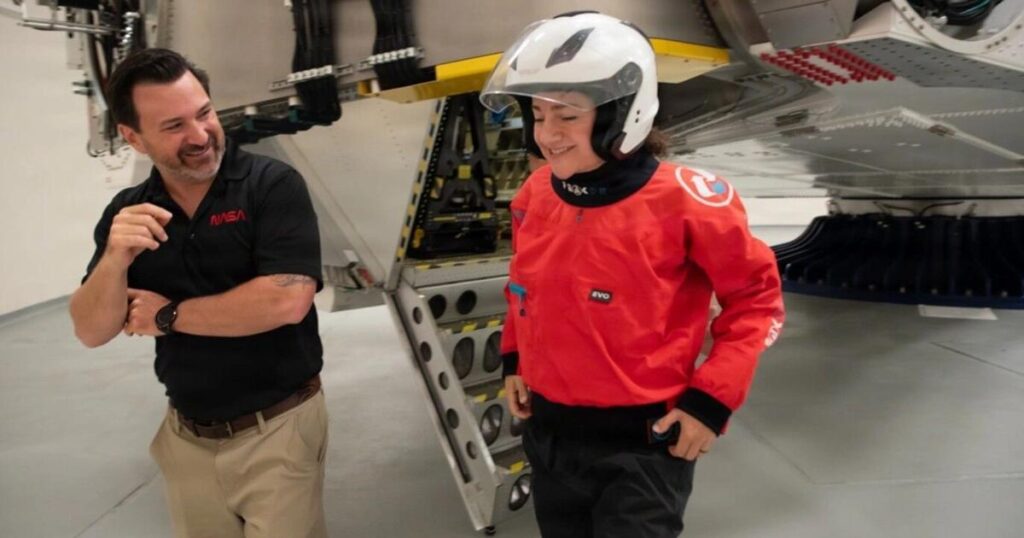

NASA astronaut Jessica Meir (right) speaks with John Trentini, NASA flight surgeon, after exiting the 711th Human Performance Wing’s centrifuge at Wright-Patterson Air Force Base on June 20, 2025. Meir was one of five astronauts from NASA, the Canadian Space Agency and the European Space Agency who completed centrifuge training, which simulates gravitational forces, or g-forces, experienced during launch and return to Earth. Richard Eldridge / u.s. air force
The first astronauts to travel to the moon, and well beyond, since 1972 have returned home — and a research team at Wright-Patterson Air Force Base will help NASA astronauts continue to find their way back to the lunar surface.
“We’re a part of that new chapter,” said retired Navy Capt. Richard Folga, who works as a program manager at the Naval Medical Research Unit at Wright-Patterson.
The research unit — sometimes called “NAMRU-Dayton” — did not have a prominent role in NASA’s recent Artemis II mission.
But the Wright-Patterson team expects to host NASA astronauts as early as this summer for simulated training on landing on the moon, Folga told the Dayton Daily News.
NASA’s “Artemis” program is a multi-mission saga. Artemis II was just completed. The Artemis III mission, in which rendezvous and docking operations will be tested, is scheduled for mid-2027.
And Artemis IV, a crewed lunar surface landing, isn’t scheduled before early 2028, NASA has said.
“Our work now is targeted at Artemis IV and Artemis V,” Folga said.
Folga is enjoying NASA’s recent success. He recalled being glued to the television for hours as the Artemis II team flew further from Earth than any other human beings have ever achieved.
“We’re excited for every bit of it,” Folga said of Artemis II. “I personally met (astronaut) Victor Glover. He came to NAMRU and we shook hands, and we gave him a tour of the Kraken.”
The “Kraken” is the the GL-6000 Disorientation Research Device at Wright-Patterson, a device able to create realistic motion simulations for passengers.
Astronauts will ride the Kraken in training to prepare for landing on the lunar service, Folga said.
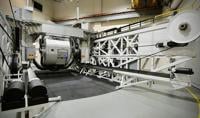
The Kraken, a large gravitation motion device at Wright Patterson Air Force Base. FILE
“Those astronauts who are coming through for Artemis IV may be here in Dayton, and they may be here in the Kraken, before the end of the year,” Folga said.
“Now we’re prepared for (Artemis) III,” he added. “We’re almost up. We’re not in the on-deck circle yet, but we’re warming up.”
In one sense, this is nothing new. Air Force and Navy researchers at Wright-Patterson have worked with NASA for decades.
American and European astronauts trained on the 711th Human Performance Wing’s centrifuge — not the same device as the Kraken — at Wright-Patterson last summer.
A 2024 video of the Kraken disorientation device at Wright-Patterson Air Force Base. The Kraken, or the the GL-6000 Disorientation Research Device, creates realistic motion simulations.
“We are proud to partner with domestic and international space agencies in supporting their critical space exploration missions,” Brig. Gen. Robert K. Bogart, then-commander of the 711th, said in a December account of that training.
“Our centrifuge provides a unique and valuable training environment, leveraging our expertise in human performance to ensure the safety and readiness of astronauts facing the extreme forces of spaceflight. This collaboration exemplifies our commitment to advancing human potential in challenging environments, whether in the air or in space.”
Bogart recently relinquished command of the 711th to Col. Dale Harrell.
Navy researchers want to learn more about how humans handle motion sickness and changes in acceleration and gravity.
If you have a current medical clearance for aviation, and TRICARE health insurance, then the folks at NAMRU would like a word with you.
But Folga cautioned that the the research focused on getting astronauts safely to the moon’s surface is separate from that study.
The actual moon lander has not been built yet, Folga said. It should be an automated landing. But the training, with custom motion-control algorithms, is crucial and still must take place.
“Every time I talk to them, they thank us for being there,” Folga said of his partners at NASA.