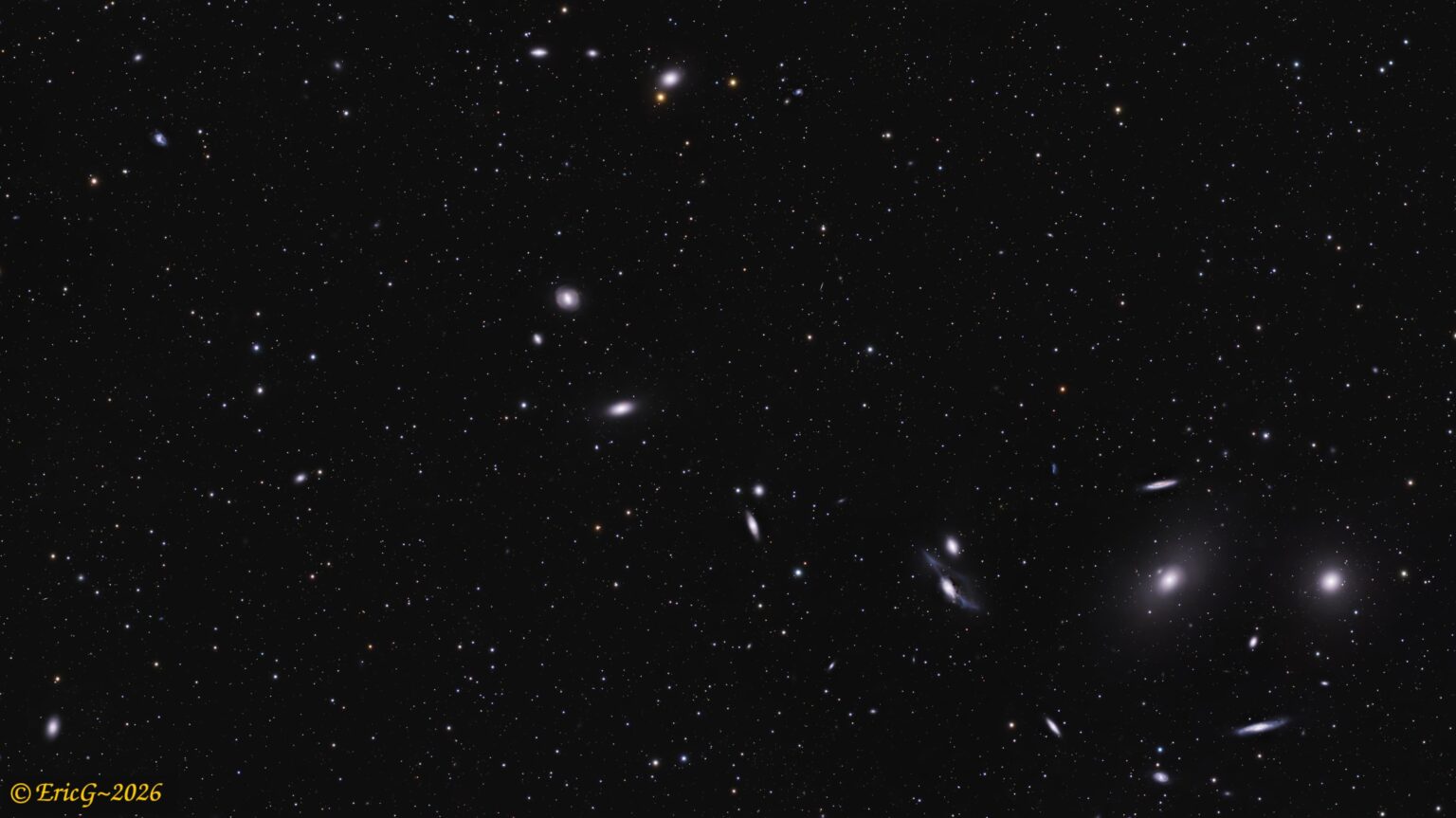
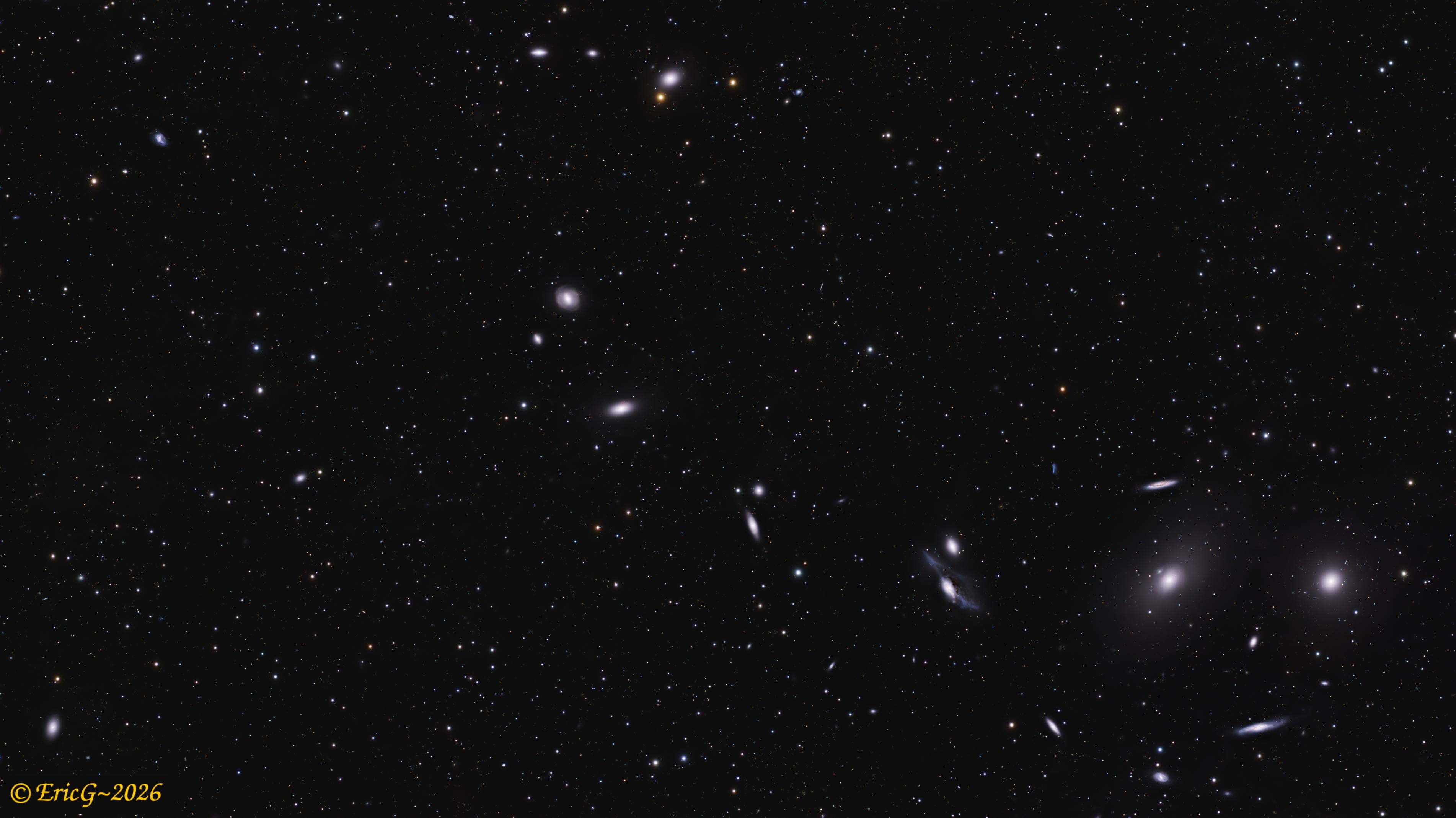
Markarian’s Chain is a stretch of galaxies that forms part of the Virgo Cluster. When viewed from Earth, the galaxies lie along a smoothly curved line. Charles Messier first discovered two of the galaxies, M84 and M86, in 1781. The other galaxies seen in the chain were discovered by William Herschel and are now known primarily by their catalog numbers in John Louis Emil Dreyer’s New General Catalogue, published in 1888.[2] It was ultimately named after the Armenian astrophysicist, Benjamin Markarian, who discovered their common motion in the early 1960s.
About 1100 one minute LRGB subs (over 17 hrs total)
Processed using PixInsight, RC Astro, Seti Astro, Cosmic Photons, GIMP
NINA, PHD2, Pegasus PPBA2
WO RedCat51, ZWO ASI585MM, ZWO AM3, BeeLink mini pc
Astronomik NB filters, ZWO EFW, EAF, ASI 178MM guide camera, WO 32 guide scope

1 Comment
Markarian’s Chain is a stretch of galaxies that forms part of the Virgo Cluster. When viewed from Earth, the galaxies lie along a smoothly curved line. Charles Messier first discovered two of the galaxies, M84 and M86, in 1781. The other galaxies seen in the chain were discovered by William Herschel and are now known primarily by their catalog numbers in John Louis Emil Dreyer’s New General Catalogue, published in 1888.[2] It was ultimately named after the Armenian astrophysicist, Benjamin Markarian, who discovered their common motion in the early 1960s.
About 1100 one minute LRGB subs (over 17 hrs total)
Processed using PixInsight, RC Astro, Seti Astro, Cosmic Photons, GIMP
NINA, PHD2, Pegasus PPBA2
WO RedCat51, ZWO ASI585MM, ZWO AM3, BeeLink mini pc
Astronomik NB filters, ZWO EFW, EAF, ASI 178MM guide camera, WO 32 guide scope