
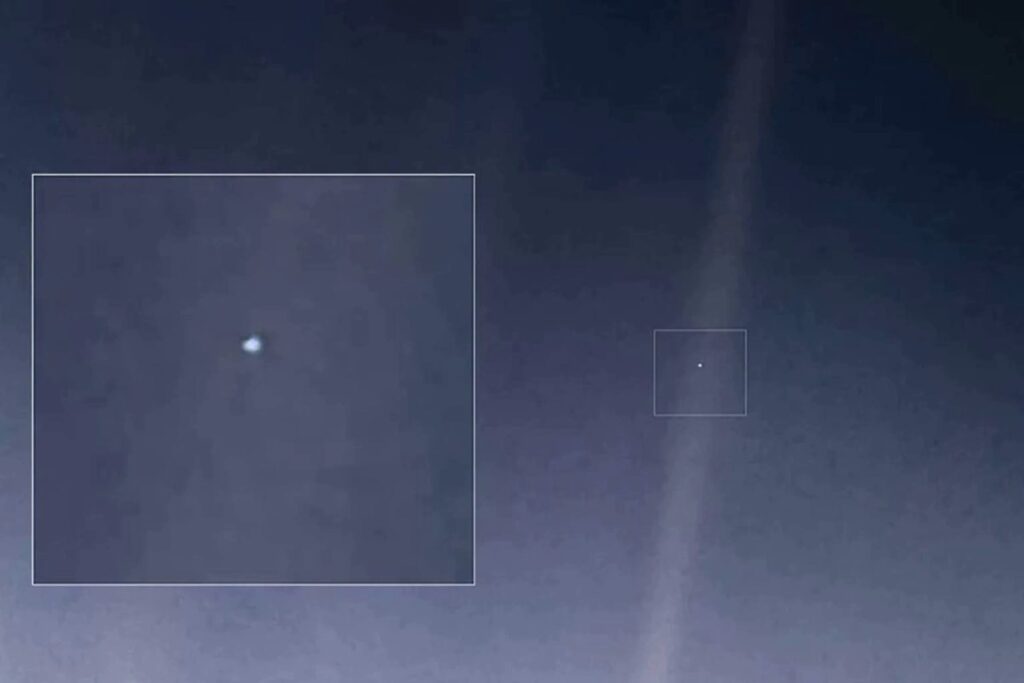
NASA’s Voyager 1 is about to achieve an extraordinary milestone in space exploration come November 2026. After nearly five decades of continuous travel, this tiny spacecraft will become the first human-made object to reach a distance from Earth that light itself takes a full day to cover—a staggering demonstration of both human ingenuity and the enormity of the cosmos.
This moment isn’t just about a number. It’s a testament to our relentless curiosity and the enduring quest to push beyond the confines of our solar system. Let’s delve into the incredible journey of Voyager 1 and explore what this monumental achievement signifies for humanity’s place in the universe.
The incredible voyage of Voyager 1 through interstellar space
Launched in 1977, Voyager 1 has been cruising through space for nearly 47 years, traveling a mind-boggling distance of almost 16 billion miles from Earth. This journey has already broken records—it was the first spacecraft to cross the heliopause, the boundary where the Sun’s solar wind yields to interstellar space. Now, it is on course to reach a distance known as a light-day, meaning the distance that light travels in 24 hours.
Traveling at about 38,000 miles per hour, Voyager 1’s progress may seem slow compared to light speed, but it reveals the vast scales of cosmic distance. Radio signals sent from the spacecraft take nearly 23 hours to reach Earth, which offers a glimpse into the immense challenges of communicating across these astronomical expanses.
On November 15, 2026, Voyager 1 will officially mark the milestone of being one light-day away from Earth. A couple of months later, it will be just as far from the Sun, highlighting our expanding cosmic footprint in the great void beyond our solar system.
NASA’s detailed overview of Voyager 1’s historic journey through interstellar space.
Why the speed of light remains unreachable for human spacecraft
Humans have long dreamed of traveling at the speed of light, the cosmic speed limit at approximately 670 million miles per hour. By comparison, the fastest human-crewed mission, Apollo 10, reached speeds close to 25,000 miles per hour, a record still unmatched today.
Despite Voyager’s impressive velocity, it will still take decades and even centuries to travel just a few light-years. To put this in perspective, light takes only about 8 minutes to reach Earth from the Sun, but even at Voyager’s speed, crossing that same distance would take over four and a half years. This vast disparity underscores why interstellar travel is such a profound challenge. A 2022 study published by the NASA Institute of Advanced Concepts confirms that new propulsion technologies will be essential to close the gap between human spacecraft speeds and the speed of light.
This reality is humbling; it places our cosmic ambitions into a patient, long-term framework. Voyager is a symbol of perseverance, still sending faint signals back decades after its mission began, reminding us of the power of sustained curiosity and endurance.
Defining the edge of the solar system: A cosmic boundary without clear lines
As Voyager 1 voyages further into the depths of space, it also challenges our understanding of where the solar system truly ends. Is it marked by the last planet, Neptune? Or perhaps the distant Oort Cloud—a spherical shell of icy objects influenced by the Sun’s gravity extending thousands of astronomical units away? Possibly, the boundary lies even farther, where the Sun’s gravitational influence roughly equals the pull of nearby stars.
NASA explains that the solar system’s outer limits are not a precise cutoff but an extensive transition zone. Voyager 1, moving relentlessly at over 35,000 miles per hour, will take nearly 40,000 years to reach the outermost gravitational boundary, located approximately two light-years away.
Understanding these boundaries deepens our appreciation for the sheer scale of our cosmic neighborhood and highlights how pioneering missions like Voyager lay the groundwork for the explorers who will journey beyond in the centuries to come.
The legacy of Voyager 1 and the future of space exploration
Voyager 1 embodies the spirit of exploration—a small probe launched in an era before smartphones or the internet, journeying into the unknown and continually expanding humanity’s horizons. Its golden record, containing sounds and images of Earth, symbolizes a message of peace and curiosity sent to the stars.
As it continues to sail through interstellar space, Voyager sparks profound questions about our future in space. Will humans ever develop technology capable of traveling faster than light? Or will the vastness of space forever keep us Earthbound? These questions inspire both scientists and dreamers alike.
Dr. Lisa Nguyen, an astrophysicist at the University of Arizona, remarked in a 2024 symposium that “Voyager’s enduring mission reminds us that patience and innovation are key to unlocking the mysteries of the universe.”
What message would you send to Voyager if you could reach it today? Do you believe humanity will someday overcome the cosmic speed barrier? Share your thoughts and stories below—your voice might inspire the next leap forward in our journey to the stars.
Your curiosity and engagement help keep the legacy of Voyager alive. Join the conversation, react, and share this story with space enthusiasts everywhere!