**First Light from Our New Remote Observatory in Australia: The Vela Supernova Remnant**
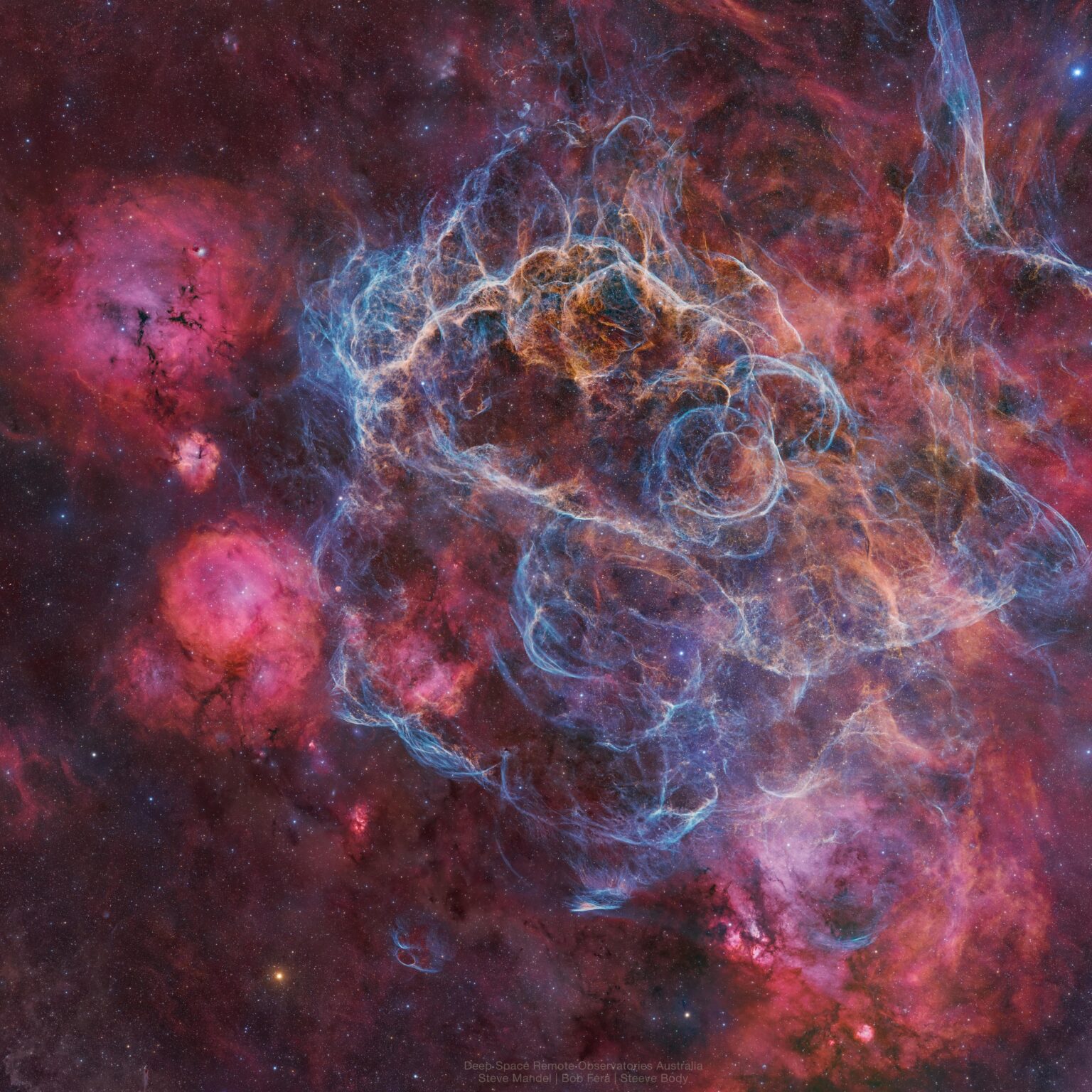
There’s something truly special about seeing the first deep-sky image emerge from a brand-new remote observatory. After months of planning, assembling, and fine-tuning, I’m thrilled to share the first major image from the **Swan Reach Imaging Remote Observatory**: a deep, high-resolution mosaic of the **Vela Supernova Remnant.**
With this milestone, I’m also excited to officially **join the DSRO Australian team**, working alongside **Steve Mandel and Bob Fera**. This marks the start of an exciting new chapter, with many more stunning deep-space images to come under the **DSRO Australia** name.
**The Observatory: A Game Changer**
Coming from **Melbourne’s Bortle 7 skies** (~40 usable nights a year) to **Bortle 1 conditions** with **2,900 hours of imaging time per year at f/3.6**, this observatory is a complete game changer for me. The level of faint detail and filamentary structures in this Vela dataset is unlike anything I’ve seen before.
**The Image: A Deep Look at Vela’s Cosmic Debris**
This **six-panel mosaic** captures the vast remains of a massive star that exploded **~11,000 years ago**. At **200 hours of total exposure**, this is likely one of the deepest and most detailed images of this region to date, and we’re planning to push it even further in the coming months (which probably means I’ll need a new computer just to process it!).
bsteeve_astro on
**Processing & Colour Mapping**
A lot of time was spent ensuring the **LRGB base image** looked natural and well-balanced before incorporating **narrowband data** to highlight fine structures:
🔴 **H-alph**a: Mapped mainly to red, with a slight blue blend for a pinkish-red hue.
🔵 **Oxygen II**I: Mapped to blue and green.
🟡 **Sulfur I**I: Mapped to both green and red to produce a natural yellow tone.
Rather than using a traditional **HOO or SHO palette**, this approach preserves emission line accuracy while keeping the **star colours natural** and visually engaging.
**The Setup & Collaboration**
This observatory wouldn’t exist without **Steve Mandel**, who brought me onboard and spearheaded **DSRO South** and this new **Swan Reach** expansion in South Australia. I designed and assembled this rig in December 2024, and after a short month of fine-tuning (and a few thousand km of driving), it’s now running flawlessly.
One of the biggest breakthroughs is the **Electronic Assisted Photon Cage**, which enables automated tilt correction—essential at f/3.6—eliminating a major headache in deep-sky imaging.
**Imaging Details**
• **Total Integration:** 200h
• **Optics:** f/3.6 system
• **Filters:** Antlia 3nm Narrowband + LRGB
• **Location:** Swan Reach, South Australia
bsteeve_astro on
🔗 **See the full high-resolution (18,000×18,000) image here**:

3 Comments
**First Light from Our New Remote Observatory in Australia: The Vela Supernova Remnant**
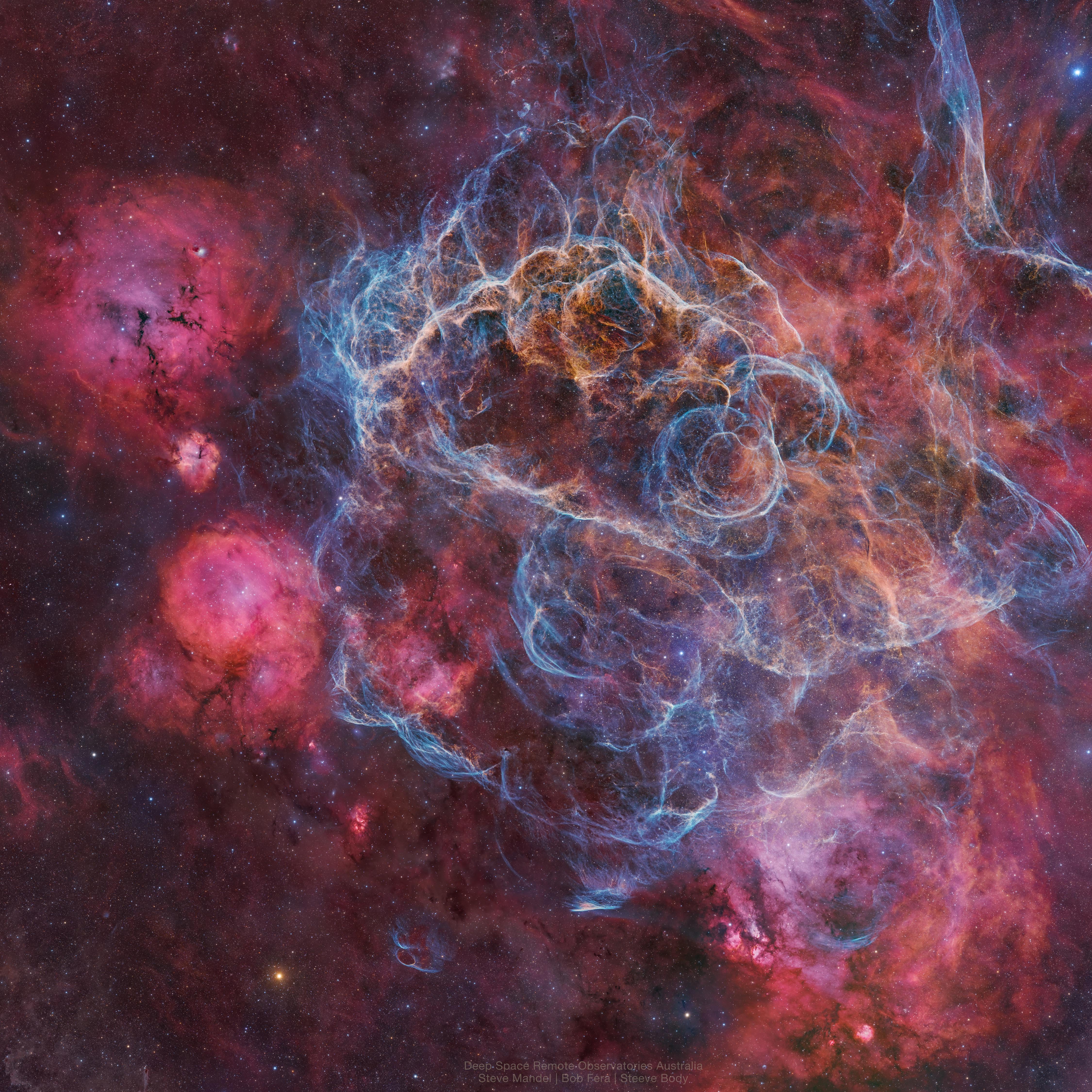
There’s something truly special about seeing the first deep-sky image emerge from a brand-new remote observatory. After months of planning, assembling, and fine-tuning, I’m thrilled to share the first major image from the **Swan Reach Imaging Remote Observatory**: a deep, high-resolution mosaic of the **Vela Supernova Remnant.**
With this milestone, I’m also excited to officially **join the DSRO Australian team**, working alongside **Steve Mandel and Bob Fera**. This marks the start of an exciting new chapter, with many more stunning deep-space images to come under the **DSRO Australia** name.
**The Observatory: A Game Changer**
Coming from **Melbourne’s Bortle 7 skies** (~40 usable nights a year) to **Bortle 1 conditions** with **2,900 hours of imaging time per year at f/3.6**, this observatory is a complete game changer for me. The level of faint detail and filamentary structures in this Vela dataset is unlike anything I’ve seen before.
**The Image: A Deep Look at Vela’s Cosmic Debris**
This **six-panel mosaic** captures the vast remains of a massive star that exploded **~11,000 years ago**. At **200 hours of total exposure**, this is likely one of the deepest and most detailed images of this region to date, and we’re planning to push it even further in the coming months (which probably means I’ll need a new computer just to process it!).
**Processing & Colour Mapping**
A lot of time was spent ensuring the **LRGB base image** looked natural and well-balanced before incorporating **narrowband data** to highlight fine structures:
🔴 **H-alph**a: Mapped mainly to red, with a slight blue blend for a pinkish-red hue.
🔵 **Oxygen II**I: Mapped to blue and green.
🟡 **Sulfur I**I: Mapped to both green and red to produce a natural yellow tone.
Rather than using a traditional **HOO or SHO palette**, this approach preserves emission line accuracy while keeping the **star colours natural** and visually engaging.
**The Setup & Collaboration**
This observatory wouldn’t exist without **Steve Mandel**, who brought me onboard and spearheaded **DSRO South** and this new **Swan Reach** expansion in South Australia. I designed and assembled this rig in December 2024, and after a short month of fine-tuning (and a few thousand km of driving), it’s now running flawlessly.
One of the biggest breakthroughs is the **Electronic Assisted Photon Cage**, which enables automated tilt correction—essential at f/3.6—eliminating a major headache in deep-sky imaging.
**Imaging Details**
• **Total Integration:** 200h
• **Optics:** f/3.6 system
• **Filters:** Antlia 3nm Narrowband + LRGB
• **Location:** Swan Reach, South Australia
🔗 **See the full high-resolution (18,000×18,000) image here**:
[https://steevebody.com/portfolio/the-vela-supernova-remnant/](https://steevebody.com/portfolio/the-vela-supernova-remnant/)
This is just the beginning—many more images to come! Let me know what you think! 🚀🔭