
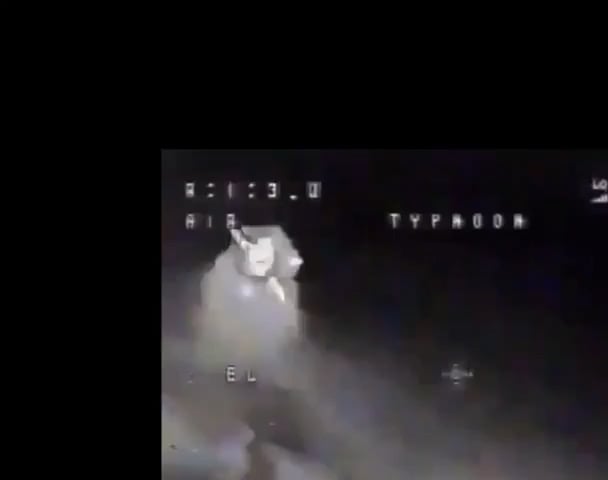
A visual anomaly that was observed by a few users in the original post's discussion, but with no conclusion so far that I could find.
As per this cropped clip – you can see the drone correcting roll with the horizon after turning toward the UAP, but the features (6 protruding spikes from the central rounded structure) always aligns to the roll angle of the drone. Notice how the horizon changes, but the object stays exactly aligned to the camera angle.
Is the UAP rolling with the drone as it corrects? Are the features on the UAP a side effect of the technology used to capture the video feed (blooming/flaring? Or is this a fingerprint of manual retroactive insertion of the object into the video feed?
To be clear, I'm not advocating for the video being fake, Just want to bring to light an observation that was made.
by _verniel
9 Comments
Submission statement: Anomalous roll alignment of the Ukrainian UAP drone footage to that of the drones’, and questions around whether this is an artefact of the video capture technology.
A good angle for sure. Not sure what that is, but the fact it rolls with the camera is very, very interesting.
It might be that the bright star shaped points are some kind of reflection or light artifact but the round object that the six spikes appear to coming out of is the actual shape of the uap. it might be a sphere.
I think the “spikes” are just some type of star bloom effect, ether from something very hot or bright. Not sure how these types of sensors and lenses function, but the most reasonable explanation for why the spikes stay aligned to the camera is that they are just a star bloom effect and aren’t physical at all. This also explains why they are perfectly symmetrical.
It does appear to be a stationary, hot, bright object forcing heat downward though.
People keep ignoring this and it’s driving me crazy lol I’m worried we are being set up on purpose to be embarrassed, everyone comparing this to biblical angels, completely buying in and then it will be pointed out this is human tech
It looks like the spikes are some kind of lens flare / diffraction lines like everyone has been saying! However the plume of hot air / gas / exhaust (no way to tell what it is except it’s hotter than the surrounding air) seems to be coming off the bottom of the object. You can see that it consistently flows down towards the horizon and doesn’t not follow the rotation of the spikes / fpv drone. I wonder what the actual shape of the object is, it looks like a sphere but I feel like there’s not enough footage from different angles to know for sure.
The theory of a bullet hole, on the outer glass, that hit the battery, creating off gassing and low battery notification, makes the most sense.
**I hate to say this, but guys, this is most likely AI. The horizontal scan lines and static give it away.**
**What caused lines and static in analog footage:**
Analog video worked by encoding image information as a continuous electrical signal. Several physical phenomena caused the artifacts you’re describing:
Horizontal scan lines — Analog CRT cameras and TVs built images by scanning an electron beam across the screen line by line (interlacing). Electrical interference, weak signal, or magnetic fields near the camera head could disrupt individual scan lines, causing them to shift, brighten, or drop out entirely.
Tape degradation — VHS and other magnetic tape formats stored video as magnetic patterns on a physical medium. Over time, the magnetic coating flakes off, stretches unevenly, or demagnetizes in patches, causing dropout artifacts — those brief horizontal white or colored streaks.
Head clog/wear — The spinning read/write heads that contacted the tape would accumulate debris or wear unevenly, producing bands of static or complete line loss in periodic patterns tied to the head rotation speed.
RF interference — Analog signals were vulnerable to electromagnetic interference from nearby electronics, power lines, or radio frequencies, which superimposed noise onto the signal in real time.
Sync signal corruption — Analog video depended on precise timing pulses to keep the image stable. When those sync signals degraded, the image would roll, tear, or display diagonal banding.
**Can modern digital cameras do this?**
**Essentially no** — not in the way analog did. Digital sensors capture discrete pixel values and encode them mathematically. There’s no scan line electron beam, no magnetic tape head, no analog signal chain to corrupt. Digital artifacts look completely different: compression blocking, pixel freezing, color channel errors, or dropped frames. They do not produce the smooth, drifting, organic-looking horizontal interference lines that analog did.
The only partial exceptions would be a failing HDMI/SDI cable between a camera and a recorder introducing signal corruption, or a genuinely broken sensor with stuck rows — but these look harsh and inconsistent, not like the “atmospheric” analog noise pattern you’re describing.
AI adds these in to make things seem more authentic, because old analog footage recorded on old and poor genuinely had a lot of this.
ITS JUST A BRIGHT LIGHT!!!!!!