
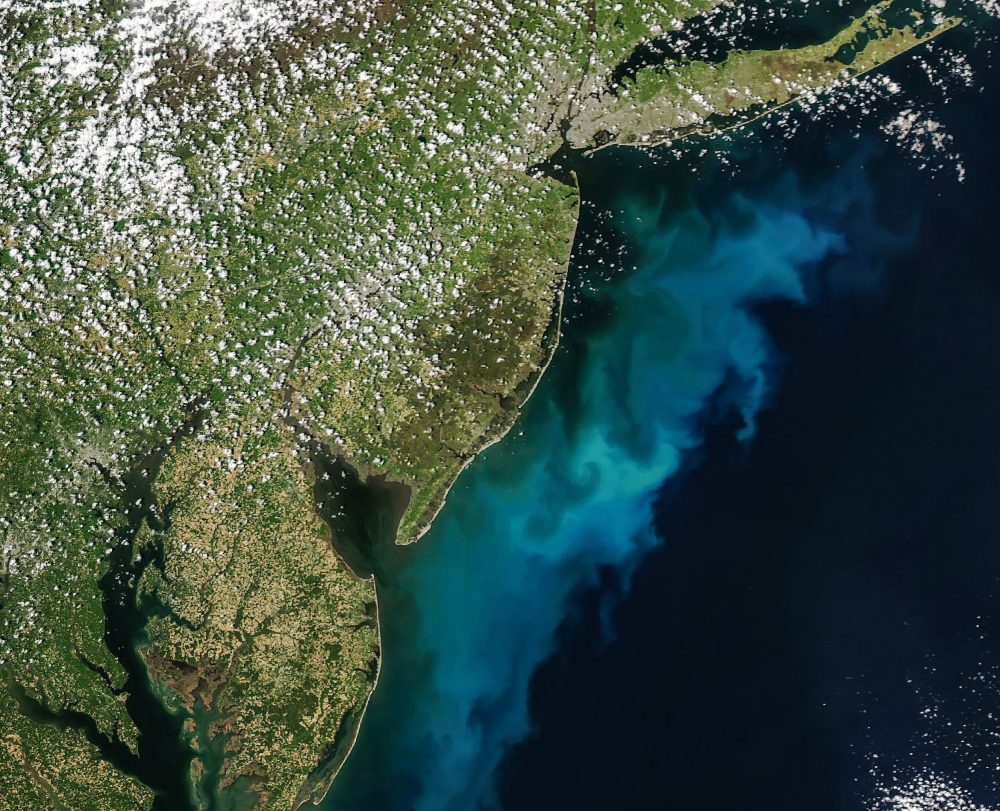
Today’s Image of the Day from NASA Earth Observatory features unusual colors stretching along the Mid-Atlantic coast.
Brown, green, and bright turquoise water spread offshore from New Jersey down past Virginia.
The patterns are so vivid they almost look painted onto the Atlantic.
What’s driving the changes
The colors first appeared in satellite data in early April. They gathered most strongly where the waters of Raritan Bay, Delaware Bay, and Chesapeake Bay meet the ocean in a region known as the Mid-Atlantic Bight.
Scientists quickly recognized that several things were happening at once beneath the surface.
Some of the discoloration came from rivers carrying sediment into coastal waters after spring storms.
But another process was unfolding too. Massive blooms of microscopic marine organisms had begun spreading across the region.
A difficult place to study
Coastal waters are challenging to study compared to the open ocean.
Rivers dump mud, nutrients, and runoff into shallow areas already filled with seagrass beds, sandbars, and changing currents.
That makes it difficult for satellites to separate one signal from another.
Scientists who study ocean color often describe these areas as noisy or dirty because so many different materials affect the way light reflects off the water.
For years, that optical clutter made it hard to identify exactly which kinds of phytoplankton were blooming near the coast.
That situation has started to change with newer satellite technology.
NASA’s PACE mission, launched in 2024, can measure many more wavelengths of light than older ocean-observing satellites.
That added detail is helping researchers distinguish different types of phytoplankton even in visually complex coastal waters.
Multiple NASA satellites, including PACE, Aqua, and Terra, captured the recent Mid-Atlantic event.
The data revealed signatures linked to chlorophyll, a key sign that phytoplankton blooms were active offshore.
“There are likely phytoplankton blooms happening,” said Anna Windle, a research scientist at NASA’s Goddard Space Flight Center.
“Diatoms typically dominate blooms early in the spring, but we are seeing some signs of coccolithophores mixed in as well.”
The role of ocean churning
The greenish areas seen in satellite images are likely tied to diatoms, one of the most important groups of phytoplankton in the ocean.
Diatoms thrive in spring because winter weather leaves surface waters packed with nutrients.
Cold-season winds churn the ocean vertically, pulling nitrogen and phosphorus toward the surface.
Longer daylight hours then provide the energy phytoplankton need to grow rapidly.
Diatoms can multiply explosively under those conditions. Entire blooms can spread across huge stretches of coastline within days.
In satellite imagery, they often give the water a cloudy green appearance.
The reflection of sunlight
The brighter turquoise colors likely point to coccolithophores, another type of microscopic marine organism.
These tiny plant-like life forms surround themselves with calcite plates called coccoliths, which strongly reflect sunlight back toward satellites.
That reflection creates the milky blue color visible from space.
Though each coccolith is only a few thousandths of a millimeter thick, the organisms appear in such enormous numbers during blooms that they become visible from orbit.
Scientists estimate coccolithophores are responsible for about half of the modern precipitation of calcium carbonate in the ocean.
That makes them an important part of Earth’s carbon cycle.
Tiny organisms with a massive role
Phytoplankton may be microscopic, but they sit near the foundation of marine life. They function much like grasses and ground cover on land, forming the base of the ocean food web.
Small fish feed on phytoplankton directly. Larger fish then feed on smaller species, linking phytoplankton to nearly every marine ecosystem.
These organisms also play a major role in regulating carbon. Through photosynthesis, phytoplankton absorb carbon dioxide while producing oxygen and organic matter.
Some of that carbon eventually sinks into deeper ocean layers when the organisms die.
A seasonal pattern
Spring blooms are especially important because they represent one of the most productive periods of the year in many coastal oceans.
“But over time, as big spring phytoplankton blooms grow, they deplete the nutrients,” said Rutgers University oceanographer Oscar Schofield.
“Unless big river outflows or storms replenish the nutrients, we’ll likely see this bloom start to decline in the coming weeks.”
That seasonal rise and fall is normal. Blooms expand rapidly when nutrients are abundant, then fade once those supplies begin running low.
Scientists are watching closely because better satellite observations could improve understanding of fisheries, coastal ecosystems, and carbon cycling.
The new generation of satellites is also giving researchers a clearer picture of how ocean biology changes from season to season.
Image Credit: NASA Earth Observatory
—–
Like what you read? Subscribe to our newsletter for engaging articles, exclusive content, and the latest updates.
Check us out on EarthSnap, a free app brought to you by Eric Ralls and Earth.com.
—–