
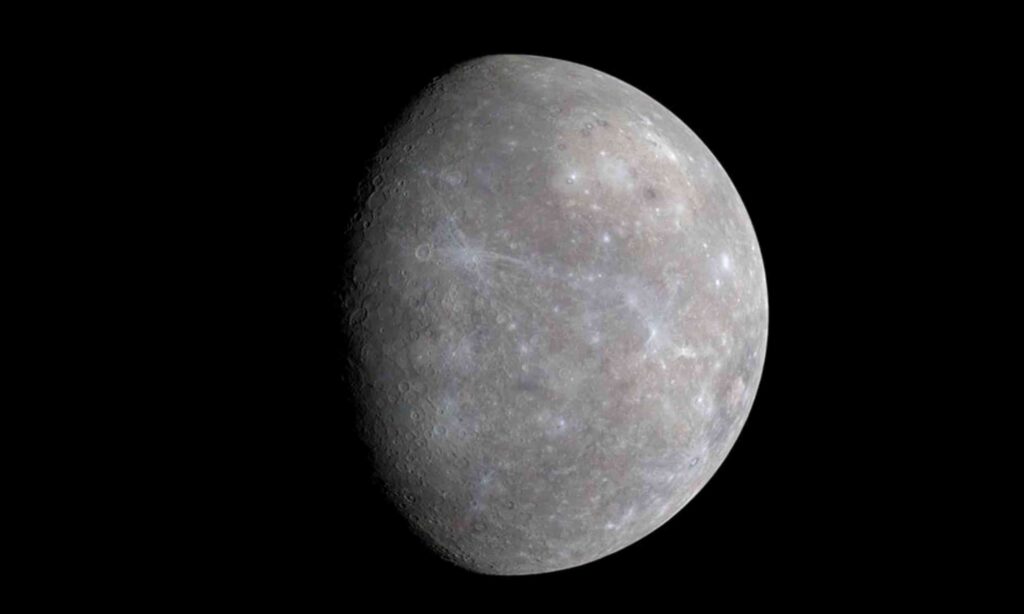
Webb has found that a nearby rocky exoplanet is dark, without atmosphere, and coated in material more like Mercury’s surface than Earth’s crust.
The discovery gives astronomers a rare surface-level clue to how rocky worlds outside our solar system age, dry out, and lose their atmosphere.
An exoplanet under glare

Evidence comes from LHS 3844 b – a rocky planet that is about 30 percent wider than Earth, 48.5 light-years away, and trapped in an 11-hour orbit around its star.
By reading the exoplanet’s heat, Sebastian Zieba, Ph.D., at the Center for Astrophysics | Harvard & Smithsonian showed that the glow fits dark rock rather than Earth-like crust.
Fresh powder would have looked brighter, while older surface material that is darkened by radiation and impacts still fits the signal.
That match leaves scientists with a sharper puzzle: whether Webb is seeing young solid rock or older ground that has been worn down by space.
Exoplanet’s heat becomes evidence
Webb did not photograph the planet’s surface. Instead, astronomers measured the tiny light drop when the planet slipped behind its star, separating the star’s steady glow from the planet’s hot dayside.
The Max Planck Institute for Astronomy (MPIA) in Heidelberg, Germany, helped frame the heat as surface evidence rather than a hunt only for atmosphere.
“We see a dark, hot, barren rock, devoid of any atmosphere,” said Laura Kreidberg, Ph.D., director at the Max Planck Institute for Astronomy.
Why Earth comparison fails
Earth’s continents carry silica, which is silicon and oxygen bound into rock, in minerals that help make granite-rich crust light in color.
Building that kind of crust usually takes water and plate tectonics – moving crustal plates that recycle rock through melting and cooling.
Webb’s signal ruled out a similar crust, so the exoplanet does not look like a bigger Earth that has been stripped down to bedrock.
“This planet likely only contains little water,” said Zieba.
Two rocky possibilities
The best fits split into two explanations for the same dark signal. One option is basalt, a dark volcanic rock that is rich in iron and magnesium, and is spread across broad areas by relatively recent eruptions.
Older, broken material could also work if it has sat exposed long enough for radiation and impacts to change its color and texture.
Both possibilities hide fine details in the current signal, so the surface’s age remains the hard part.
Weather makes darkness
In the absence of an atmosphere, rock does not stay fresh for long. Space weathering – damage from radiation and tiny impacts – breaks hard rock into grit and changes its surface chemistry.
Over time, the loose layer becomes regolith, which is fine dust and broken rock, like the material on the surface of the Moon.
That darkening matters because fresh powder looked too bright in the calculations, while weathered powder could match Webb’s dim signal.
Exoplanet’s missing volcanic gases
Earlier measurements had already ruled out a thick atmosphere, so the new gas search sharpened an older picture.
Recent eruptions should have left gases above the hot surface, because molten rock releases trapped chemicals as it rises and cools.
Sulfur dioxide, a common volcanic gas, did not show up at levels above 10 microbars, a pressure far thinner than Earth’s air.
Carbon dioxide stayed below 100 millibars, about one-tenth of Earth’s sea-level air pressure, so an old weathered surface fits better than a recently gassy one.
Mercury offers context
Mercury is the comparison because it is rocky, cratered, and has no thick atmosphere to cushion meteor hits.
Similarity does not make LHS 3844 b Mercury’s twin; it means both worlds may have changed in the same basic way when bare rock met impacts and radiation.
LHS 3844 b orbits so close to its star that one side stays in permanent daylight near 1,340°F (727°C).
Comparison gives readers a familiar reference point, while the evidence still points to an alien world with its own heat and history.
Webb reads surfaces
Surface geology this far away depends on heat, not pictures. The Mid-Infrared Instrument – Webb’s tool for warm infrared light – split the dayside glow into small wavelength pieces.
A spectrum, which sorts brightness by wavelength, can reveal texture and minerals because different rocks absorb and emit heat in different patterns.
Models compared those patterns with rock libraries from Earth, the Moon, and Mars, then rejected fresh fine powders because they appeared too bright.
Next observations matter
New Webb observations aim at the solid-or-loose surface problem. Solid rock and loose grains send heat back to space at slightly different angles, because rough surfaces scatter and emit light unevenly.
Scientists already use that behavior to study asteroids, which are small rocky bodies orbiting the sun.
Applied to LHS 3844 b, the same idea could separate an active rocky crust from an ancient, weathered layer.
What comes next
Webb’s result narrows one nearby world to a dark surface where atmosphere, water, plate recycling, and fresh volcanism all look limited.
Future measurements can test whether the ground is solid rock or weathered grit, and that same approach may sort other hot rocky planets by active interiors, dead crusts, or thin traces of atmosphere.
The study is published in Nature Astronomy.
—–
Like what you read? Subscribe to our newsletter for engaging articles, exclusive content, and the latest updates.
Check us out on EarthSnap, a free app brought to you by Eric Ralls and Earth.com.
—–