
Back to Article List
Now 15th magnitude, the comet is well-positioned for observation late overnight and into the early-morning hours.
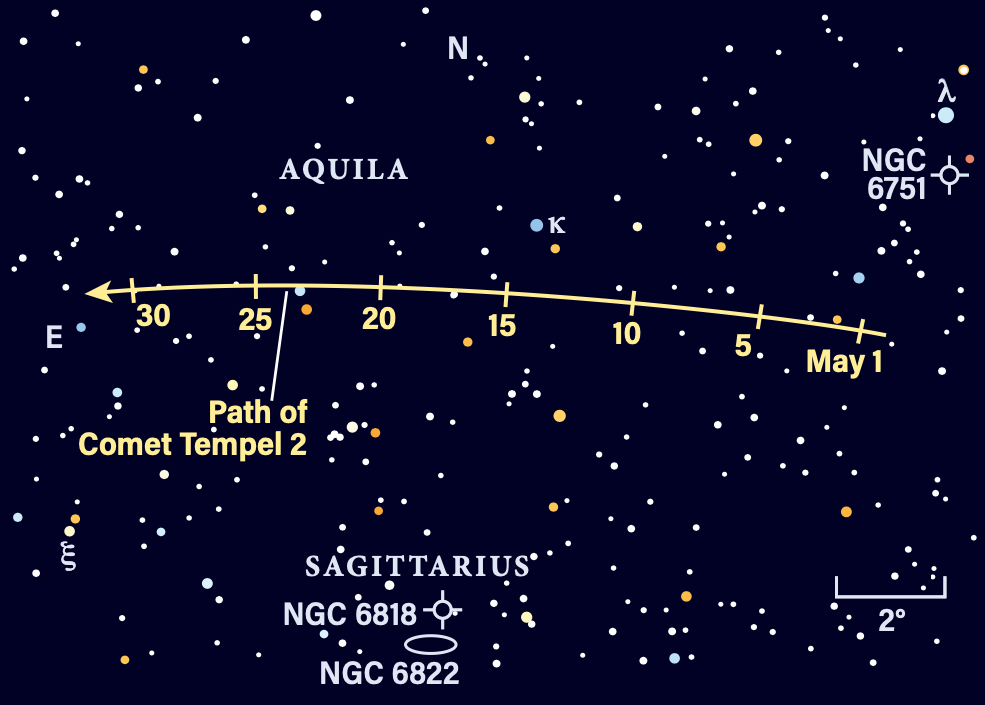
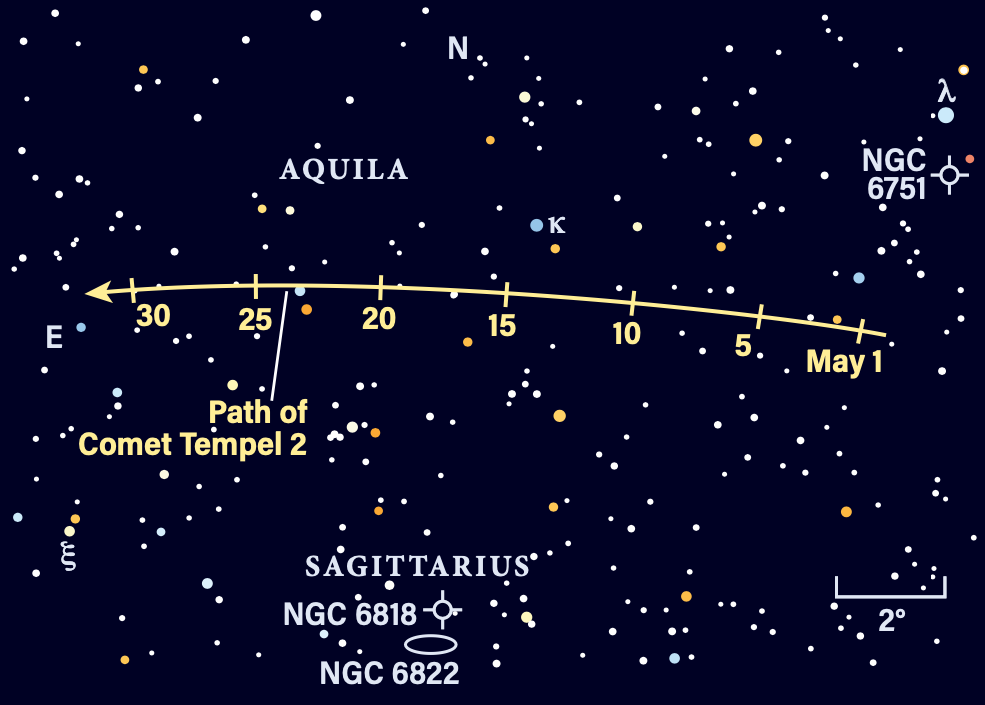
Comet Tempel 2 is passing through the rich star fields of southern Aquila this month. The Sagittarius Teapot and NGC 6638 lie southwest of the region shown here, while northwestern Capricornus is at lower left. Credit: Astronomy: Roen Kelly
Looking for a sky event this week? Check out our full Sky This Week column.
May 9: Look the croc in the eye
Although still best for experienced observers with larger scopes, Comet 10P/Tempel (also called Tempel 2) is quickly brightening. Glowing at roughly magnitude 15, Tempel 2 is currently in Aquila the Eagle, rising late in the evening and gaining altitude overnight. The best time to observe it is a couple of hours after midnight; it reaches 20° above the southeastern horizon by 2 A.M. local daylight time.
If you’ve got country-dark skies, a 4- to 6-inch scope will net you a view. Under brighter skies, go larger. The easiest way to find the comet right now is to start at Lambda (λ) Aquilae, the 3rd-magnitude star marking the Eagle’s tail. From here, slide about 6.5° southeast to find the comet. This icy, faraway fuzzball may appear lopsided, as solar radiation pushes on dust liberated from the nucleus as the comet sails toward the Sun.
Compare Tempel 2’s appearance to 9th-magnitude NGC 6638, located in nearby Sagittarius. You can find this globular cluster just 0.7° southeast of Lambda Sagittarii, the lid of the Teapot asterism. By contrast, the globular should look rounder and more symmetrical than the comet.
Tempel 2 is expected to reach 8th magnitude this summer, so keep an eye out and watch its progress!
Sunrise: 5:50 A.M.
Sunset: 8:04 P.M.
Moonrise: 2:26 A.M.
Moonset: 1:15 P.M.
Moon Phase: Waning crescent (38%)
*Times for sunrise, sunset, moonrise, and moonset are given in local time from 40° N 90° W. The Moon’s illumination is given at 10 P.M. local time from the same location.