
Europe’s First Reusable Spacecraft Prepares for Launch
Before Europe’s first reusable spacecraft, Space Rider, can embark on its first mission to low Earth orbit, the European Space Agency (ESA) must first test the most challenging stages of its return to Earth. In particular, engineers need to verify how the spacecraft will withstand high temperatures during atmospheric re-entry and how it will execute a precise landing. Engineers have subjected the spacecraft’s thermal protection system to extreme conditions and have completed the assembly of a full-scale prototype for landing tests. These actions by ESA indicate that Space Rider is actively being prepared for its first flight, which is scheduled to take place at the end of this decade, writes [Focus](https://focus.ua/technologies/753297-space-rider-pervyy-mnogorazovyy-kosmicheskiy-korabl-evropy-gotovitsya-k-zapusku-video).
Engineers have subjected the spacecraft’s thermal protection system to extreme conditions and have completed the assembly of a full-scale prototype for landing tests. Space Rider is an unmanned reusable spacecraft that serves as a scientific laboratory, capable of staying in low Earth orbit for about two months before landing. After this, the spacecraft can be reused. ESA does not have a similar spacecraft, making Space Rider the first of its kind.
Space Rider uses a controlled parachute for landing and lands like an airplane on a runway, but it will be launched into space by a launch vehicle.
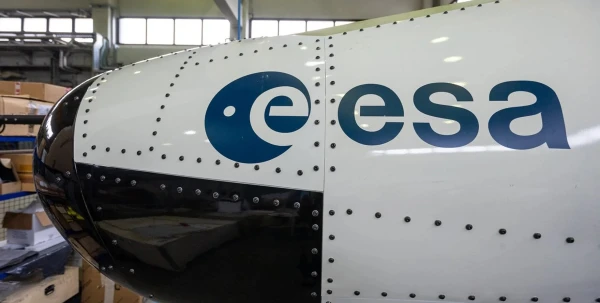
For the landing test, ESA engineers created a full-scale model that can autonomously control the parachute after deployment. The prototype is equipped with onboard software for navigation and control, which will actively manage the descent during the test. It is scheduled for late 2026, when the Space Rider prototype will be dropped several times from a helicopter over the Italian island of Sardinia.
This test will not simulate atmospheric entry. However, engineers are preparing for that as well. Any spacecraft returning from space enters the atmosphere at speeds exceeding 27,000 km/h. At such speeds, particles in the upper layers of the atmosphere collide with spacecraft with such intensity that heat accumulates due to friction – gases become ionized, and all spacecraft are enveloped in a burning ball of plasma with temperatures exceeding 1,600 degrees Celsius.
ESA engineers have tested the thermal protection system of Space Rider to ensure it can withstand atmospheric entry in a plasma wind tunnel in Italy, exposing materials to temperatures around 1,600 degrees Celsius.
The Space Rider prototype has so far shown excellent test results, ESA stated.