By Avesta Afshari-Mehr
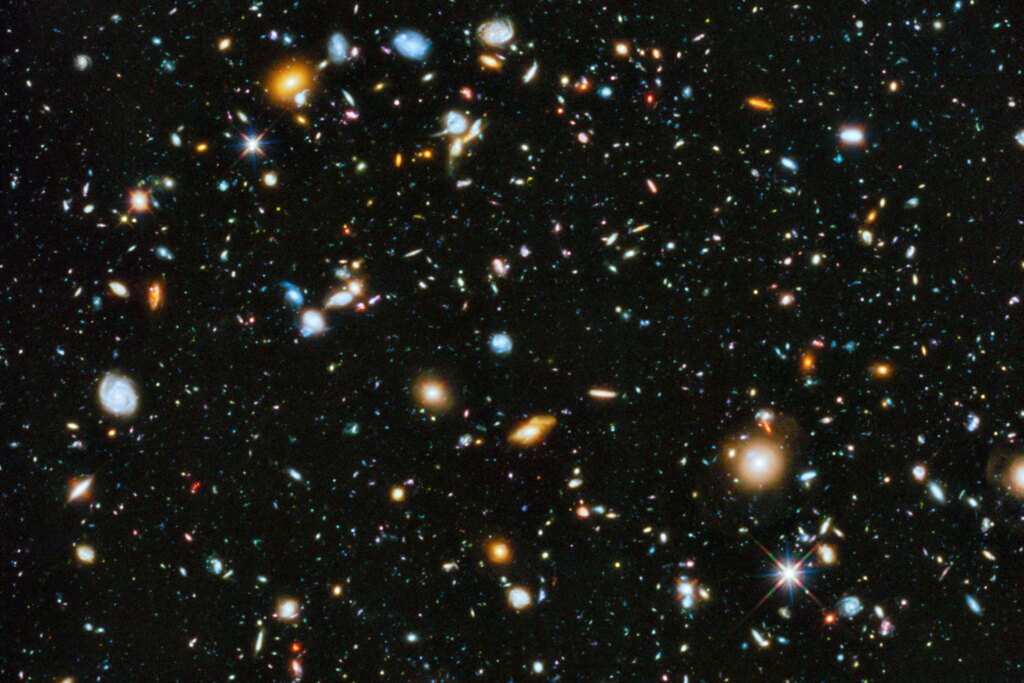
What determined whether the first galaxies in our universe lit up with stars, or remained forever dark?
New supercomputer-based research from Durham University’s Department of Physics suggests the answer may lie in something deceptively subtle: radiation. Using cutting-edge, high-resolution simulations, researchers have found that the smallest galaxies (known as ultra-faint dwarf galaxies) are far more sensitive to radiation in the early universe than their larger counterparts. These faint, often overlooked systems may hold the key to understanding why the Universe looks the way it does today.
The study focused on the earliest stages of cosmic history, when the universe was less than 500 million years old; a fraction of its current age of around 13 billion years. During this period, the first structures were beginning to form within dark matter haloes, dense regions that act as the gravitational scaffolding for galaxies. By altering radiation levels in their simulations, Durham researchers were able to observe how these early environments influenced galaxy formation. What they found was striking; while larger galaxies, like our own Milky Way, were largely unaffected by changes in radiation, the smallest systems were extremely vulnerable. In these ultra-faint galaxies, even slight variations in radiation could determine their entire fate. Some haloes managed to form stars and become visible galaxies. Others failed entirely, remaining as invisible clumps of dark matter with no stellar light. This sensitivity offers a powerful insight into the early universe. It suggests that galaxy formation was not simply a matter of size or mass, but of environmental conditions. Two seemingly similar regions could evolve in completely different ways depending on the radiation surrounding them. In other words, the early universe may have been far less uniform than previously thought.
In these ultra-faint galaxies, even slight variations in radiation could determine their entire fate
These findings open up new possibilities for understanding cosmic evolution. If ultra-faint galaxies are so strongly shaped by early radiation, then studying them today could provide a kind of “fossil record” of those ancient conditions. By examining which galaxies formed stars and which did not, scientists can begin to reconstruct the invisible forces that influenced their development billions of years ago. This further helps address that longstanding question we’re all much too familiar with within the realms of astrophysics: why do some galaxies grow into large, luminous systems while others remain small and faint (or never even form at all)? The answer, it seems, may lie not just in their initial mass, but in the timing and intensity of radiation during their earliest stages.
However, as with all simulations, the next step is verification. This is where future observations come in: particularly from the Vera C. Rubin Observatory in Chile. Equipped with one of the most powerful survey telescopes ever built, the Rubin Observatory is expected to dramatically expand the number of known ultra-faint dwarf galaxies orbiting the Milky Way. At present, only a limited number of these galaxies have been detected, largely because of how dim and diffuse they are. Rubin’s capacity to scan large areas of the sky with unprecedented sensitivity will allow astronomers to identify many more of these elusive systems. This is crucial. The more ultra-faint galaxies we can observe, the better we can test the predictions made by Durham’s simulations. If the real universe shows the same patterns, with smaller galaxies displaying clear signs of sensitivity to early radiation, it would provide strong support for the model. Conversely, if observations reveal discrepancies, it may indicate that other factors are at play, prompting further refinement of our understanding.
But what makes this research particularly exciting is its local relevance. Rather than looking billions of light-years away, scientists are studying galaxies in our own cosmic neighbourhood: satellites orbiting the Milky Way. Yet these nearby systems carry information about events that occurred near the dawn of time. It is a reminder that the universe’s history is not only written in distant light, but also in the faintest structures close to home. In the coming years, as new data from observatories like Rubin becomes available, researchers will be able to test these ideas with increasing precision. Each newly discovered ultra-faint galaxy will add another piece to the puzzle. Through this, we may begin to answer one of the most fundamental questions in cosmology: why did some parts of the universe ignite with stars, while others remained forever in the dark?
Image Credit: NASA and ESA via Wikimedia Commons