

–
Senior Staff Writer
·
May 7, 2026
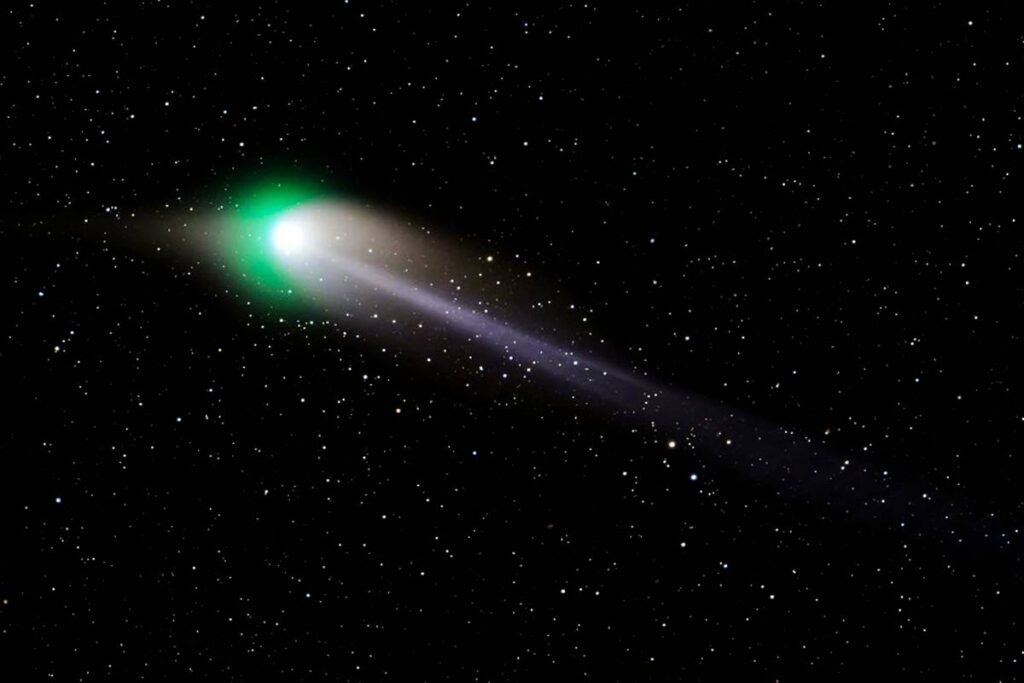
After the stunning Eta Aquariids meteor shower and May’s Flower Moon lit up skies in recent weeks, another celestial event could light up the skies across Australia. A rare blue-green comet is currently passing through Australian skies, giving stargazers a short window to catch a glimpse before it disappears back into deep space. Known as C/2025 R3 PanSTARRS, the comet has already been spotted across parts of Europe and North America before recently swinging into view from Australia. It’s expected to remain visible for only a short period after sunset over the coming days, with astronomers describing it as a potential once-in-a-lifetime viewing opportunity for southern hemisphere skywatchers. Here’s everything you need to know.
What is Comet C/2025 R3 PanSTARRS
C/2025 R3 PanSTARRS was first discovered in late 2025 and is believed to have originated from the distant Oort Cloud, a vast region of icy objects at the outer edge of the solar system. Astronomers estimate the comet takes around 170,000 years to orbit the sun, meaning this could be the only chance in a lifetime to see it from Earth. Its distinctive blue-green colour is created by gases released as the comet heats up while passing through the inner solar system.
Where and when to spot the rare comet in NSW and Australia
The comet is best viewed shortly after sunset by looking towards the western horizon once the sky is properly dark. Unlike bright planets or the moon, the comet is expected to appear more like a faint glowing blur, so binoculars or a small telescope would offer the best chance of spotting its tail.
Stargazers hoping for a clearer view are likely to have better luck in areas with minimal light pollution and an open horizon, such as beaches, lookouts or open parkland away from dense city areas. The comet is expected to remain visible until around May 10 before fading from view.
In NSW, dark sky locations away from the CBD are likely to offer the best chances to view the comet. Areas around the Blue Mountains, Palm Beach headland right here in Sydney and regional dark-sky destinations like Warrumbungle National Park are among the more reliable options, particularly on clear evenings with low cloud cover. Coastal lookouts with open views towards the western horizon may also improve visibility.
Live tracking and visibility updates for C/2025 R3 PanSTARRS are also available through astronomy platforms like The Sky Live and NASA’s small-body database.