
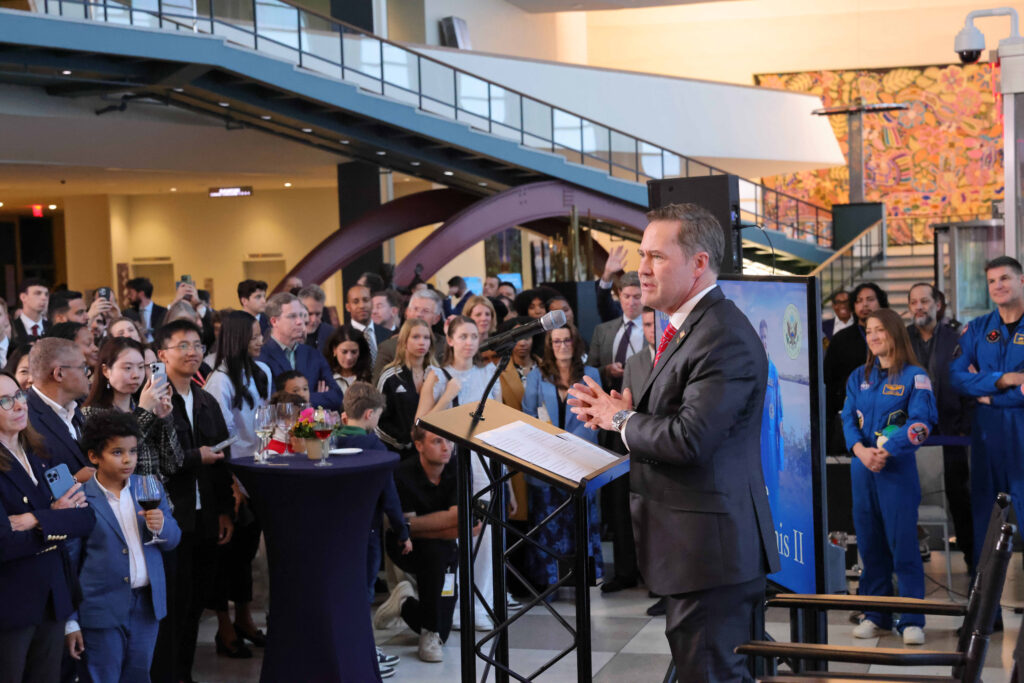
Ambassador Mike Waltz
U.S. Representative to the United Nations
New York, New York
AS DELIVERED
Well, welcome everyone. We’re so excited. I think. Are we a little bit excited? We’re so excited to have you here, Administrator Isaacman. Jared Isaacman, thank you for being here, and thanks for bringing the incredible Artemis II crew.
It is truly such an honor to have you here. It is, you know, it’s hard to describe the courage, the boldness, the fact that you guys competed to do this, and how just three—had the opportunity to talk to everyone on the way here—I mean, three kind of pretty normal, but pretty overachieving Americans and a Canadian can execute this mission.
I was just telling them, a lot of us have done some hard things. I have a very secret ambition that is now going to be not so secret, to be the first Green Beret in space. There we go. It can happen. And maybe, if we really think big, we could have our first Security Council meeting in space 200,000 miles above the Earth.
But all jokes aside, these four great individuals just showed the world what we can do when we truly put our minds to it, and what we’re capable of doing when we, as President Kennedy, said, we don’t do things because they’re easy. We do things, great things, because they’re hard.
I want to take a minute and also thank our European partners—including many of you who are in this room—The European Space Agency contributed to the Orion service and life support module that kept everyone safe and healthy. So, thank you.
Artemis II also carried scientific and technology payloads from Argentina, the Republic of Korea, the Kingdom of Saudi Arabia, and Germany. And all of this was supported by communications dishes and other ground equipment in Australia and Spain, just like during the Apollo missions.
So, as NASA accelerates the pace of its lunar missions—and Jared, they’re going to be going faster and faster, right? All right. As we head back to the moon, it has welcomed all kinds of new payloads and contributions from the private sector, as well as all of our international partners.
So, I for one—and I know many Americans here—we’re tired of hearing that the moon was out of reach when we first landed there a half century ago. And in fact, I can tell you that never sat well with President Trump. I’ll never forget joining him for the Falcon 9 launch at the Kennedy Space Center. If you remember that, just five years ago, in my old congressional district, it was the first manned space launch on American soil on a private sector rocket with two colonels—they were Air Force and Marines, but that’s okay, Colonels Bob and Doug. There you go. Oorah—in nearly a decade. And just like with Artemis II, a lot was riding on its success.
Since the retirement of the space shuttle, we had been reliant on other countries to get people back up in space. So, the President came, and I just want to share this with you for a moment, and then I’ll shut up and let you hear from who you really want to hear from.
But this is the power of what they just did, and what happened even then, when President Trump came, then in 2020, actually the launch was called off with 15 seconds to go. He immediately turned to then NASA Administrator, Bridenstine, and said, when are we going again? And came back the next week.
And in the meantime, in between that time, sadly and tragically, George Floyd was killed, and the nation erupted in unrest. But in the middle of that unrest, when we went for that second launch, watching those two colonels go back up into space from American soil, the entire country stopped and paused and came together and cheered those two colonels on.
And that is what I love about the space program, in that it unifies us. There are no partisans in space. Heck, I think, as you’ll hear tonight, as they were looking back on the world, we are all fellow human beings, and we all have a shared humanity.
I’ll tell you, with this new space economy, this is what I’m so excited about in that we now have, I mean, it’s incredible. We have privatized space stations underway. We have a company that is slinging small satellites into space and conducting pharmaceutical experiments and zero gravity. We have limbs being grown. You know, the biggest impediment to if someone needs a piece of a spine because they’ve been paralyzed or what have you, is gravity, and now that is happening, and those experiments are happening up in space. Even 3D printing that we’re going to see when our base is on the moon, very soon.
So this new space economy is like the beginning of the internet, that really, truly, I think, the world and the universe sits before us. I just have one more thing before I hand it over, Victor, if you’ll come up here. One more thing before I hand it over to our 15th NASA Administrator.
Today, is Victor Glover’s 50th birthday. So, I’m really gonna embarrass the hell out of him. Will you join me in a birthday song to Victor? Ready? [Song]
All right. Okay. With that, our 15th NASA Administrator, the great Jared Isaacman.
###