
Our Milky Way is a true cosmic predator. It acquired its current form by gradually absorbing smaller neighboring galaxies and merging with them. Astronomers have learned to identify these “alien” stars by their strange, elongated orbits and their lack of heavy chemical elements.
 Illustration of the Milky Way devouring the dwarf galaxy Loki billions of years ago. Created by Copilot AI
According to a recent report in the journal Monthly Notices of the Royal Astronomical Society, scientists have discovered a unique group of 20 stars. According to their calculations, all of them are remnants of an ancient dwarf galaxy they have named “Loki.” It became one of the Milky Way’s first “victims” at the dawn of its evolution.
The “building blocks” of the universe
The first stars in the history of the Universe consisted almost entirely of hydrogen and helium. In their searing depths, they forged heavier elements, passing them on to subsequent generations, who continued this endless cycle of cosmic alchemy. Astronomers refer to stars with relatively low levels of certain elements—such as iron—as “metal-poor.” It was systems formed from such stars that served as the primary building blocks of the early universe.
When these ancient structures collided to form the proto-Milky Way, the oldest stars must have settled in its inner regions. Instead, for a long time, most metal-poor stars were found in the distant outskirts—in the sparse outer halo. It has traditionally been believed that stars moving against the direction of the Galaxy’s rotation (retrograde) formed first, while those moving “with the flow” (progressive) joined much later.
Galaxy hidden from view
In a new study, scientists focused on 20 metal-poor objects located directly within the Milky Way’s galactic plane. They had extremely elongated orbits and moved in both prograde and retrograde directions. However, their chemical composition proved to be the most interesting aspect.
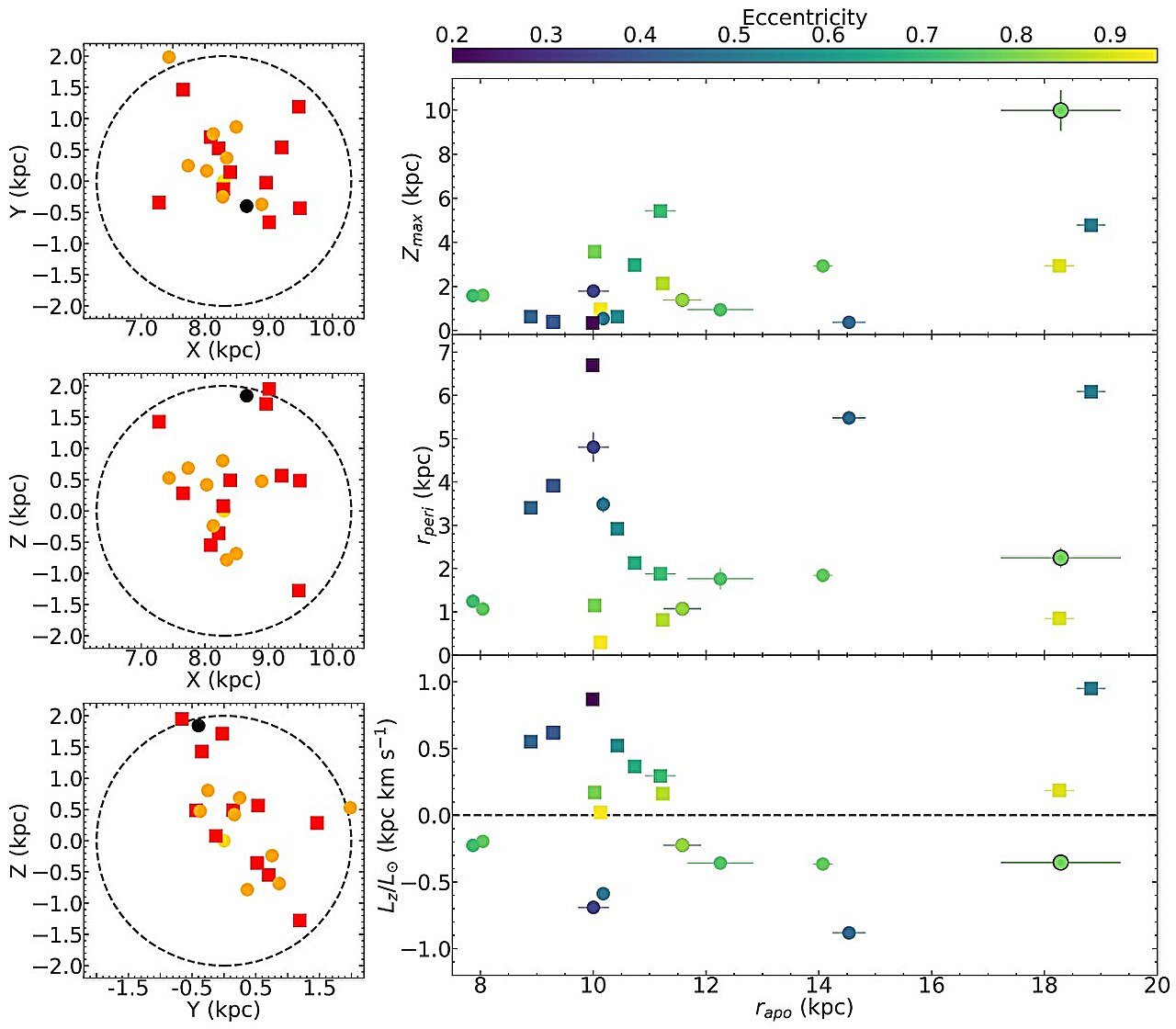 Orbital parameters. Left panel: current galactocentric coordinates: Y relative to X (top left), Z relative to X (center left), and Z relative to Y (bottom left). Source: Monthly Notices of the Royal Astronomical Society (2026)
The researchers compared their chemical “profile” with that of stars in the halo and other dwarf systems. It turns out that the “Loki” group formed under extreme conditions: it was enriched by the explosions of high-energy supernovae and hypernovae, rapidly rotating massive stars, and collisions between neutron stars. However, no evidence of white dwarf explosions was found. This suggests that their home was a very energetic but short-lived dwarf galaxy. Moreover, the self-contained nature of this parent system is confirmed by the lower dispersion of chemical elements compared to other parts of the Milky Way.
Two orbits—one source
This raises a logical question: could stars traveling in opposite directions have originated from two different systems? Astronomers are certain the answer is no. Computer simulations of gas and star masses suggest that all these objects belonged to a single dwarf galaxy.
If these were two separate systems, they would have to be identical twins—sharing an absolutely identical history and chemical evolution—which is highly unlikely. Furthermore, the total mass of these systems would have to be twice as large as current data suggest.
Although the sample studied so far is small, astronomers have high hopes for future large-scale spectroscopic surveys, such as the WEAVE and 4MOST projects. They will help shed light once and for all on the origin of these mysterious stars and provide a deeper understanding of the turbulent early days of our Milky Way.
According to phys.org