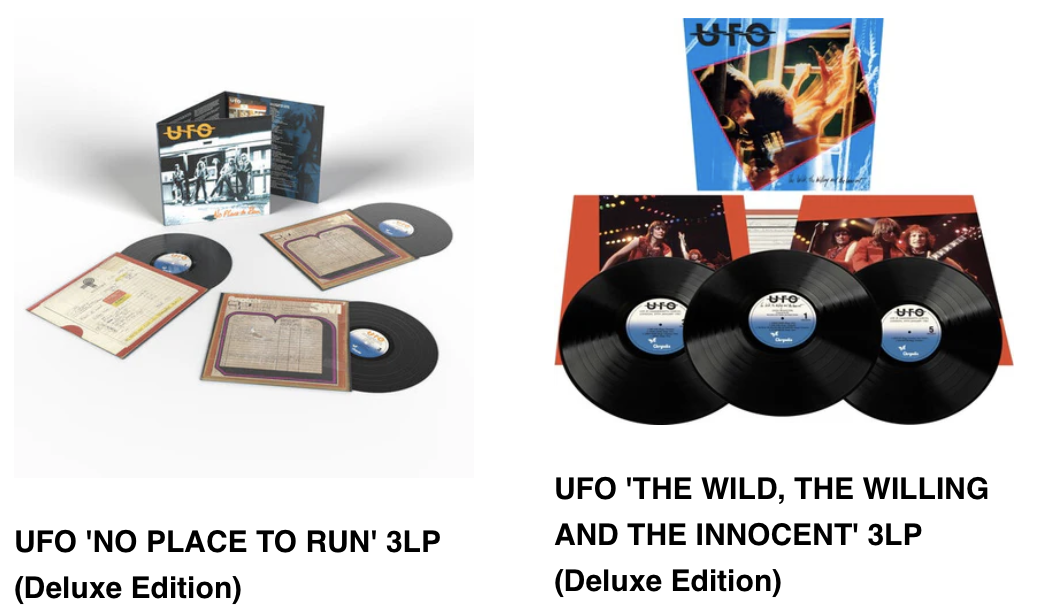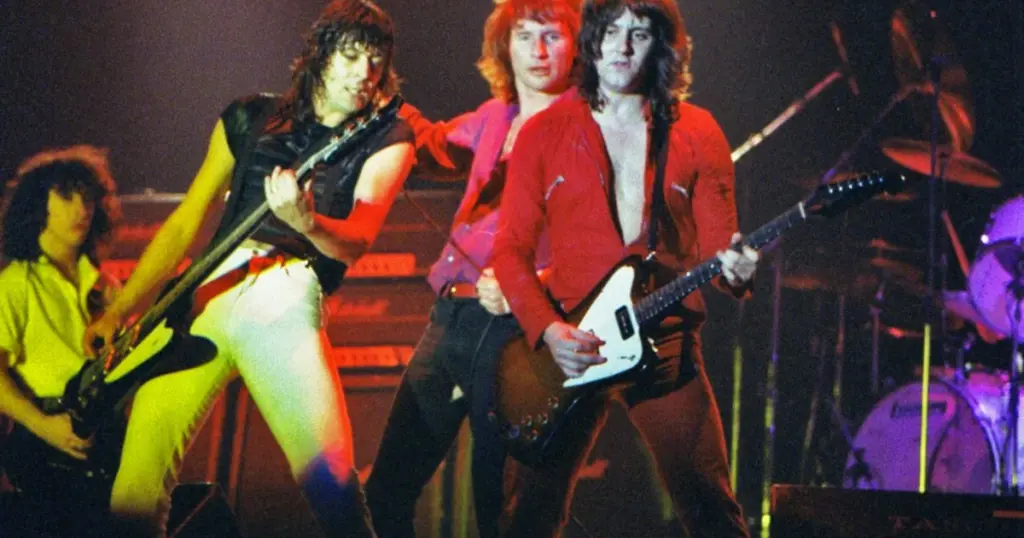
We’re used to multi-platinum albums from the past getting deluxe reissue treatment, but it’s less often we see a quiet cult classic like UFO’s ninth album sashay down the red carpet. But here it comes, The Wild, The Willing and the Innocent, originally issued January 10, 1981, all decked out in a remastered LP and CD package, along with a live show from January 29 of that year, capturing UFO positively levitating at the Hammersmith Odeon in London.
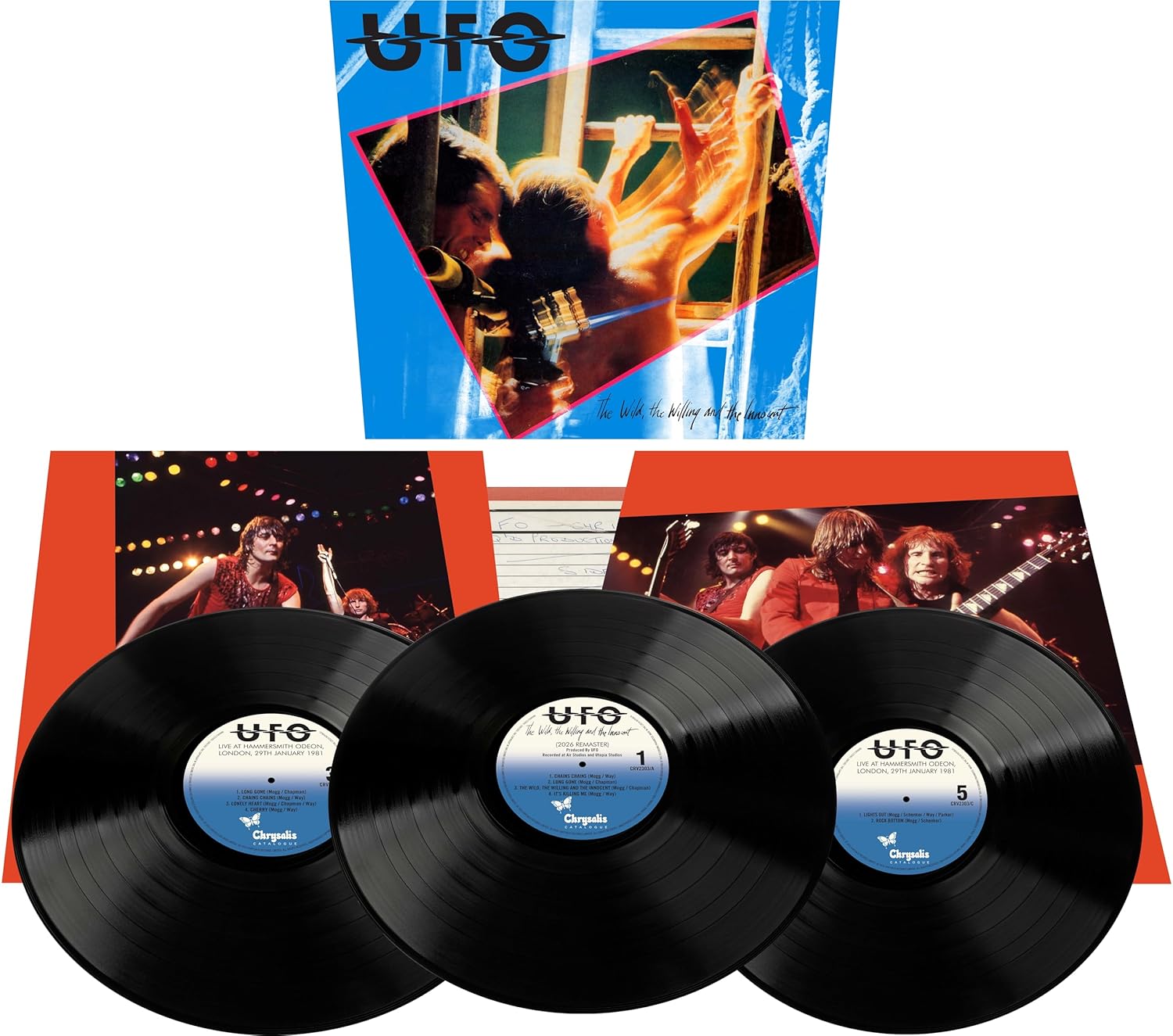
“I could walk from my house to the gig, and I thought that was fantastic,” muses UFO lyricist and singer Phil Mogg, asked about the show. “It was like doing a residency where I actually went, ‘Well, this isn’t so bad after all.’ I could walk to work. No, the Hammersmith gigs were always enjoyable; it’s a great gig. I can remember we got that in, but we also managed to squeeze in a Marquee show too, before that, in November. But no, the Hammersmith gigs were really enjoyable.”
Back to the studio album, The Wild, The Willing and the Innocent was the second to feature guitarist Paul Chapman, who had replaced Michael Schenker in time for 1980’s George Martin-produced No Place to Run. New to the fold for the present record was Neil Carter, replacing Paul Raymond, who was now off to join Michael in The Michael Schenker Group. However, Carter was popping in just at the end. He’d figure more prominently on 1982’s Mechanix, whereas this record would prove to be Paul “Tonka” Chapman’s main milestone with the band in terms of songwriting.
“Paul had a leaning towards the blues thing,” notes Phil, “which was what we wanted anyway. He used to play with a band called Skid Row back in the day (ed. and Lone Star); I think he took over from Gary Moore a long time ago. We wanted that kind of bluesiness. The other guy we were looking at was Steve Hunter, who played on the beginning of the Lou Reed live album. Steve had a really nice touch. We had spoken about him, but we hadn’t approached him. We’d spoken to some other guys, but they didn’t really kind of fit. And then we thought, Well, maybe we’ll give this guy, Steve Hunter, a shot. But as that was happening, the Chapman thing turned up. We went for Paul because he was a mate and because sometimes it’s really difficult to know someone. You don’t know what you’re getting.” (laughs)
They wouldn’t be getting anybody to produce the album, much less calling the esteemed George Martin back. The Wild, The Willing and the Innocent would be self-produced, with Steve Churchyard in as engineer.
As Mogg explains, “No Place to Run was a good experience. A good experience: I use that term loosely. Whilst being an experience, it was kind of trying in terms of playing the stuff. It wasn’t quite how we would have liked to have approached something. And then we got the opportunity to do Wild, Willing, where we sort of thought, Well, let’s do this ourselves and just stretch out and enjoy the thing. We got to the stage with that album where there was no one looking over our shoulder; Chrysalis, bless their hearts, just let us get on with it, although they popped up occasionally to the studio because it was at AIR in Oxford Street. But more or less they left us to our own devices, which was kind of great in one way, a little bit bad in the other. But that was one of the most enjoyable things about doing that album. Everybody thoroughly enjoyed it.”
As for the title of the record, Paul Chapman once told me, “Phil was actually big into Bruce Springsteen at the time, and he had The Wild, the Innocent & the E Street Shuffle, so you can see where that connection came from. And that’s how the saxophone got in on ‘Lonely Heart’ (laughs). Phil was into that whole thing. In actual fact, that wasn’t going to be the title track for the album. It was kind of like an also-ran, until it had gotten closer to the end, and then we realized that it was really good and it would maybe give it a little higher profile.”
Yes indeed, “Lonely Heart,” issued as the album’s second single, features saxophone, which the guys had to get out of new arrival Neil Carter. “Now, it wasn’t that hard,” explains Phil, responding to rumors that Carter didn’t want to do it. “You have to procure. You can’t just say to someone, ‘Yeah, I want you to put sax in this place.’ It has to be more like, ‘Hmm, I wonder if… what do you think?’ You have to lure someone a bit. But no, I said, ‘Let’s try it; let’s see what happens.’ And so we tried it and I thought it sounded rather lovely. Then again, I do like a sax.”
Phil [Moog] was actually big into Bruce Springsteen at the time, and he had The Wild, the Innocent & the E Street Shuffle, so you can see where that connection came from.
Which comes more from Van Morrison than Bruce Springsteen. “Yes, Van Morrison was the man when I was growing up. But then, funny enough, a lot of my influence goes back to [Bob] Dylan, for some strange reason. And this whole spiel of going from there to Morrison and Springsteen is kind of a generational thing. But as far as all that stuff goes, for me, in the end, it’s Dylan. With Van Morrison, it’s more like Astral Weeks. I listened to that and went, ‘Oh, I like’ (laughs). And you kind of pinch bits, take bits of this and that, and you put them in a rock idiom, a rock thing — that was the general idea. It was kind of like an anomaly. And I like that vocal with a heavier sound; you know, something with some bollocks behind it.”
Asked why “Lonely Heart” was issued as a single, Phil says, “Chrysalis obviously had a bearing on it, because they’re gonna have to go out and sell it. And I guess that one sounded the most appealing for them to go out and slog, as it were.”
Another highlight is the dark and pensive “Couldn’t Get It Right,” which had been issued as the record’s advance single, October 17, 1980. “I have no idea why that was picked as a single,” reflects Phil. “I suppose it might have been the most… not catchy, but one you might remember more than others. Lyrically, that was a song about constant failure. Something like that—yeah, constant failure. Then ‘Profession of Violence’ was written after I read a book on the Cray brothers, which is called Profession of Violence. And ‘Chains Chains’ is a bar-room song. ‘Another one for me, please’ (laughs). It’s straight down the line.”
That’s a song that supports the idea that, all told, The Wild, The Willing and the Innocent is a fairly heavy album for the band, with these sort of outlaw, raw and rockin’ production values to match. I asked Phil who among the band members — we haven’t mentioned Pete Way on bass and Andy Parker on drums yet — might have taken to production duties more than others.
“Whoever was most sober. (laughs) No one. It was pretty much only staying around, chatting, coming back for it. Steve would put the tape on and then we’d go, ‘You know, if we change this and maybe try that,’ and then someone else would make a suggestion. But no arguments broke out. It was quite a genteel discussion about something, and we’d come to some conclusion. No one was shouting about anything. It was all very civilized; I don’t recall any bust-ups there. Steve Churchyard was really good. We had the songs written and the arrangements were all tied up anyway — we’d done all that. So it was just down to getting the sound we wanted and making sure that the bits in between all tallied up together. But Steve did a grand job.”
“Whoever was most sober,” says singer Phil Moog on band members who might have taken to production duties more than others.
The music-writing credits on the album are pretty much evenly split between Tonka and Pete, with the anarchic bassist in stripey pants known to be the more rock ‘n’ rollsy songwriter of the two.
“Oh, Pete was a constant,” muses Phil — we lost Paul on June 9, 2020, and then Pete just a couple months later, on August 14. “I’d say Pete was the cornerstone of a lot of the UFO stuff. I wrote a lot with Pete. Pete was a rock man. He was very, you know, Eddie Cochran, The Who, early Led Zeppelin, Free. So the material you got from Pete was just nice.”
Way at the other end aesthetically were the string arrangements on the album, provided by Paul Buckmaster. The highlight in this regard is “Long Gone,” a raging rocker but with a surprise half-time section where disorienting strings are prominent.
“We originally wanted strings on the album before, with George Martin,” explains Phil. “That was one of the cock-ups. We wanted strings, but Chrysalis had obviously told him they wanted a rock album. And George really isn’t a rock producer, so much. And we thought, Well, damn it, we’ll get them on this album. I don’t know about you, but there was an Elton John album I liked where Paul Buckmaster had done the strings. You go, Wow, the strings are great. It’s all that low cello, and it’s dark. You know, where you can go with that? So we thought we’d get Paul Buckmaster. He lived around the corner from me in Barnes in London. So I went around to see him, and he was free, and we chatted over what we were looking for, and he said, ‘Yeah, OK,’ and that’s how we collared him.”
Asked if he was personally there to see the strings get done, Phil says, “Oh yeah, I showed up for the strings. Nothing like a girl playing a cello in a mini skirt.”
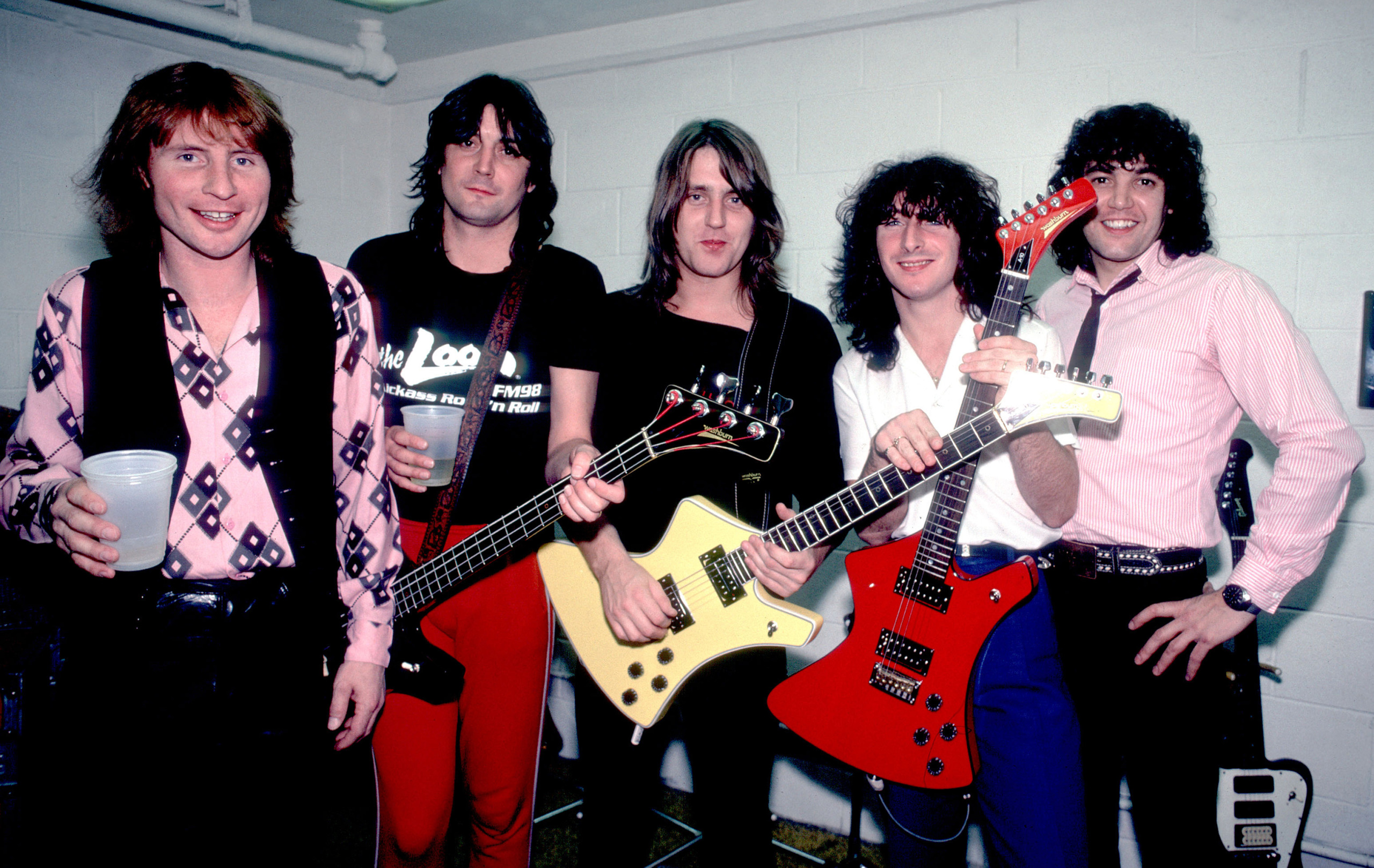 UFO on 3/13/82 in Chicago, Il. (L-R): Phil Mogg, Pete Way, Paul “Tonka” Chapman, Neil Carter and Andy Parker, Photo by Paul Natkin/WireImage)
As for the “Long Gone” lyric, Mogg says, “Do you remember The Animals doing ‘In this dirty old part of the city?’ Well, when that came out, I thought, Bloody ‘ell, I can totally relate to this. Because at some point — I think about 1952 in London — Liverpool Street station was still a sh*t-hole. You know, there were still tanks down on the corner, which they hadn’t cleared up yet. And you look at it and it’s dirty. Steam engines — filthy. But people were fine with it because that’s how it was. But those words — ‘And you’re long gone, down in this hell’— were just a reminder of the filth and dirt.”
Once the finished record was in the shops, punters were confronted with another UFO album cover designed by storied graphics firm Hipgnosis, only this is a late-period effort by the firm, and notably not particularly good.
“We were kind of hooked on Hipgnosis,” says Phil. “I think with our band, when they get along with people, they tend to stick with them. And Hipgnosis were great, and it was great fun seeing them come up with ideas. They were good to work with, so it was a natural to go to Hipgnosis. But to be perfectly honest, I’m not that keen on that cover. It’s not up to the quality of their older stuff. It looks a bit violent, doesn’t it? You’re not quite sure. I’m not quite sure whether it’s a building site or not. There’s a lot of welding going on. But that’s Hipgnosis — you don’t know what you’re going to get.”
“We were kind of hooked on Hipgnosis,” says Phil Moog on picking the design firm to produce most of UFO’s album covers.
Then it was time to tour the record, which means I had to ask Phil about a story Joe Lynn Turner told me about Rainbow playing with the band in 1981. Why did the Rainbow guys call UFO “NyQuila?”
“Nothing to do with me,” laughs Phil. “Hang on. You need experts on that, like Way and Tonka. They know about NyQuil. NyQuil acts like Night Nurse, doesn’t it? It’s to send you to sleep if you’ve got a really bad cough, right? You have Night Nurse in America, don’t you? Those guys would probably be drinking, and then they’d chuck some NyQuil down just to top it off, like an hors d’oeuvre. And I guess it was just extra fuel to see if you could reach Planet X. Unfortunately, a couple of them did.”
In closing, I asked if Phil still lives close by to Michael Schenker. “No, he lives close by to me. And also Herman Rarebell, just down the road. You know, the drummer from Scorpions. So they’re taking over. I mean, they didn’t get over in the Second World War, but now they’re creeping in. No, I see Michael occasionally—very occasionally. Yeah, we wave. And what did he say to me last time I saw him? It was about two years ago. He rolled down his window as I was crossing the road with the dog, and he said, ‘There is no escape.’”
GET MORE UFO ON VINYL IN THE GOLDMINE SHOP: