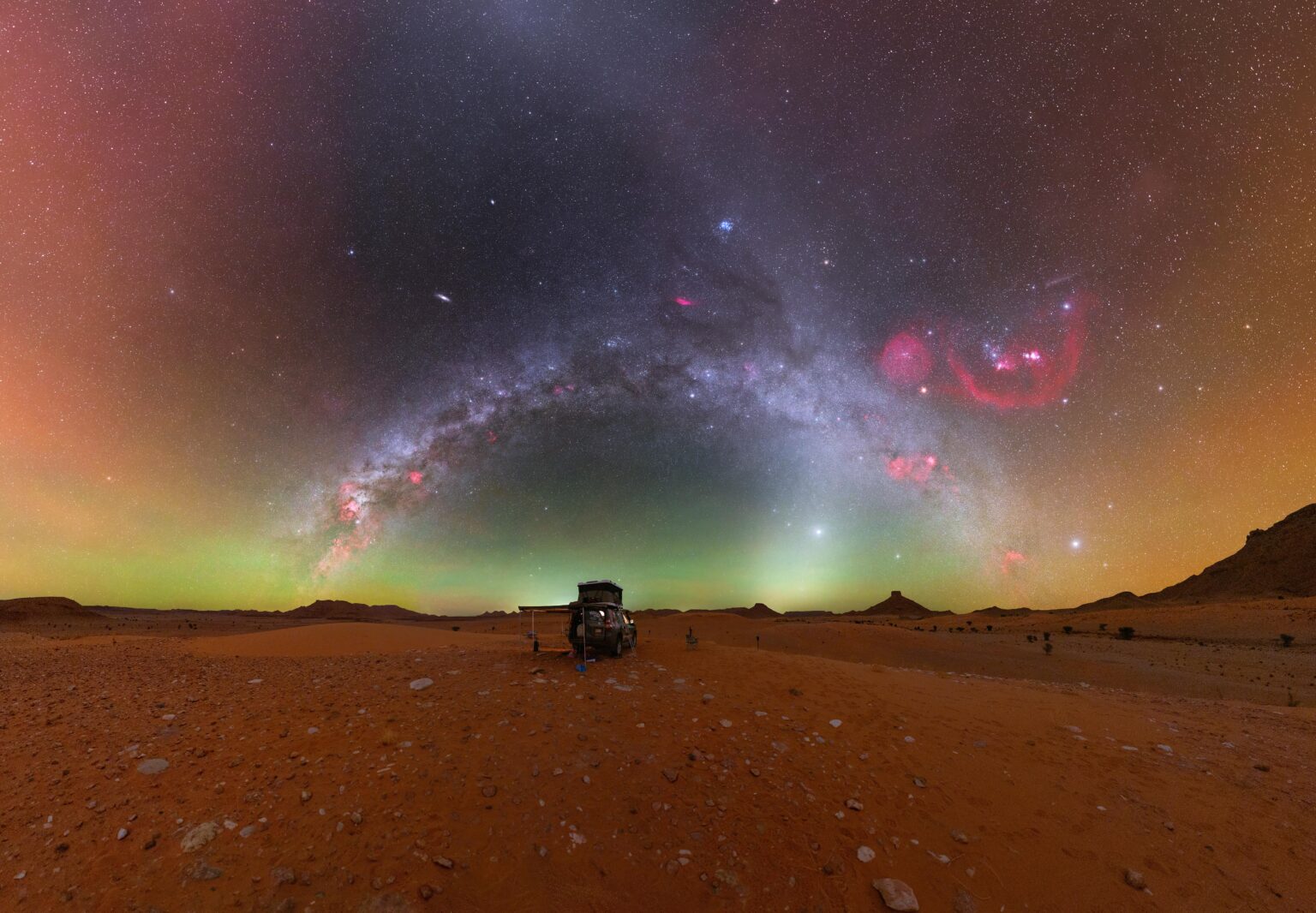
I captured this image in eastern Morocco, near the Algerian border, during an astrophotography trip last October. The sky there was exceptionally pure, with absolutely no light pollution (Bortle 1).
This photo was taken on the third night of the trip. We reached these remote mountains behind the Ouzina desert by 4×4, driving off-road through vast and isolated landscapes, and found the perfect place to set up camp on top of a small hill in the valley. The scenery was breathtaking, offering a full 360-degree view.
There was no one around, just the desert stretching endlessly into the distance. For a brief moment, a single headlight appeared in the mountains far away. Our guide told us it could be a drug trafficker crossing the border, or someone searching for dinosaur fossils, as the area is known for them.
This image is one of my favorites from the trip. The airglow was present all around us, and for a moment, I felt like I was on another planet.
In this image, you can see:
– The winter Milky Way arch, with on the right the red emission of the Cone Nebula, the Rosette Nebula, the Orion Nebula and Barnard’s Loop. Near the center are the blue Pleiades and the red California Nebula. The Andromeda Galaxy. At the lower left of the arch the Cygnus region are visible.
– Zodiacal light, a faint glow in the night sky caused by sunlight scattering off interplanetary dust in the Solar System.
– Airglow, a faint natural glow of Earth’s atmosphere caused by chemical reactions high above the surface, which can appear green or red.
I shot the image as a panorama using 15 photos for the foreground and 21 for the sky. I used an equatorial mount to achieve 45 seconds exposures without star trails.
—-
As a reminder, the sky looks very different to the naked eye than it does in long-exposure astrophotography. With unaided vision, you can easily recognize the shape of the Milky Way and notice a few of the brightest nebula regions as very faint, diffuse glows, but you cannot see the deep reds or the intricate structures shown here.
—-
The Bortle Scale is a nine-level system used to measure light pollution and the quality of the night sky at a given location. It ranges from Class 1, representing the darkest skies available on Earth, where the Milky Way appears highly detailed and the zodiacal light is visible, to Class 9, which corresponds to inner-city skies where only the brightest stars and planets can be seen.
—-
📷
Sigma Art 20mm – Canon 6D astromodded – Skywatcher Star Adventurer
Sky: 15 tiles – 45seconds – ISO 3200 – F/2
Foreground: 21 tiles – 45seconds – ISO 4000 – F/2.5
Dear-Personality-299 on
Fck it, i saw this last week as View from Mars 🙂
lucky_maurya9839 on
wish i could see it with my own eyes
SUP3RMUNCh on
Do you have the unedited picture for a comparison?

4 Comments
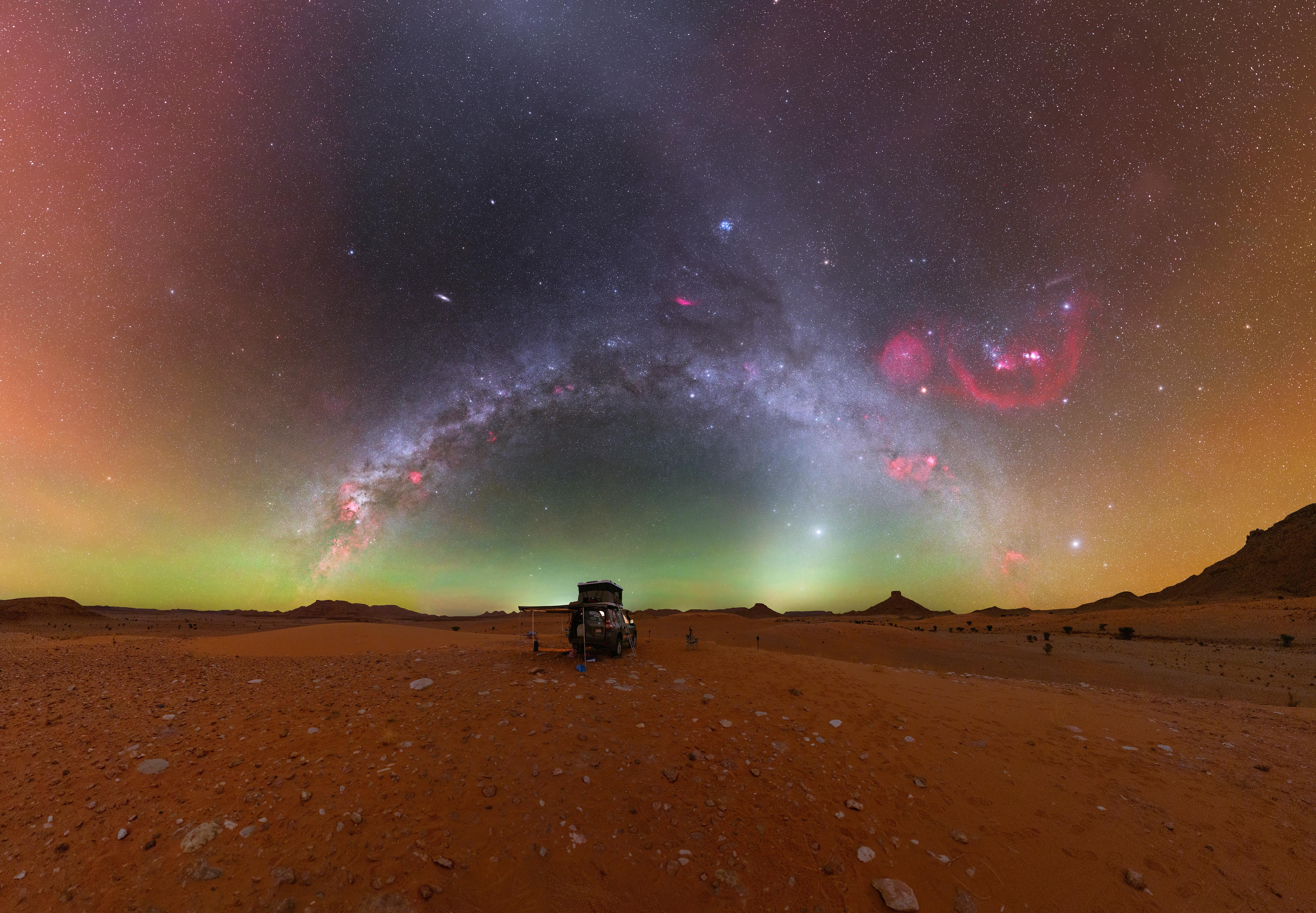
I captured this image in eastern Morocco, near the Algerian border, during an astrophotography trip last October. The sky there was exceptionally pure, with absolutely no light pollution (Bortle 1).
If you’re interested, you can find more of my work on [Instagram](https://www.instagram.com/tinmar_g/).
This photo was taken on the third night of the trip. We reached these remote mountains behind the Ouzina desert by 4×4, driving off-road through vast and isolated landscapes, and found the perfect place to set up camp on top of a small hill in the valley. The scenery was breathtaking, offering a full 360-degree view.
There was no one around, just the desert stretching endlessly into the distance. For a brief moment, a single headlight appeared in the mountains far away. Our guide told us it could be a drug trafficker crossing the border, or someone searching for dinosaur fossils, as the area is known for them.
This image is one of my favorites from the trip. The airglow was present all around us, and for a moment, I felt like I was on another planet.
In this image, you can see:
– The winter Milky Way arch, with on the right the red emission of the Cone Nebula, the Rosette Nebula, the Orion Nebula and Barnard’s Loop. Near the center are the blue Pleiades and the red California Nebula. The Andromeda Galaxy. At the lower left of the arch the Cygnus region are visible.
– Zodiacal light, a faint glow in the night sky caused by sunlight scattering off interplanetary dust in the Solar System.
– Airglow, a faint natural glow of Earth’s atmosphere caused by chemical reactions high above the surface, which can appear green or red.
I shot the image as a panorama using 15 photos for the foreground and 21 for the sky. I used an equatorial mount to achieve 45 seconds exposures without star trails.
—-
As a reminder, the sky looks very different to the naked eye than it does in long-exposure astrophotography. With unaided vision, you can easily recognize the shape of the Milky Way and notice a few of the brightest nebula regions as very faint, diffuse glows, but you cannot see the deep reds or the intricate structures shown here.
—-
The Bortle Scale is a nine-level system used to measure light pollution and the quality of the night sky at a given location. It ranges from Class 1, representing the darkest skies available on Earth, where the Milky Way appears highly detailed and the zodiacal light is visible, to Class 9, which corresponds to inner-city skies where only the brightest stars and planets can be seen.
—-
📷
Sigma Art 20mm – Canon 6D astromodded – Skywatcher Star Adventurer
Sky: 15 tiles – 45seconds – ISO 3200 – F/2
Foreground: 21 tiles – 45seconds – ISO 4000 – F/2.5
Fck it, i saw this last week as View from Mars 🙂
wish i could see it with my own eyes
Do you have the unedited picture for a comparison?