
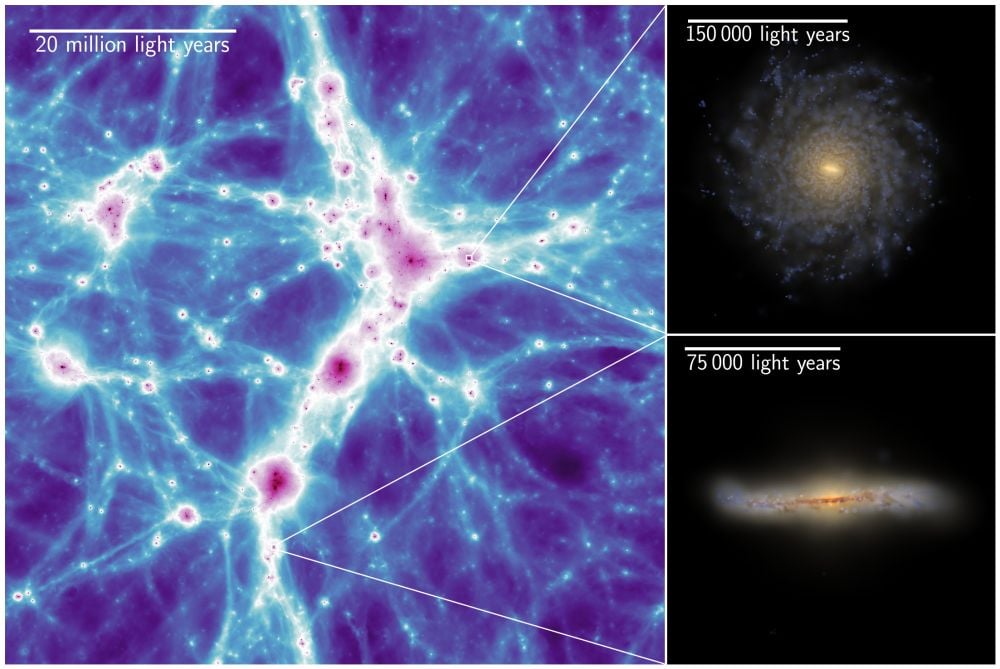
We can’t really understand the Universe without knowing its history. Since galaxies are among the Universe’s defining features, understanding how they form and evolve is a huge part of knowing the Universe’s history. Galaxies are also intermediary between both smaller structures like globular clusters and larger structures like galaxy groups, so a deeper comprehension of galaxies extends to other structures, too. The boundaries between structures are our own invention, not Nature’s.
Simulations are a powerful tool in science’s toolbox, and astronomers use extraordinarily detailed and powerful simulations to probe the formation of galaxies and galaxy groups and how they evolve. One of these supercomputer simulations is called The Colibre Project, where Colibre stands for COLd Ism and Better REsolution.
A new paper in the Monthly Notices of the Royal Astronomical Society presents Colibre and its first results. It’s titled “The COLIBRE project: cosmological hydrodynamical simulations of galaxy formation and evolution,” and the lead author is Joop Schaye. Schaye is a professor at Leiden University in the Netherlands.
“Hydrodynamical simulations following the concurrent formation and evolution of cosmological structures and the galaxies that they contain have become a central part of research in extragalactic astronomy and cosmology,” the authors write. “They serve a wide range of purposes.”
Among those purposes are a more complete understanding of astrophysical processes, testing data analysis techniques, and “guiding the design of new observational campaigns,” according to the authors.
There are other powerful supercomputer simulations, but Colibre is different than others. It’s relatively new, and it’s partly a response to some of the JWST’s findings. JWST observations of the early Universe found that black holes and galaxies were more massive than our understanding of the cosmos could account for.
Colibre’s main strength over prior simulations like Illustris TNG is how it treats gas and dust inside galaxies, the raw material for star formation. In galaxies, much of this gas and dust is cold, and while previous simulations didn’t address this, Colibre does. It doesn’t impose a temperature and pressure floor on this gas and dust like other simulations. “The multiphase interstellar medium is explicitly modelled without a pressure floor,” the Colibre website states.
Colibre has other strengths, too. It simulates how dust grains evolve in a galaxy, and includes new, more complex models for things like AGN feedback. “COLIBRE includes new models for radiative cooling, dust grains, star formation, stellar mass loss, turbulent diffusion, pre-supernova stellar feedback, supernova feedback, supermassive black holes, and active galactic nucleus (AGN) feedback,” the authors explain in the paper.
Colibre looks like a powerful new scientific tool that will advance our understanding of the cosmos. But its different from other simulations not just in its scientific detail. It also has a sonic component that make the simulations almost cinematic. Colibre also has interactive maps that users can explore.
“We’re excited not just about the science, but also about creating new ways to explore it,” concludes Dr. James Trayford of the University of Portsmouth, who led the development of COLIBRE’s dust model and the sonification of its visualisations. “These tools could provide new insights, make our field more accessible, and help us build intuition for how galaxies grow and evolve.”
In terms of raw power, Colibre takes advantage of new, more powerful algorithms and supercomputers.
“Much of the gas inside real galaxies is cold and dusty, but most previous large simulations had to ignore this,” said project leader Schaye in a press release. “With COLIBRE, we finally bring these essential components into the picture.”
Colibre has shown that despite the JWST’s observations of the early Universe, the Standard Cosmological Model, aka Lambda Cold Dark Matter (Lambda-CDM), is consistent with obsevations of the early Universe. “Comparisons with various low-redshift galaxy observations generally show very good numerical convergence and excellent agreement with the data,” the authors write in their paper.
“Some early JWST results were thought to challenge the standard cosmological model,” says Dr. Evgenii Chaikin of Leiden University, lead author of several accompanying COLIBRE papers and co-author of the main study. “COLIBRE shows that, once key physical processes are represented more realistically, the model is consistent with what we see.”
Colibre can’t account for all of the JWST’s eary Universe observations, though. Colibre couldn’t predict the puzzling Little Red Dots (LRD). LRDs could be the seeds for supermassive black holes, and Colibre assumes they already exist. Researchers are hopeful that future simulations and supercomputers will be able to predict them.
It takes years to run these simulations and process their voluminous data. While most simulations were completed in 2025, others are still running and should finish after this summer.
Colibre is a powerful new upgrade to the suite of cosmological simulations. But it has its drawbacks, according to the authors. “Although we consider COLIBRE to be a major step forward compared to previous simulations of representative volumes, it has many known weaknesses (which are not unique to COLIBRE),” the authors write. For example the structure of star-forming molecular clouds is not resolved in most galaxies.
“To our knowledge, both the level of numerical convergence and the level of agreement with a diverse range of galaxy data that we find for COLIBRE are unprecedented for cosmological hydrodynamical simulations,” the researchers write.