
by Robert Schreiber
Berlin, Germany (SPX) Apr 23, 2026
The European Space Agency’s Plato mission has completed a demanding series of tests in space-like conditions, clearing an important milestone as the spacecraft moves toward a planned launch in January 2027.
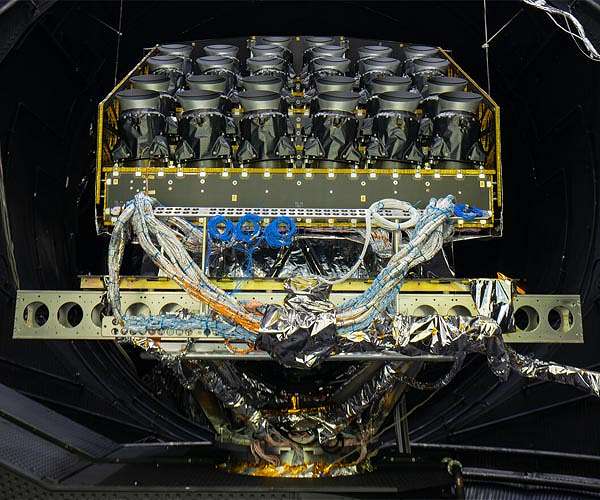
Plato recently came out of the Large Space Simulator at ESA’s Test Centre, where engineers exposed the spacecraft to the vacuum and temperature extremes it will face in orbit. The campaign followed the long-standing engineering rule of testing a spacecraft as closely as possible to the way it will actually fly.
After the chamber was sealed in early March, pumps removed the air to create a vacuum about a billion times thinner than normal atmospheric pressure. At the same time, liquid nitrogen circulated through the chamber walls to reproduce the cold of space, while internal heating elements simulated sunlight striking Plato’s solar panels and sunshield.
The tests focused heavily on the mission’s 26 ultrasensitive cameras, which are central to Plato’s search for Earth-sized planets around bright Sun-like stars. The spacecraft will look for tiny dips in starlight caused when a planet crosses in front of its host star.
“To find and characterise Earth-like planets in orbit around Sun-like stars, we need to tease out variations in a star’s luminosity smaller than 80 parts per million,” explains Ana Heras, ESA’s Plato Project Scientist.
“Such a high precision is very demanding, and these tests in space-like conditions are crucial. They allow us to verify that we can control the response of the cameras and the rest of the spacecraft systems to the level that we need for detecting small planets.”
ESA said the thermal test series examined both the cameras and the spacecraft as a complete system under the same environment expected in flight. Engineers also worked to confirm that they can keep the optical system precisely tuned once Plato is in orbit.
“We carried out dedicated tests to assess the correct functioning of Plato’s cameras and the complete spacecraft in the thermal conditions that it will experience in its final orbit,” adds Thomas Walloschek, ESA’s Plato Project Manager.
“The sharpness of the cameras – their focus – is fine-tuned by adjusting the temperature of their optical tubes. So, we ran a series of tests to establish that we can maintain the cameras’ optimal focus by controlling their temperatures with very high accuracy.”
Engineers then pushed the spacecraft through both nominal and more extreme thermal cases. In the hot phase, all spacecraft elements operated at full power while the solar-panel side reached 150 C. At the same time, the cameras, shielded from direct heating and pointed toward the cold side of the chamber, were kept between -70 C and -90 C.
During the cold phase, temperatures were lowered across the spacecraft and onboard heaters had to keep the cameras from becoming too cold. ESA said this stress testing went beyond the normal conditions Plato is expected to see in orbit so teams could confirm margin as well as nominal performance.
ESA has completed the environmental campaign itself, but analysis of the data gathered inside the chamber will continue for months. Engineers and scientists will use the results to better understand the spacecraft’s behaviour and to refine the thermal models that will help predict detailed camera performance during the mission.
Plato is expected to be ready for launch by the end of this year. Arianespace is planning the mission’s liftoff on Ariane 6 for January 2027.
Related Links
European Space Agency
Lands Beyond Beyond – extra solar planets – news and science
Life Beyond Earth