
Topline
On the evening of Saturday, April 25, skywatchers in 18 eastern U.S. states, as well as in parts of Mexico and northern South America, will have the chance to watch a rare lunar occultation as bright star Regulus disappears behind the moon. During the event, the moon will drift in front of one of the night sky’s most famous stars before it blinks back into view minutes later. A fabulous sight in a pair of binoculars, it will be visible in the early evening. Here’s when, where and how to watch the lunar occultation of Regulus.
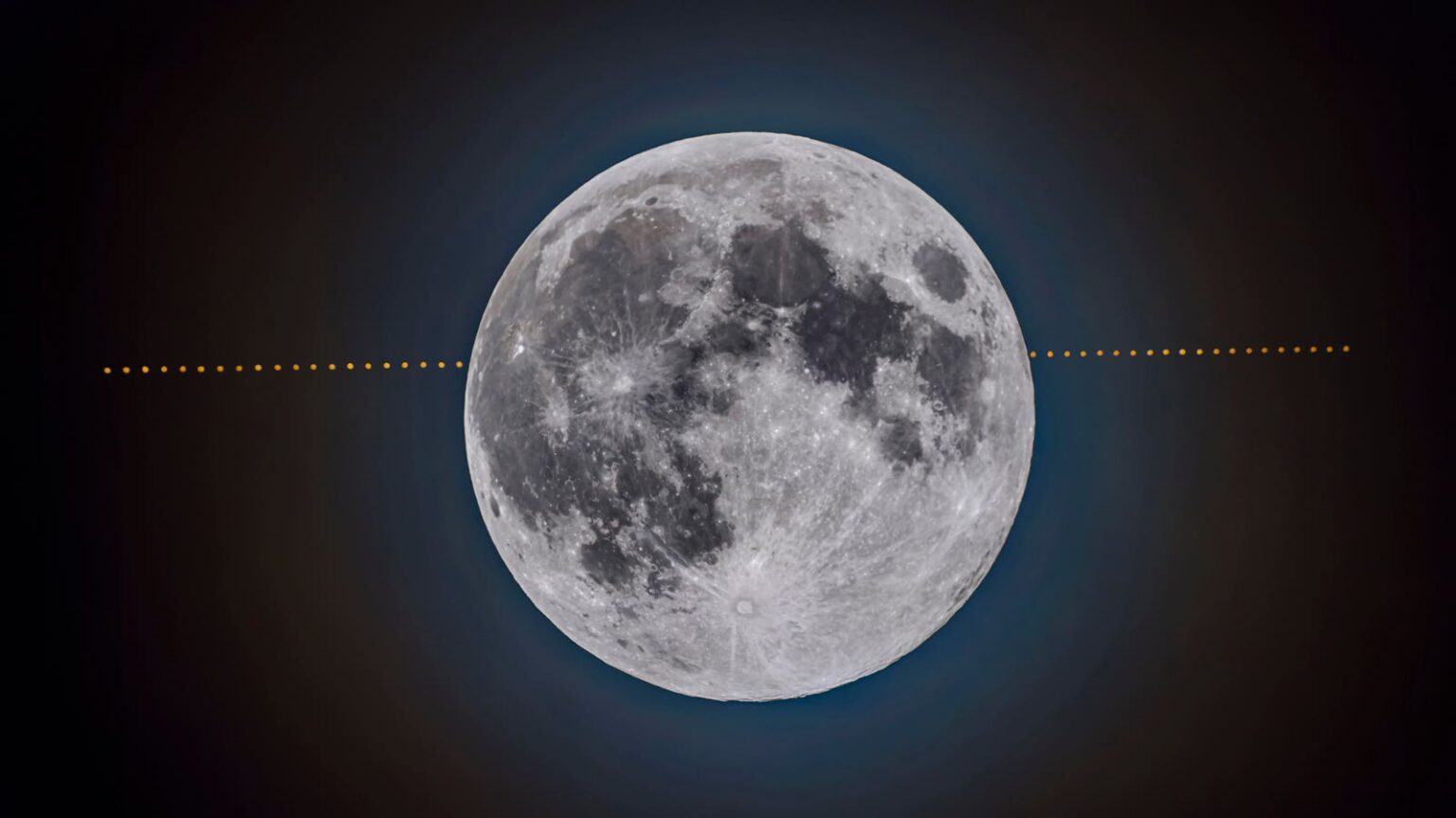
On Saturday, April 25, a 70%-lit waxing gibbous moon will sit extremely close to Regulus high in the southwestern sky after dark. (Image shows a timelapse of Mars being occulted by the moon in 2022).
gettyKey Facts
On Saturday, April 25, a 70%-lit waxing gibbous moon will sit extremely close to Regulus high in the southwestern sky after dark. It will take place between 7:16 and 11:38 p.m. EDT.
Parts of eastern North America, Central America and northern South America will see a full occultation. At the same time, some regions will witness a rare grazing occultation as Regulus appears to skip along the edge of the moon. Whether you see a full occultation, a near miss or simply a close conjunction depends entirely on where you are.
Parts of six states will see Regulus both disappear and reappear: eastern Pennsylvania, Maryland, Washington D.C., Delaware, eastern Virginia and eastern North Carolina.
Parts of 18 states will see Regulus reappear only: New York (southwest tip), New Jersey (southern), Delaware, Maryland, Washington D.C., Pennsylvania, Ohio, Indiana (southern), Kentucky, West Virginia, Virginia, North Carolina, South Carolina, Tennessee, Mississippi, Louisiana, Alabama, Georgia and Florida.
Regulus is about 79 light-years from the sun and is the 21st brightest star in the night sky.
A chart showing Regulus reappearing from behind the moon on April 26, 2026.
StellariumWhat Is An Occultation?
An occultation is when the moon passes in front of a distant object, blocking it from view. Regulus will disappear in an instant behind the moon’s dark limb because the moon has no atmosphere. Its return from behind the bright lunar limb can be just as sudden, but more difficult to see because the moon is so bright.
Sample Times For Major Cities
Here are the exact times of disappearance and reappearance for cities in the six states that will see the full occultation. Exact times for any location are available at In-The-Sky.org.
In Philadelphia, Pennsylvania, Maryland, Regulus will disappear at 8:53 p.m. EDT and reappear at 9:16 p.m. EDT. In Baltimore, Maryland, Regulus will disappear at 8:43 p.m. EDT and reappear at 9:21 p.m. EDT. In Washington, D.C., Regulus will disappear at 8:41 p.m. EDT and reappear at 9:25 p.m. EDT. In Wilmington, Delaware, Regulus will disappear at 8:51 p.m. EDT and reappear at 9:17 p.m. EDT. In Richmond, Virginia, Regulus will disappear at 8:41 p.m. EDT and reappear at 9:28 p.m. EDT. In Norfolk, Virginia, Regulus will disappear at 8:38 p.m. EDT and reappear at 9:31 p.m. EDT. In Wilmington, North Carolina, Regulus will disappear at 8:33 p.m. EDT and reappear at 9:39 p.m. EDT.
Map of the lunar occultation of Regulus on Saturday, April 25, 2026, from In-The-Sky.org/Dominic Ford.
In-The-Sky.org/Dominic FordWhat Is Regulus?
Regulus, sometimes called the “Heart of the Lion,” marks the base of Leo’s distinctive backward question-mark shape, known as the Sickle of Leo. A hot, blue-white star roughly four times the sun’s diameter and far more luminous, Regulus sits along the ecliptic — the path the sun, moon and planets follow through the sky — so the moon frequently passes close to Regulus, but rarely occults it for any given location. Regulus is the 21st brightest star in the night sky.
Further ReadingForbesArtemis Astronauts See Earthrise, Earthset And A Total Solar EclipseBy Jamie CarterForbesNASA Changes Moon Plan: Landing Now Depends On SpaceX Or Blue OriginBy Jamie CarterForbesThe Next U.S. Total Solar Eclipse Is 7 Years Today — In AlaskaBy Jamie CarterForbes11,000 Asteroids Have Just Been Found — 33 Are Near-Earth ObjectsBy Jamie CarterForbesYour Ultimate Guide To Stargazing And Astronomy In 2026By Jamie CarterForbesYour Full Moon Guide For 2026 — All 13 Dates For Your DiaryBy Jamie Carter