
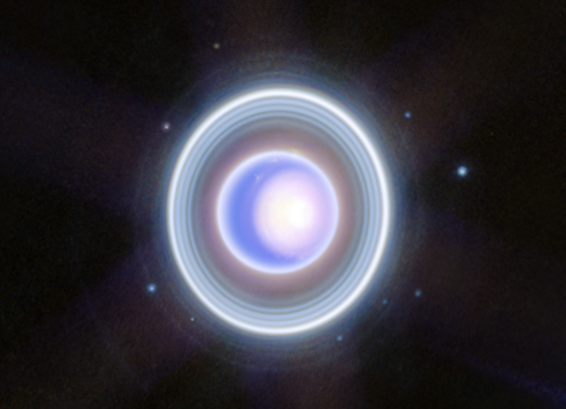
Uranus has 13 known rings, but the two outermost ones — called the mu- and nu-rings — have long puzzled scientists. New observations combining data from the James Webb Space Telescope with older data from Hubble and the Keck Observatory have given astronomers their clearest look yet at these rings, and what they found raises more questions than answers.
The mu-ring is blue because it's made of tiny water-ice particles, much like a ring around Saturn that is fed by geysers on one of its moons. Scientists have traced Uranus's mu-ring back to a small, 12-kilometer-wide moon called Mab — but that's strange, because most of Uranus's other inner moons are rocky and dusty, not icy.
The nu-ring, by contrast, has a reddish tint and contains carbon-rich organic compounds, the kind typically found in the cold outer solar system. Researchers believe this ring is being fed by unseen moonlets — small moons we haven't discovered yet — getting pelted by tiny space rocks and shedding dust.
Uranus currently has 29 known moons, but the evidence from these rings strongly suggests more are hiding in plain sight. Scientists say a dedicated spacecraft mission to Uranus will likely be needed to solve these mysteries for good.
Credit: NASA, ESA, CSA, STScI
by Busy_Yesterday9455
26 Comments

They could have asked first

Probe harder, scientists, probe harder
Be the bigger man. Be the bigger man. Be the bigger man… Don’t let the adolescent child out…

They did wha
Oh no you don’t!
Interesting. I wonder what they’ll find?

Definitely needs to be NSFW
The craziest thing is that ring μ confirms that the moon Mab is almost entirely made of ice, while the other inner moons are rocky and dusty. Why is it the only one that’s different? we urgently need a mission to Uranus.
That’s some good space porn
I keep telling them there’s nothing up there.

Uranus jokes never get old lol


Hehe, *probe*
[NASA announces plans for near future exploration of Uranus.](https://www.youtube.com/watch?v=OSWszdSHkyE)
*…Really, Shepard?*
The scientific term for the moons around Uranus is called Dingleberries
Nothing like probing ur anus.
Damn this really is space porn.
Buy me a drink first.
nice.
