
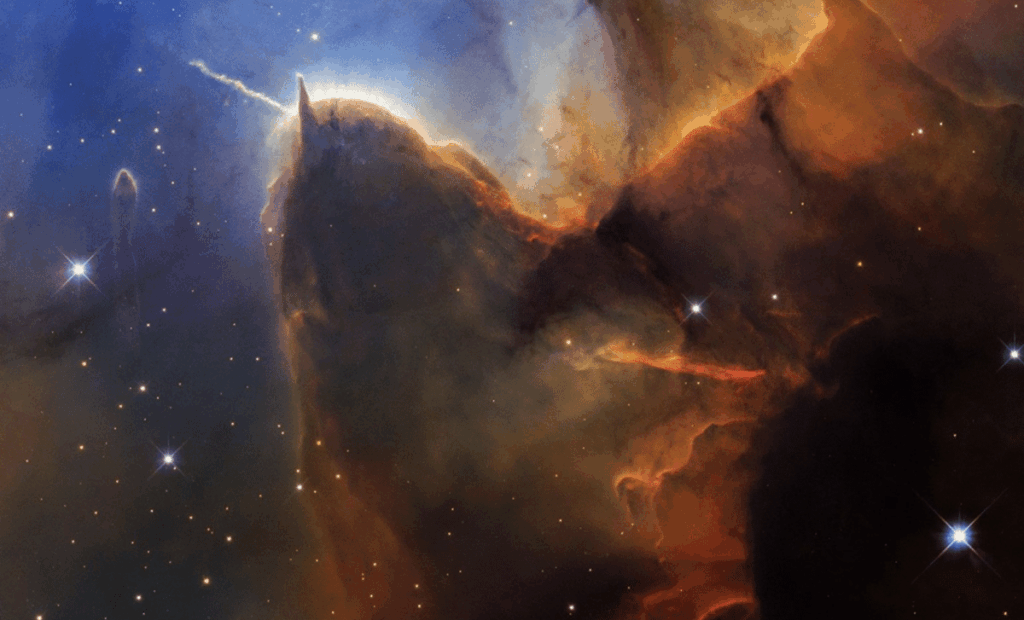
In a stunning new image that marks the 36th anniversary of NASA’s Hubble Space Telescope, scientists have captured a breathtaking new view of the Trifid Nebula, a stellar nursery where new stars are being born. The latest observations, published by NASA, provide unprecedented details of this distant cosmic landscape, showcasing the dramatic interplay of gas, dust, and massive young stars. This breakthrough not only highlights the ongoing birth of stars but also opens new windows for understanding the lifecycle of star-forming regions across the universe.
Hubble’s New Image of the Trifid Nebula
The Trifid Nebula, located 5,000 light-years from Earth, has long fascinated astronomers due to its vivid display of star birth. However, Hubble’s latest image captures this region with unprecedented clarity, revealing intricate details that were previously obscured. The colors and textures in the image evoke comparisons to an underwater scene, with dark lanes of gas and dust that ripple through the cosmos. These visual elements are more than just aesthetic, each one tells a story about how stars form and interact with their environment.
The image was captured using Hubble’s advanced camera, which boasts a wider field of view and greater sensitivity compared to earlier technology. This improvement, a result of Hubble’s long-term servicing and technological advancements, allows for a clearer picture of how the nebula’s gas and dust are shaped by powerful stellar winds. The nebula’s signature glowing bubble, carved by ultraviolet radiation from nearby massive stars, is revealed in striking detail.
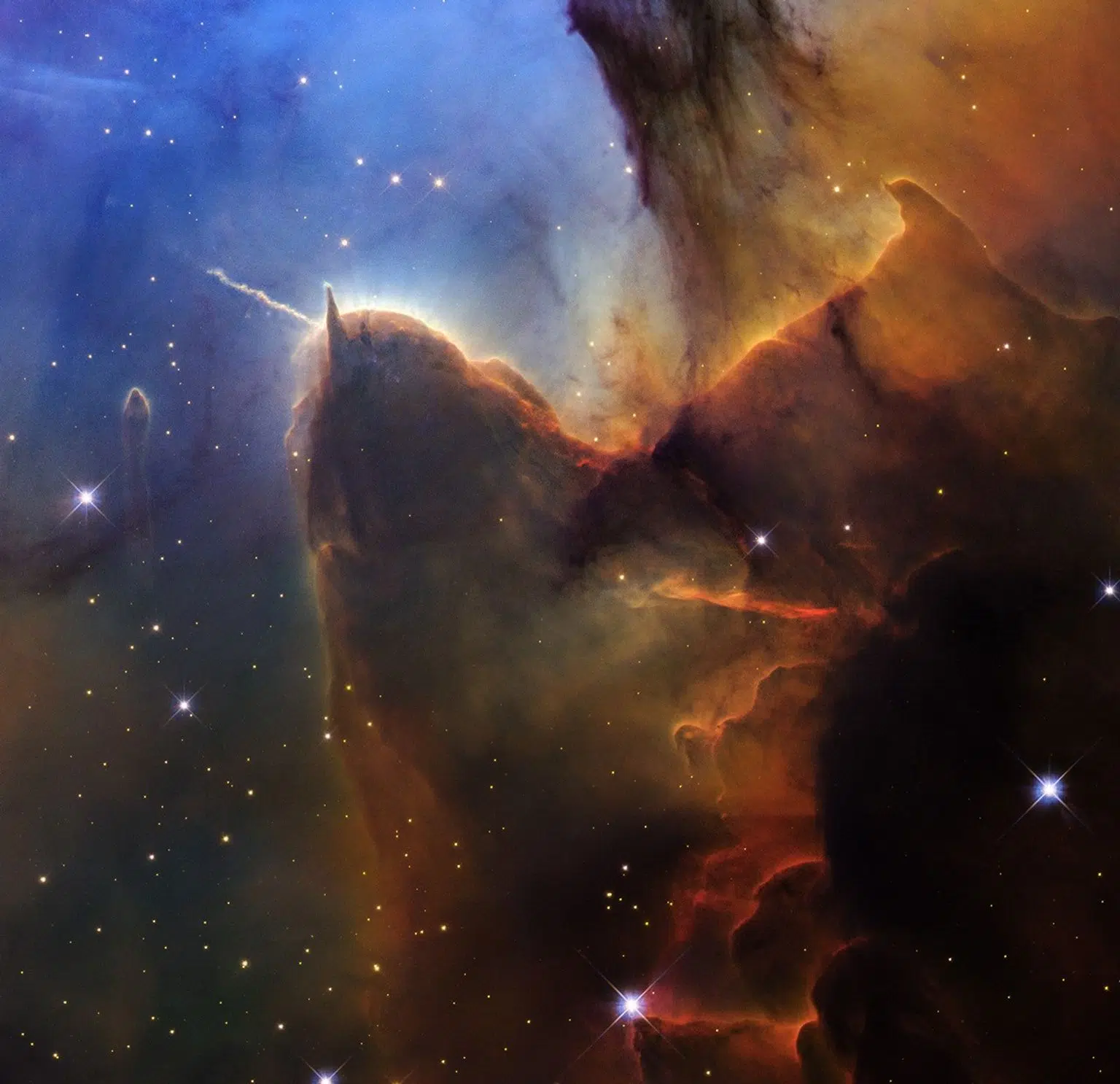 NASA celebrates Hubble’s 36th anniversary with a new image of the Trifid Nebula, a star-forming region it first captured in 1997. The telescope leveraged almost its full operational lifetime to show us changes in the nebula on human time scales with an improved camera.
NASA, ESA, STScI; Image Processing: Joseph DePasquale (STScI)
The Impact of Ultraviolet Radiation
At the heart of the Trifid Nebula’s awe-inspiring beauty lies an incredible process: the birth of stars. Massive stars, located just outside the current field of view, have been influencing this region for at least 300,000 years. Their ultraviolet radiation strips electrons from surrounding gas, triggering the formation of new stars in the process. As these stars continue to grow, their powerful winds blow away the surrounding dust, creating cavities and leaving behind a glowing bubble.
These interactions provide researchers with a real-time look at how new stars shape their surroundings. By studying these processes, scientists can glean crucial insights into the stages of star formation, which will help unravel the mysteries of our universe’s early development. Understanding these processes is critical for advancing theories about how stars, planets, and galaxies form in the cosmos.
Celebrating Hubble’s 36 Years of Discovery
The latest Trifid Nebula image marks a milestone in Hubble’s impressive 36-year legacy of space exploration. Launched on April 24, 1990, Hubble has revolutionized our understanding of the universe through more than 1.7 million observations. Over the decades, it has provided crucial data for over 29,000 peer-reviewed papers, furthering research in everything from the formation of stars to the exploration of distant galaxies. NASA’s continuous investment in Hubble’s technology ensures that it remains one of the most productive scientific instruments in history.
Hubble’s ability to capture light across multiple wavelengths, from ultraviolet to near-infrared, has been key in helping researchers study objects across the universe in different stages of development. This versatility has been instrumental in building a comprehensive picture of how celestial bodies evolve over time.
Collaboration With James Webb and Future Missions
While Hubble’s contributions are monumental, it is not working alone. Recent missions, such as the James Webb Space Telescope, are helping to push the boundaries of discovery even further. By combining data from these telescopes, astronomers can gain a more complete understanding of the universe. For example, the James Webb Space Telescope’s near-infrared observations will complement Hubble’s visible-light data, creating a deeper, multi-dimensional view of star-forming regions like the Trifid Nebula.
Looking ahead, NASA is preparing for even more advanced missions that could significantly impact our understanding of the universe. The Nancy Grace Roman Space Telescope, for instance, will soon scan large swaths of the sky, providing insights into the Trifid Nebula and similar regions on an even grander scale. Such instruments will continue the work Hubble started, offering future generations the ability to explore and understand the cosmos in ways we never thought possible.
Unveiling Protostar Activity
Hubble’s new image reveals striking evidence of protostar activity within the Trifid Nebula. Protostars, the nascent form of stars, are at the center of this stellar drama. The image shows evidence of jets of plasma being ejected by young protostars embedded in the dense gas and dust. These jets, known as Herbig-Haro objects, are a telltale sign of the ongoing star formation process.
These outflows are crucial to the nebula’s evolution. As they interact with surrounding materials, they help clear away gas and dust, potentially triggering the formation of even more stars. Studying these protostar jets provides valuable data on how stars influence the environment around them and how they eventually evolve into fully formed celestial bodies.
The Trifid Nebula’s Unique Position in Stellar Evolution
The Trifid Nebula is one of the most important star-forming regions we can observe, as it gives astronomers a glimpse into the complex processes that drive stellar evolution. With its combination of massive stars, protostars, and dense gas clouds, it serves as a natural laboratory for studying the early stages of star life.
This new view from Hubble adds to the growing body of knowledge about how stars are born, evolve, and eventually die. The data gathered here will help researchers understand not only the lifecycle of individual stars but also the broader processes that shape the cosmos.