
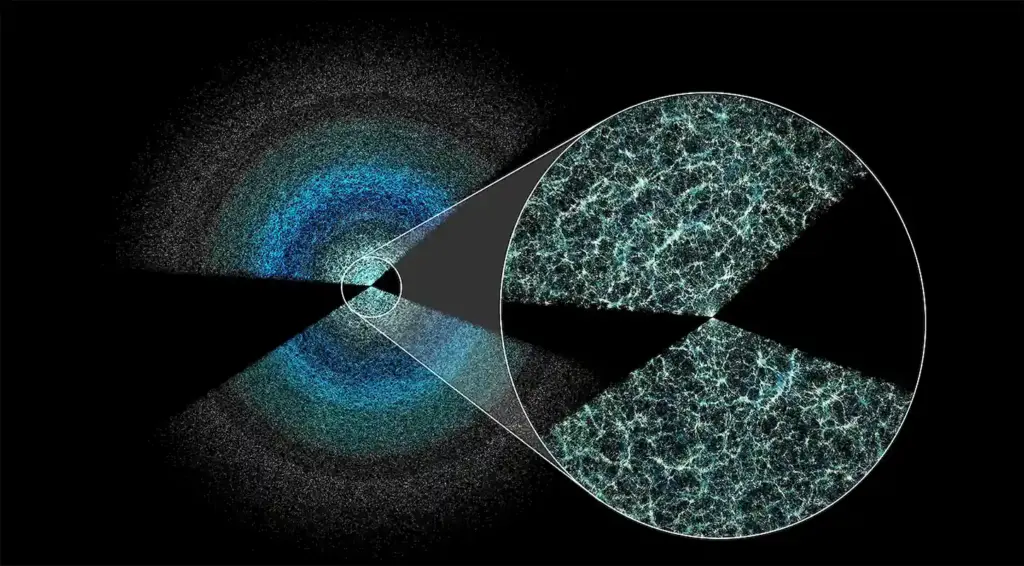
The universe possesses a hidden structure that determines the arrangement of all visible matter, and a professor at the University of Virginia is currently immersed in the process of mapping it in three dimensions through the positional analysis of 46 million galaxies and quasars, along with 19 million stars belonging to our own Milky Way.
Satya Gontcho A Gontcho, assistant professor in the university’s Department of Astronomy, is part of the international team operating the Dark Energy Spectroscopic Instrument, known by its acronym DESI, an ambitious project led by the Lawrence Berkeley National Laboratory and located at the Kitt Peak National Observatory in Arizona, whose primary goal is the execution of one of the most exhaustive cosmological surveys ever undertaken by humanity, with the express aim of studying dark energy, considered one of the greatest unresolved questions in the field of contemporary physics.
The work of the DESI consortium has culminated in the construction of the largest and most detailed three-dimensional map of the cosmos to date, a colossal enterprise that allows astronomers to overcome the inherent limitations of traditional two-dimensional observation of the sky.
Gontcho A Gontcho described the methodological essence of this initiative, noting that if, starting from an image of the sky, one can add a third dimension in the form of an extraordinarily precise distance measurement that indicates the exact location of galaxies, one is effectively creating a 3D map that reveals how those galaxies are positioned relative to one another from our privileged vantage point on Earth.
The professor emphasized a crucial fact underlying this cosmic distribution: galaxies are not scattered randomly in the void but follow a subtle and special pattern, a kind of invisible scaffolding formed by a dark matter substructure on which they rest and around which they cluster over eons of cosmic evolution.
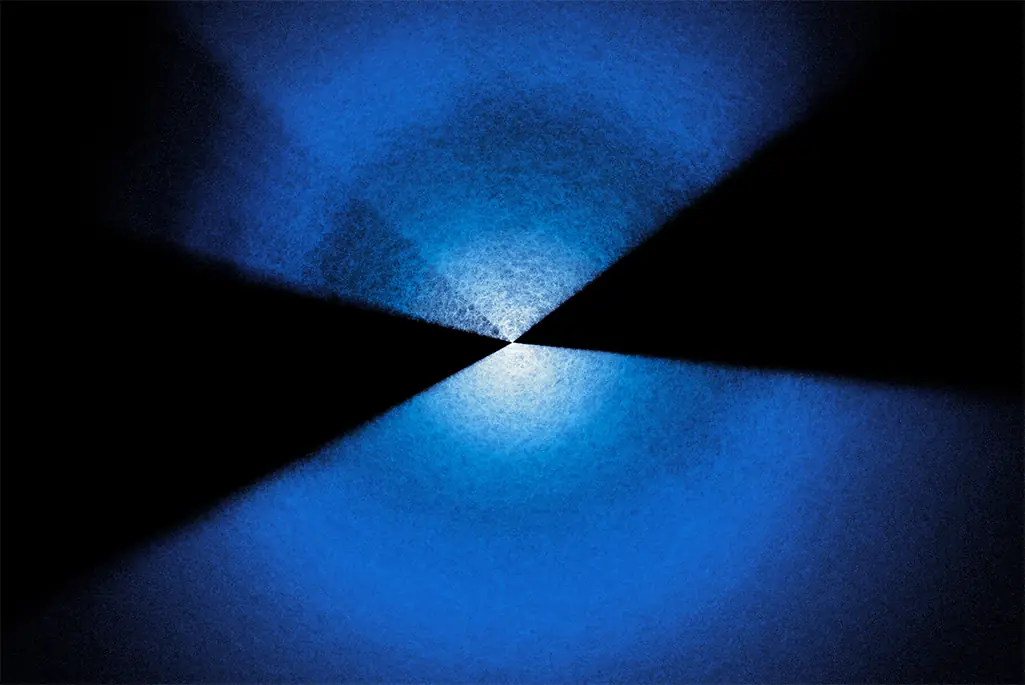 Researchers use DESI’s huge 3D map to study dark energy. Earth is at the center of this map, and every point is a galaxy. Credit: DESI collaboration and KPNO/NOIRLab/NSF/AURA/R. Proctor
By placing these light-emitting objects in a coherent three-dimensional relationship to one another, astronomers can indirectly visualize the large-scale gravitational architecture on which these celestial bodies rest, a cosmic web that acts as the skeleton of the universe.
To accomplish such an observational feat, the team maintains a full-time operational regime at the telescope located at the Kitt Peak National Observatory, a facility that, as Gontcho A Gontcho detailed, requires titanic logistics and uninterrupted human coordination.
The researcher described the effort as a monumental enterprise in which it is imperative to meticulously decide which sectors of the sky to scrutinize each night, constantly verifying that the resulting map is representative of the deep cosmos and that the data collected maintain internal cohesion to ensure the scientific validity of the whole.

Subscribe to our newsletter
Receive our news and articles in your email for free. You can also support us with a monthly subscription and receive exclusive (occasional) content.
To sustain this work pace and manage the avalanche of spectral information arriving from Arizona, the active and synchronized participation of more than twenty-five people is required, contributing at all times to the daily operations of the instrument, ensuring that the robotic mirrors point with micrometric precision to the targets selected from among millions of candidates.
At the academic end of this chain of scientific production, Professor Gontcho A Gontcho has established at the University of Virginia a working group composed of postdoctoral researchers, doctoral students, and undergraduates, all dedicated to assisting in the complex analysis of the data transmitted by DESI, unraveling the light signatures that hold the keys to universal expansion.
The data obtained through this spectroscopic survey allow scientists to scrutinize a primordial cosmic pattern imprinted in the fabric of the universe in each of its evolutionary eras, from its earliest and densest stages to the current configuration we observe.
Gontcho A Gontcho explained that, thanks to this immense amount of positional information, the team can observe how that structural pattern inherent to the cosmos has grown and distorted between two distinct moments separated by billions of years in the universe’s evolution, thus providing a kind of fossil record of the action of the fundamental forces that govern large-scale reality.
It is estimated that the total content of the universe is composed of approximately twenty-five percent dark matter, a component of still unknown nature that acts as the gravitational glue holding galaxies together in clusters and preventing them from dispersing due to their own rotation; meanwhile, an overwhelming seventy percent of the cosmos would be made up of dark energy, an even more enigmatic entity that exerts a negative pressure responsible for pushing galaxies apart and accelerating the expansion of space-time itself inexorably.
This visualization shows how DESI’s map of the universe accumulated over five years. It begins with DESI’s tiles on the night sky and transitions to the 3D map. Earth is at the center of the wedges, and every dot is a galaxy.
In characterizing the dual nature of these antagonistic forces, Gontcho A Gontcho turned to a biological analogy to illustrate the behavior of dark energy, describing it as a kind of cosmic growth hormone. In her words, dark energy drives the universe to expand faster and faster, a statement that constitutes the current frontier of human knowledge on this phenomenon.
The professor was categorical in stating that, although science has managed to measure with increasing precision what this exotic component does—that is, accelerate the separation of material structures—its intimate nature is completely unknown. Its elusive character lies in the fact that it pushes things to move away from one another but emits no light or electromagnetic radiation of any kind, making it an invisible agent to our telescopes; the only knowledge we have of it derives exclusively from the measurable and observable effect it has on surrounding objects and on the global geometry of the expanding universe.
The DESI project, initially conceived as a five-year survey and later promoted and extended to an eight-year campaign, has managed to capture the spectra of millions of distant galaxies, extremely bright quasars, and nearby stars in our galactic neighborhood.
The resulting three-dimensional graphical representation of this colossal database shows the relative locations of galaxies and reveals a texture that Gontcho A Gontcho compared to an impressionist painting, in which, by placing all these luminous points in a volumetric space, the recognizable silhouette of the dark matter structures on which they rest emerges before the researcher’s eyes.
The most relevant finding from this visualization is that this structure is not chaotic but possesses a defined and recurring pattern, a kind of cosmic signature that can be consistently identified and tracked along cosmic time, from the primordial universe to the present.