
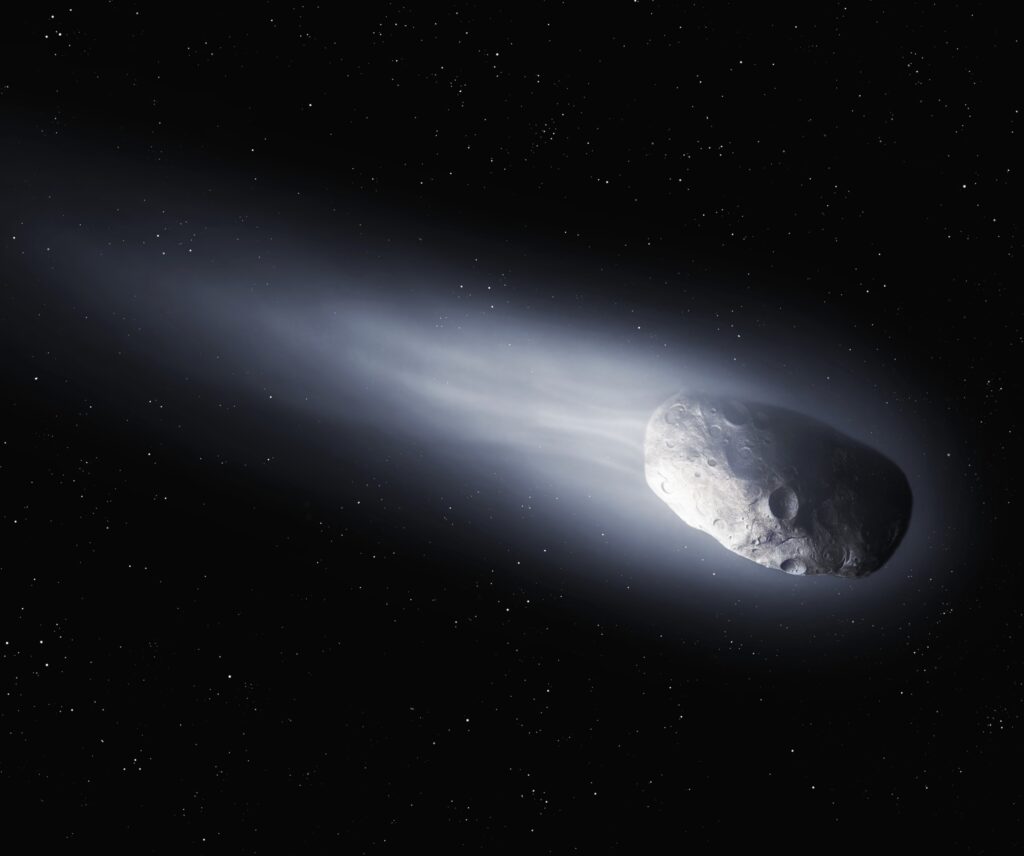
A new study has found that interstellar comet 3I/ATLAS, a rare icy object that came from outside our Solar System, carried far less carbon dioxide relative to water after passing the Sun.
Earlier observations had suggested a much higher CO2 content.

The discovery recasts the comet as a layered object whose outer surface and deeper interior do not release the same material.
The comet’s shifting chemistry
On January 7, 2026, the gas cloud around 3I/ATLAS showed a different oxygen-light balance than astronomers had seen before.
Researchers tracked that post-Sun glow with the Subaru Telescope, a large optical observatory on Maunakea in Hawaii.
Yoshiharu Shinnaka of Kyoto Sangyo University documented a lower carbon-dioxide-to-water balance than space telescopes had inferred earlier.
The contrast emerged after perihelion, the point in its orbit when the comet passes closest to the Sun, when solar heating had more time to expose material beyond the comet’s outermost layer.
Because gas in the coma comes from the nucleus itself, the new chemical mix points inward and sets up the question of what the comet was releasing before.
A signature in the coma
3I/ATLAS carries a visible coma, and that alone makes its chemistry easier to study than some earlier interstellar visitors.
That cloud of gas and dust streams off the nucleus, so its chemistry acts like a fresh sample of buried material.
As sunlight warms the surface, different ices vaporize at different times, which can make the mix change within weeks.
For this comet, a before-and-after comparison around perihelion became the heart of this story.
Why oxygen helps
Instead of measuring carbon dioxide and water directly, the team traced oxygen light released after sunlight broke those molecules apart.
When that breakup leaves oxygen in excited states, it emits faint forbidden lines, light produced by rare atomic transitions.
The balance between a green line and two red lines changes depending on whether water or carbon dioxide supplied more oxygen.
Because the red pair matched its expected 3-to-1 behavior, the researchers could trust that this oxygen clue was stable enough to use.
An odd benchmark
Most comets at roughly the same distance from the Sun show a lower green-to-red oxygen ratio than 3I/ATLAS did.
Only the earlier interstellar comet 2I/Borisov, another visitor from outside our Solar System observed in 2019, landed in the same neighborhood, which makes this newcomer look unusual but not alone.
That middle position matters because it places 3I/ATLAS above ordinary Solar System comets without pushing it into its own category.
So the result reads less like a one-off oddity and more like a sign of a broader interstellar family.
Heating near the Sun
Before passing the Sun, observations from JWST showed that 3I/ATLAS was releasing about 7.6 times more carbon dioxide than water at a distance of roughly 309 million miles.
That value placed 3I/ATLAS among the most carbon-dioxide-rich comets ever measured, far above ordinary long-period or Jupiter-family comets.
One idea held that long exposure to galactic cosmic rays, high-energy particles that travel through interstellar space, had chemically altered the surface.
If that outer layer was only skin deep, heating near the Sun could peel back the disguise and expose different ice below.
When the comet’s activity spiked
After perihelion, the SPHEREx space telescope – a mission designed to map the sky in infrared light – measured a much lower carbon-dioxide-to-water balance.
Meanwhile, another instrument on the James Webb Space Telescope reported much higher values in separate observations.
Those numbers disagree sharply, yet both teams saw a comet that was far more active after the Sun than before.
SPHEREx found water emission roughly 40 times brighter than in August, while MIRI also detected methane for the first time.
Rather than canceling the Subaru result, the spread shows that 3I/ATLAS was changing fast enough to confuse any single snapshot.
One reason for the mismatch is scale: each instrument sampled a different slice of the gas around the nucleus.
JWST looks through a relatively tight window, while SPHEREx sees a much wider area that captures more far-flung water.
If water spreads farther than carbon dioxide, a small view can make the comet look drier than it really is.
Subaru adds another wrinkle because its oxygen method depends on conversion models, so it offers independence rather than final certainty.
Months of solar heating
The simplest reading is a layered nucleus with surface material unlike what lies deeper inside.
Heat moves inward over time, and each fresh layer vents the ices that reach their boiling point first.
That would explain why carbon dioxide dominated before perihelion while water became more important after months of solar heating.
Other explanations remain possible, including changing active regions and short-term outbursts, so the layered picture is strong but not settled.
The search for interstellar objects
Each new visitor gives astronomers one more sample of how small bodies formed around other stars, rather than around our own.
“With the full-scale operation of survey telescopes in the coming years, many more interstellar objects are expected to be discovered,” said Shinnaka.
For scientists trying to compare planet-building material across star systems, that promise may become the real prize of this work.
3I/ATLAS now looks less like a comet with one fixed composition and more like a layered object revealing itself in stages.
Future surveys should show whether this kind of chemical change is rare, or whether most interstellar comets hide the same layered story.
The study is published in The Astronomical Journal.
—–
Like what you read? Subscribe to our newsletter for engaging articles, exclusive content, and the latest updates.
Check us out on EarthSnap, a free app brought to you by Eric Ralls and Earth.com.
—–