
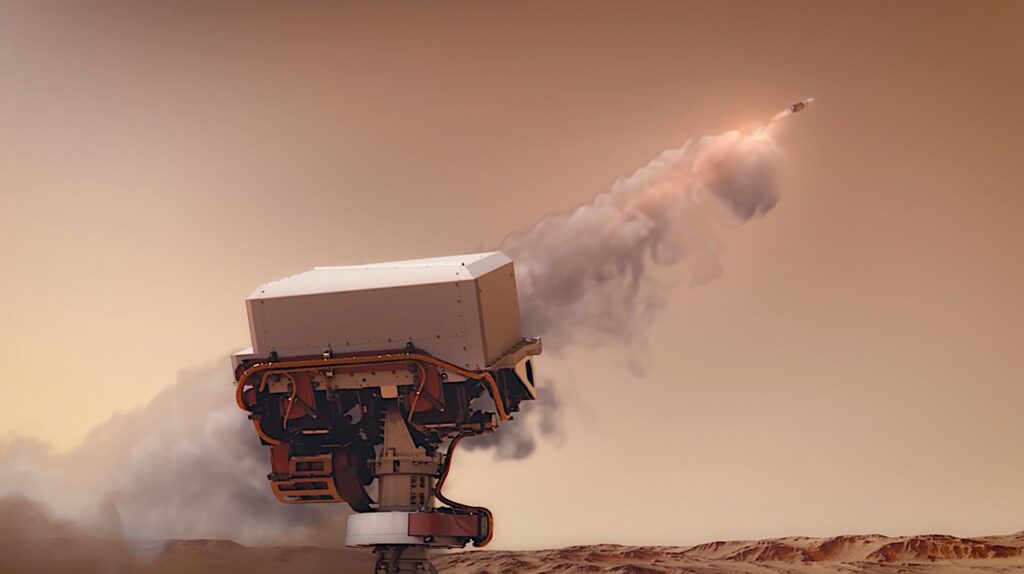
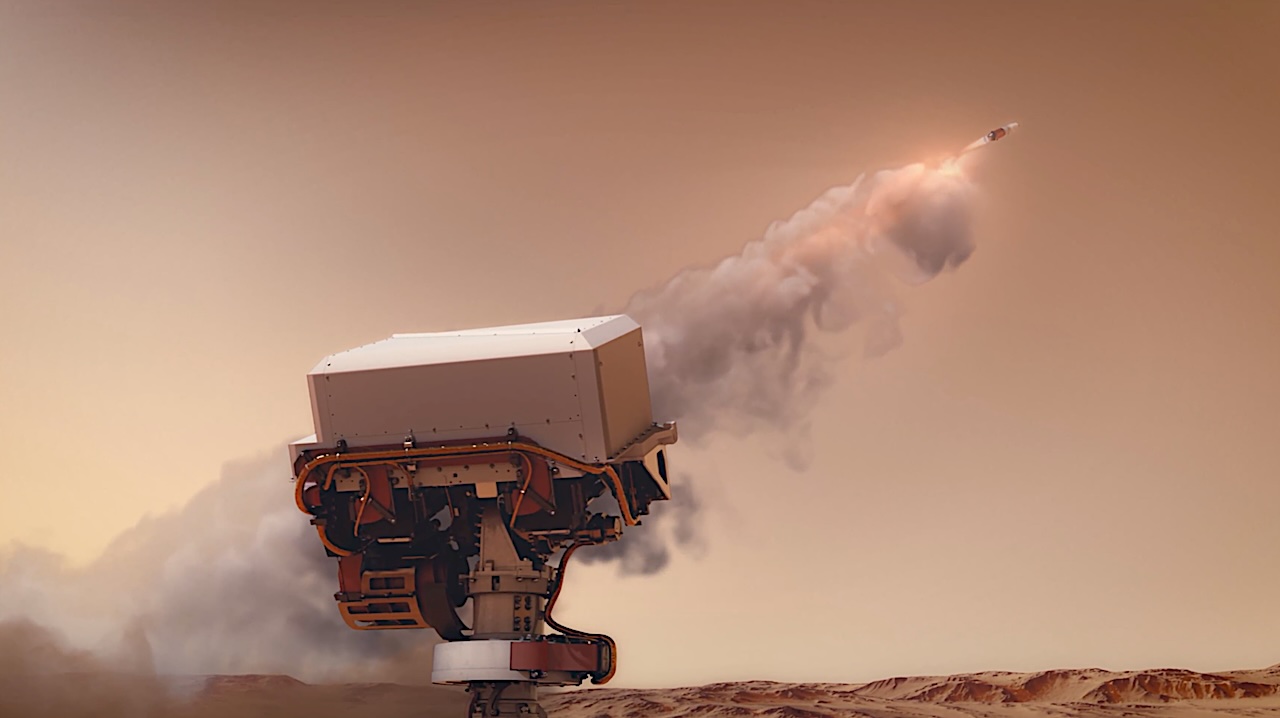
A droid watching Mars rocks leaving for Earth — NASA
Keith’s note: a letter was been sent by 4 Senators on 13 April 2026 letter to the Subcommittee on Commerce, Justice, Science and Related Agencies of the Senate Committee on Appropriations regarding NASA’s FY 2027 Science budget – specifically the Mars Sample Return mission. Full letter below
We respectfully request that you ensure a strong, sustainable future for the future exploration of Mars in the Fiscal Year 2027 Commerce, Justice, Science, and Related Agencies Appropriations bill. While Congress provided funding for NASA’s Science programs in last year’s appropriations, Mars exploration initiatives remained significantly underfunded and well below the House Appropriations level of $300 million. We are deeply concerned both by last year’s constrained funding levels and by the prospect of further reductions to NASA Science in the upcoming President’s budget request. If this funding trajectory continues and is not reversed, NASA’s Mars programs will face severe and irreversible harm, jeopardizing the United States’ ability to land spacecraft on the surface of Mars, not just in the near future, but for decades to come. More below
NASA’s Mars missions demand world-class, cutting-edge technologies developed through decades of experience, technical leadership, and relentless innovation. These extraordinarily complex and difficult missions to Mars have pushed the limits of engineering and scientific capability, inspiring the nation while solving challenges once thought impossible. The specialized workforce, infrastructure, and expertise required to achieve them cannot be quickly reconstituted and if lost, it would take many years to rebuild.
As the top priority of the community-led Planetary Science Decadal Survey, the Mars Sample Return (MSR) mission is a powerful example of the United States resolve to undertake bold and technically demanding challenges in pursuit of scientific discovery and space exploration. The sophisticated capabilities developed over the past decade to enable MSR—including precision entry, descent, and landing; launch and ascent from the Martian surface; secure sample retrieval; and safe re-entry to Earth—underscore both the extraordinary complexity of the mission and the formidable challenges that still lie ahead. If the nation intends to retrieve samples from Mars— and ultimately send humans there and safely return them—these critical capabilities must be sustained, improved upon and funded now, not deferred with an uncertain future. Missions to Mars require a complexity that depends on the ingenuity of the country’s leading scientists and engineers, whose groundbreaking innovations continue to expand the boundaries of what is possible.
As we set sights on the high ground of space exploration, we must preserve our presence and talent, tackle the next challenges that enable eventual human missions to Mars, and build upon a foundation of success as reflected by the numerous American flags that already sit on the Martian surface. Any erosion of vital infrastructure and intellectual capital would deliver lasting damage to the U.S. economy and undermine our leadership on the global stage in science and technology. In addition, we cannot allow the U.S. to cede the high ground to the Chinese government that is already working to land their own robotic Mars missions.
We respectfully urge the Committee to provide funding for NASA’s Mars exploration efforts by providing at least $400 million in FY 2027 to the Mars Future Mission program.
We also respectfully urge that the following report language be included in the Fiscal Year 2027 Commerce, Justice, Science, and Related Agencies Appropriations bill:
“The Committee continues support for the Mars Future Missions program and includes $400,000,000 to advance various technologies that are critical for robotic and human exploration. The Committee notes that NASA should maintain the capabilities developed for the Mars Sample Return mission that are critical to the success of human exploration of the Moon and Mars including the entry, descent and landing of significant assets on the Moon and Mars. In this effort, NASA is encouraged to leverage commercial capabilities for components and systems and transfer technology and expertise to industry partners, enabling lower-cost solutions while preserving NASA’s expertise for technologically novel challenges.”
We thank the Committee for your consideration of this important request and for your support for the Mars exploration in previous fiscal years. We look forward to working with you to complete Fiscal Year 2027 appropriations legislation that ensures a strong, sustainable future for NASA’s science and exploration programs and maintains U.S. leadership in space. Sincerely,
Adam B. Schiff, United States Senator
Alex Padilla, United States Senator
Mark Kelly, United States Senator
Ben Ray Luján, United States Senator