
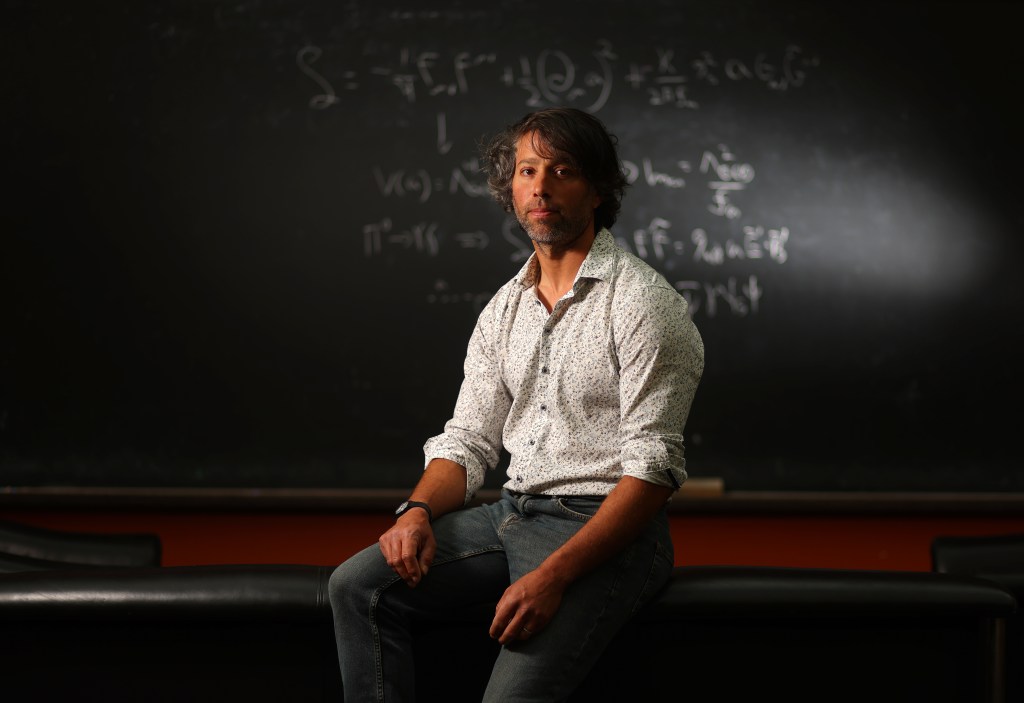
While Hollywood may be the city of stars, the Breakthrough Prize honored three Bay Area scientists with “Oscars of Science” on Saturday in recognition for their efforts to answer questions that have eluded mathematicians and physicists for decades.
The Breakthrough Prize, an organization founded by Silicon Valley titans of industry in 2012, awards $3 million annually for major scientific advancements to elevate researchers to celebrity status and inspire a new generation to tackle the greatest questions in mathematics, physics and life sciences.
“I hope that all of these awards, not just the New Horizons, but scientific awards more generally, can bring a spotlight on what’s happening in the scientific community,” said Benjamin Safdi, a University of California, Berkeley physicist and 2026 New Horizons in Physics award winner. “I hope that people read the stories from these awards and learn what people are doing and feel compelled by that to support science.”
Along with Safdi, the Breakthrough Prize awarded New Horizons in Mathematics awards to both UC Berkeley associate professor Yunqing Tang and Stanford University associate professor Otis Chodosh. Together, they represent the Bay Area’s brainpower of the Bay Area’s leading research institutions where the pursuit of knowledge has shaped the modern world.
At the Sloan Mathematics Center at Stanford, Chodosh specializes in Riemannian geometry exploring the structural properties of spaces that often exist in higher dimensions. His award recognizes his contributions to settle several questions in differential geometry that had puzzled mathematicians since the 1970s and 1980s.
“Math is not quite a science, and it’s not quite humanities. We have no experiment,” Chodosh said. “They make hypotheses, we call them conjectures. And then the replacement for the experiment is called a proof. And so you essentially have a logical deduction, step by step.”
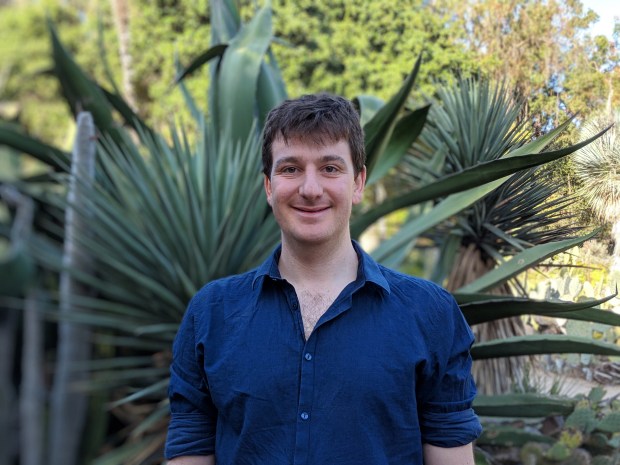 Stanford associate professor Otis Chodosh received the 2026 New Horizons in Mathematics award from The Breakthrough Prize for helping settle questions on differential geometry that had existed since the 1980s.
Chodosh’s collaboration with fellow mathematician Chao Li proved a central conjecture in the field of “scalar curvature,” realted to shapes that can be continuously shrunk to a single point, in high-dimensional spaces. Then with Christos Mantoulidis and Felix Schulze, Chodosh resolved a key problem in the geometric analysis of minimal surfaces, such as a soap film spanning a wire loop.
Mathematics research has changed immensely in the past 50 years, he said. The days of the secluded mathematician chalking up a blackboard have largely given way to a collaborative spirit as math has become increasingly technical. Like an enzyme that works as a catalyst to speed up a chemical reaction, collaboration ignites new ideas for conjectures.
The same is true at UC Berkeley, where Tang worked with Vesselin Dimitrov and Frank Calegari on the “unbounded denominators conjecture” to find a significant breakthrough in number theory and modular forms. It confirms that modular forms are not just random functions; they follow a rigid hierarchy. The beautiful order of math, she said, is like a language to her that she uses to understand the world.
“These objects not only arise from the number theory aspect, they come from our understanding of the universe,” Tang said. “When (my colleagues) put everything into the mathematical language, everything suddenly makes more sense to me.”
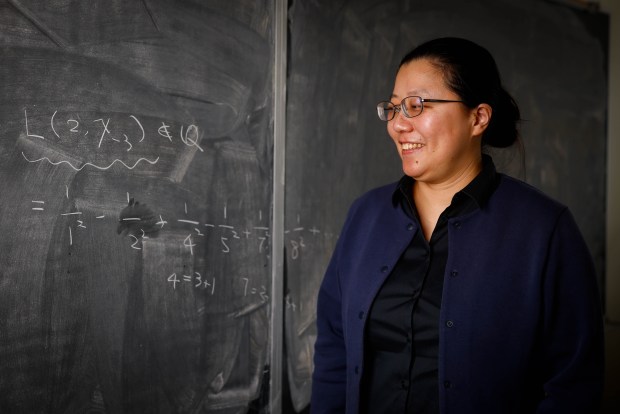 Yunqing Tang, the winner of the 2026 New Horizons in Mathematics Award, stands next to a chalk board with her award winning work at UC Berkeley in Berkeley, Calif., on Friday, April 10, 2026. (Shae Hammond/Bay Area News Group)
With her office overlooking the Campanile to the south, she reflected on the historical achievements that had been made on UC Berkeley’s campus, like Fields Medalists Richard Borcherds and Wendell Fleming. She said the math department is not only an example of prestige in her field, but a source of inspiration from working with her colleagues, students and post-docs that supports her to chase dreams – as long as there is funding for it.
Safdi hopes the award will build public awareness of the sciences and grow support for additional federal funding. This comes as the Trump administration proposed a more than 50% cut in the National Science Foundation’s budget. He said that Berkeley is the “best place” to study physics in the United States, and “maybe the world,” but scientists like himself cannot do the work without financial support.
The great question that Safi hopes to answer is to identify an axion. Axions are a theoretical subatomic particle that have existed as a concept since 1977 to explain the dark matter that makes up 85% of the universe’s mass. No scientists have been able to find axions so far, yet Safdi can’t conceive of a universe without them.
“I have trouble imagining a world in which they don’t exist because they so naturally solve so many problems that we have: they emerge very naturally in the context of string theory, and in the context of our ideas for how the universe works at its most microscopic level,” Safdi said. “I truly believe that these particles may exist.”
But technological advances are giving physicists like him more powerful tools. One of these experiment models, ABRACADABRA, employs high-sensitivity radio to capture the faint hum of axion’s oscillating magnetic fields thanks to the close cooperation of UC Berkeley and Lawrence Berkeley National Laboratory.
Safdi said he believes that the search for the axion is one of the most scientific inquiries in the long-term history of humanity, marking a milestone for science on par with quantum mechanics or Albert Einstein’s theory of relativity, theories that now undergird the GPS systems in phones and cars today.
“The world is changing rapidly but this question is not going anywhere. It’s a question about most of the matter in the universe,” Safdi. ” I find that this problem is immovable. It will always be there until we solve it. And I think I can help make that happen.”