
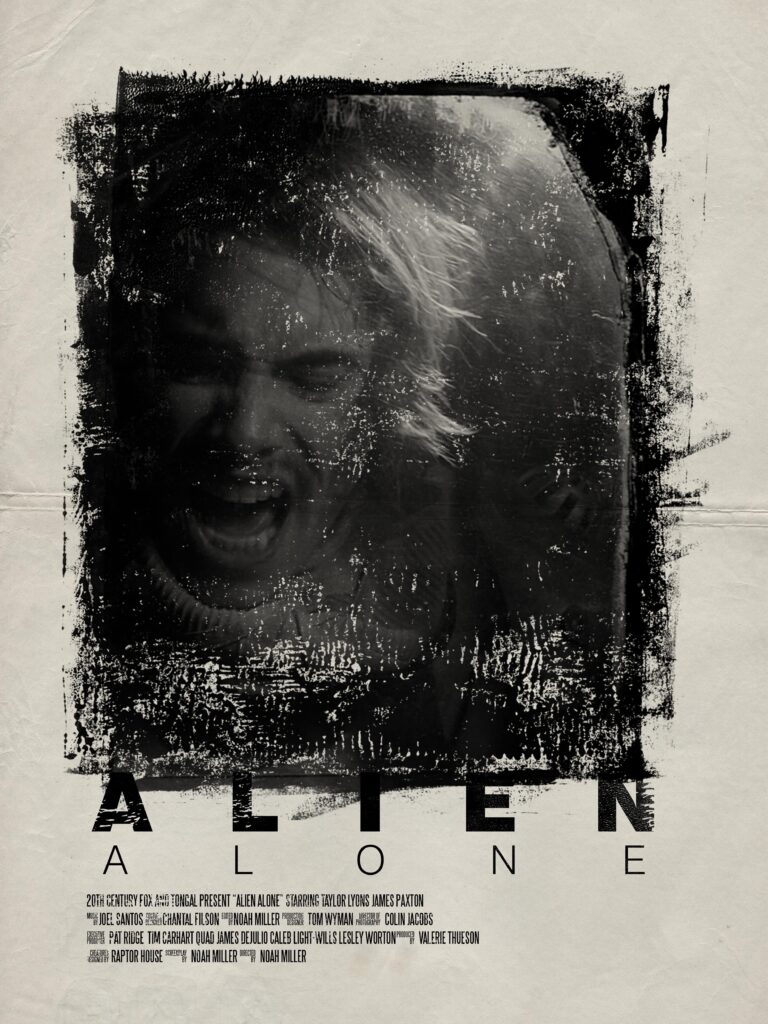
To celebrate the 40th anniversary of Ridley Scott’s Alien, 20th Century Fox partnered with Tongal to release six official short films set within the franchise’s universe. One of the standout shorts, Alien: Alone, was directed by Noah Miller. A writer and director working with Los Angeles-based Ridge Production, Miller has a background in music videos, commercials, and independent narrative features. As a lifelong, passionate fan of the Alien franchise, he brought a gritty, practical-effects-driven vision to his addition to the mythos.
Alien: Alone stars James Paxton as Macwhirr (you can read our James Paxton Interview here), an ill-fated scavenger who boards a derelict ship and encounters a severely degraded, abandoned synthetic named Hope (Taylor Lyons). In this interview, Miller breaks down his intensive, sleep-deprived pitching process to Fox and Tongal and explains the creative decisions behind his unique narrative. He also delves into the realities of indie filmmaking, detailing how his team utilised a custom animatronic Facehugger from Raptor House, repurposed an official Xenomorph suit from Alien: Covenant, and why casting James Paxton felt like the perfect tribute to his father’s legacy in the franchise.
You can listen to the interview below and read on for a transcription. Please note that the accompanying transcript has been edited for clarity and brevity.
https://www.avpgalaxy.net/files/podcasts/avpg_pc_episode086.mp3
Pitching to Fox & The Concept of ‘Hope’
Alien: Alone Poster
Aaron Percival: First off, thank you for coming on and chatting. Who are you and what do you do?
Noah Miller: I am a screenwriter and director. I do a lot of music videos, a couple of short films, and one or two features that I will never say the name of that are out there in the world. I am just an early-in-my-filmmaking-career sort of guy. I work at this company called Ridge Production, which is one of the partners in this whole thing, and we do the same sort of thing: music videos, recap videos for trade shows, short films, commercials, a lot of commercials lately. In my heart, I am a narrative filmmaker till the end. That is where I am at.
Aaron Percival: Do you remember the first time you saw Alien, and which of the films would you say is your favourite?
Noah Miller: Weirdly enough, I do not remember the first time. I am sure I was four years old seeing it on some VHS or some awful television cut over the radio. There is something about that gritty, worn-down version of it that kind of works on its own anyway. Out of all of them, Alien is clearly my favourite for a lot of different reasons. When I was in college studying writing, my film professor handed me the Alien Walter Hill draft, and that was what I learned to write from. I probably read that script a hundred times over and over again, and then from there tore apart Alien as a film because it is so well documented.
Aaron Percival: Moving on to the filmmaking process, let’s talk Alien: Alone. More specifically, I wanted to ask you about your experience with the pitching process. As I understand it, it was a two-stage process with an initial pitch, which was then given further funding to be developed even further. Can you tell us a little bit about that process and how your short, Alien: Alone, developed over the course of pitching?
Noah Miller: There wasn’t a whole lot of change in development. The original pitch was a page and a half, I think, and I did that on a throwaway whim. I am like, “This is not going to be a thing that happens.” I think it was 3:00 AM, maybe an hour before the pitch process closed, and I just threw together a document with this idea that was rattling around in my head and went to bed. Two or three weeks later, I found out that we were in the pitch video process with sixteen other people.
That is when I decided to go full bore. I took one of the computers home from work, which was really nice of them to let me do that, and stationed it in my living room. We had just moved in here, so it was empty. I had to go buy a janky desk off Craigslist and sat on a very uncomfortable folding chair and worked for four or five days straight putting together this pitch video. I had a concept artist put together a bunch of work. We did the entire story from beginning to end. So we made a full animatic of the entire thing and did sound effects and voice acting and the whole process all the way through because I wanted it to be like, if I was going to get rejected, I wanted to be rejected for my entire idea rather than, “What if I had said this? What if I had done this?”
I took that into After Effects and did a bunch of minimal animation, colour correction, lights twinkling and that sort of thing, just to make it as professional as I could get it. I went the opposite of the 3:00 AM throwaway pitch thing. Other than that, there wasn’t anything in that pitch that really changed that much from beginning to end. I think the only thing was just developing a couple of characters a little more.
Aaron Percival: Is that typical of your experience with the pitching process of shorts?
Noah Miller: Not particularly. Shorts, there isn’t a whole lot of pitching involved. You sort of just go out and do it yourself. There isn’t a whole lot of short funding out there, which made this pretty unique. Someone is like, “Here is one of the largest and most austere franchises in the world, and here is 30k, do you want it?” Like, “Yes, yes, I would like those things.” Which is a lot different from, “I have to find a way to get four people together and somehow shoot something interesting in my house.” So, yeah.
Aaron Percival: How hands-on were Fox and Tongal during the production?
Noah Miller: They weren’t incredibly hands-on, actually. There were notes passed back and forth in the screenwriting phase. Mine were pretty minimal. There were notes thrown back and forth during editing. Those were less minimal, but they were correct. I think they are used to dealing with people to make things so that they could see things I couldn’t see about what should and shouldn’t be on screen to make it entertaining.
If it were up to me, I would have done an entire real-time shoot of her just walking around the ship. Just all atmosphere, you would love it! But beyond that, they were pretty hands-off besides the basic production stuff that has to go into it, like which contracts you have to get signed, release forms, and what you can and cannot do because it is a non-union project. I think they got what they wanted early on and were happy to let us play and develop, which is also its own amazing thing. I would have expected a lot more back and forth. I think the only thing I ever pushed back on, which I still did not quite get—and at this point, it is a joke that I keep bringing up to them mostly in jest—is the font used for the Alien title. It is slightly different from what I wanted.

Alien: Alone Title Card
Aaron Percival: What did you want to go with?
Noah Miller: The adapted version of Helvetica was the original one. Even though I ended up not using them, the text font for… I had a whole thing written out for the crew etc. That was done in a version of Helvetica that was slightly blurry to match the original look, but they have a very specific one that they’re using across the franchise, which makes sense. They want their stuff to look the same all the way across the board. Brand identity is pretty important.
Aaron Percival: Alien: Alone is probably the most unique out of all the other anniversary shorts because it played around a bit more with the story than the others do. It is my favourite because of that. I wanted to ask you a bit about that concept. Where did it come from? Was this a story you had tucked away in the back of your head, or was it born from the criteria of the competition?
Noah Miller: Story-wise, I have got a couple of other features and short films that take place on broken ships in the middle of nowhere, just because maybe that is a really nice setting that I like. But more or less, it was built out of what I had available. I could afford an actor, I could afford a set, but it is not going to look good, so it had better look junkier. I cannot do a full-grown Xenomorph, so I am not particularly interested in the chestburster because all it does is run away. So I have got a facehugger and I have got one person, and how do I make it so they can be together and they are not just chasing each other around and I can tell a story? Synthetics are generally not an enemy to the facehugger, and the facehugger is not generally an enemy to the synthetic. So if the two of them were sitting there, what would they do? That was kind of where it came out of.
Aaron Percival: Did you have a lot of thought into how that interaction would go, or was it always just sort of that buddy kind of feel? Because I think that is disingenuous towards it. Did you experiment with how those interactions could go, or were you always just sold on this?
Noah Miller: I was always aware of the fact that I didn’t want it to be like, “Oh, she has got a pet and she is in love with it and it loves her,” like that sort of thing. I did not want that at all. I know that the facehugger does not care about her in any way whatsoever. There is even a line where it is only drawn to my presence. That is it. It feels motion and it gets near her. It is all in her sort of degrading head. Because of that, it was always interesting to me to be like, “How can somebody delude themselves into thinking that this thing is worth caring for?” And if I can make the audience care for it at the same time without breaking any of the established stuff, then I think I am in a good place.
Aaron Percival: I think that worked, personally. One of the things I really love about Alien: Alone as well is that it is like getting to see my favourite unmade scene get made. And that is a scene from Jon Spaihts’ Alien: Engineers screenplay where David coaxes a facehugger out of an egg and onto Dr Watts, who would be Dr Shaw in Prometheus. I was wondering if that was intentional on your part. Did that script influence Alien: Alone at all?
Noah Miller: I actually have not read Alien: Engineers. I have been meaning to. It is sitting on my hard drive, actually, probably on my hard drive on my last computer, but I never got around to reading it. That particular scene actually came out of the fact that I could not find a way to do a realistic, cinematic jump and grab onto the face. I just couldn’t find a way to do it. It was a lot more interesting to me if, instead of being in the same way that we were turning everything to the left when we were making this, is that instead of it being this very dramatic, shocking, and it is over, it was a long, drawn-out scene where our male character, James’s character, had to endure seeing this thing slowly creep towards it. I thought that would be a lot more shocking than, “Oh, it’s over with.” Because I want every character to have to live with what is going on, rather than just being one-and-done and out in a second.
Aaron Percival: That is fair. So that was born out of means?
Noah Miller: It was born out of means, but it also made sense. It clicked in my head at one point where it was like, “Oh, of course it is dying, so it is not going to jump at him.” And that way, we can make that moment a lot more interesting for Taylor’s character, Hope, because she gets to essentially take part in this process. Which was because originally it was just to throw him in the lab, lock it, and then it happens. It was a lot more meaty for her character to actually go through the process of placing the facehugger onto his face.

Taylor Lyons as Hope in Alien: Alone
Aaron Percival: I can agree with that one, actually. That works a lot better as well, given the bond. I know what I mean. But speaking of Hope then, one of the criticisms of Alien: Alone has been in the portrayal of her, the last surviving crew member of the vessel, who is a synthetic. You have alluded to me in previous conversations that you had reasons for her specific portrayal and you developed an extensive backstory for Hope. So I was wondering if you could just elaborate on this for our listeners.
Noah Miller: The simple version of it is just that she is very, very old. She looks like Taylor, our actress, who is in her twenties, but the character herself, Hope, is somewhere in her eighties. She is one of the oldest still-functioning synthetics from her particular line.
I had this story for her where she had gone from being the top of the line in the middle of a ship, respected in a way because the people would listen to her, and then as the years went on, she would be demoted farther and farther down and put on junkier and junkier ships, and there would be less maintenance done, and she would be out farther and longer. It was just what happens to that old tool when you have used it so often and passed it off, and it has gone to Goodwill, and someone picked it up at Goodwill, and then they have used it and beaten it up. It is that type of character. She has been through a lot, and is essentially at, now she is at a status level where Brett’s character is at in Alien. She is just the “you go do this because it might hurt one of us, so you do it.” Severely degraded and severely abused, I guess.