
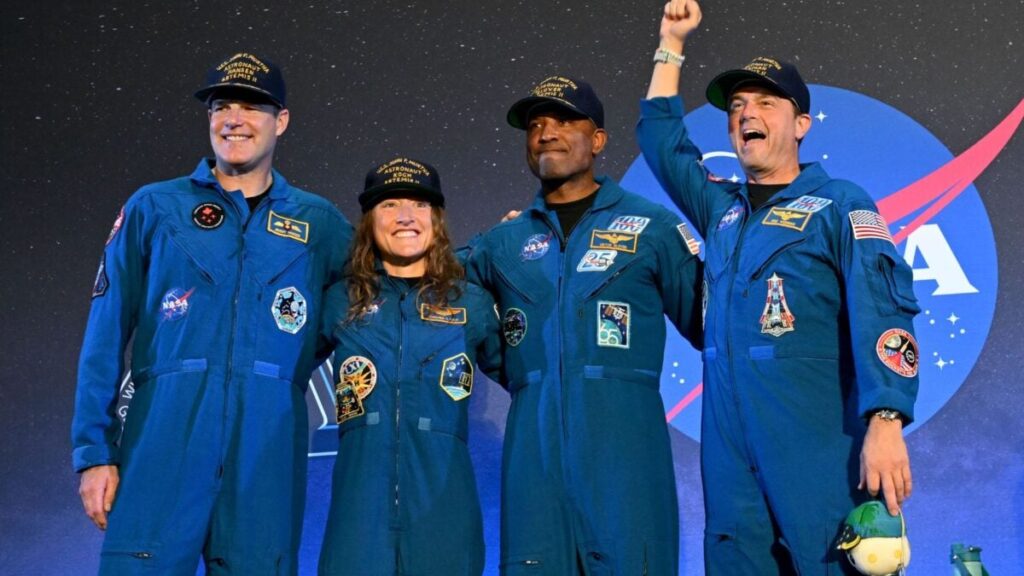
It’s been one week since NASA’s Artemis 2 mission returned to Earth, marking the end of a historic 10-day flight. We’re now entering the next phase of the mission, when scientists and engineers will begin sifting through the mountain of data that Artemis 2 produced.
Over the course of their mission, NASA’s Reid Wiseman, Victor Glover, Christina Koch, and the Canadian Space Agency’s Jeremy Hansen captured stunning images of the Moon and conducted groundbreaking research on the health effects of spaceflight. They also traveled farther from Earth than any human had gone before, completing the first crewed test flight of the Orion spacecraft.
For this Giz Asks, we asked experts on lunar science, astronaut health, and aerospace engineering what they will learn from Artemis 2 now that it has returned. Their responses underscore the incredible scientific value of this mission, which will help advance our human spaceflight capabilities and knowledge of our cosmic neighborhood.
These responses have been lightly edited for space and clarity.
Dorit Donoviel
Executive director of the Translational Research Institute for Space Health (TRISH), a $250M NASA-funded consortium of Baylor College of Medicine, California Institute of Technology, and Massachusetts Institute for Technology. TRISH funds research and technologies to help keep astronauts safe and healthy on deep space missions.
The Artemis 2 crew carried miniature tissue chips that were created using their own stem cells. This study, called AVATAR, allowed NASA to investigate the effects of 10 days of microgravity and exposure to deep space radiation on each astronaut’s tissues (in this case, only bone marrow was simulated) but on a miniature replica.
Characterizing the impacts of space on these mini bone marrow chips derived from each astronaut—and comparing them with changes in the astronauts’ own blood cells (which are derived from bone marrow)—will help validate this platform as a reliable predictor of how astronauts respond to deep-space exposure. The Translational Research Institute for Space Health (TRISH), a NASA-funded consortium based at Baylor College of Medicine, pioneered the standardization of these human tissue chips so labs can produce them consistently.
TRISH also tested many different organs in a simulated space radiation environment at Brookhaven National Lab. The vision of the SENTINEL initiative is to test these astronaut-derived tissue chips before the astronauts embark on deep space missions to predict potential tissue damage and identify personalized medications that could prevent it. Someday, this could also help personalize cancer treatment, or treatment of other diseases.
Through the Standard Measures study, NASA has been documenting how humans adapt to space in a standardized manner to better understand what normal adaptation is and what might lead to short- or long-term health problems. Most of the standardized data on changes in balance, bone, muscles, heart, vision, cognitive abilities, immune function, and more comes from astronauts on the International Space Station, which is still slightly protected from space radiation by Earth’s atmosphere.
The Artemis 2 crew was the first to provide Standard Measures data after exposure to deep-space radiation. The space health research community will learn about the effects of deep-space radiation and microgravity on the human body from comparing the changes in [the] Artemis 2 crew to those who have spent equivalent time in microgravity but were still protected by our atmosphere, such as Shuttle-mission astronauts.
Julie Stopar
Senior staff scientist at the Lunar and Planetary Institute, where she leads research on lunar geology and surface evolution.
Artemis 2 marks a major success and is an inspiration, demonstrating why we explore. But it’s also giving scientists a fresh perspective of our ancient neighbor in the sky.
During the mission, the Orion capsule and its crew looped around the Moon’s far side, following a carefully planned and practiced program of photography and real-time observations. From their unique vantage point, they captured views that we never see directly with our own eyes, including the far side of the Moon in eclipse and the Earth rising over the far side horizon.
Artemis 2 had many objectives, one of which is to advance lunar research. From my perspective as a geologist, I see the returned photographs and crew observations as adding crucial human perspective to interpretations made using spacecraft instruments and Earth-based telescopes. For example, Orion’s trajectory provided unique viewing angles and lighting conditions of the Moon’s impact basins—huge scars left by ancient collisions. Seeing those features in new ways might help us better interpret the complex landforms left behind.
The human eye is very skilled at noticing sharp contrasts as well as subtle variations. During the mission, the Artemis 2 crew reported slight color variations associated with volcanic regions and impact craters. Color differences are the result of the minerals present on the surface. Their real-time descriptions of the Aristarchus Plateau, for example, match our expectations of a thick surface layer composed mostly of volcanic glasses.
We’ve known that glass is present from studying data collected by orbiters and Earth-based telescopes since Apollo, but the new Artemis 2 observations add new context. For example, they will help identify boundaries of the glassy deposits, clarify relationships with craters, and reveal areas containing the richest and most uniform glassy deposits.
The key thing to keep in mind is that there’s nothing quite like seeing a place for yourself. At the same time, additional precise, high-quality scientific measurements are needed to advance our understanding going forward.
Artemis 2 has been a resounding success, providing key scientific context and insight, and I look forward to seeing what new discoveries are made with the data. But I am also looking forward to the missions that will place additional instruments in orbit and on the Moon’s surface, and return as many samples as possible to Earth. These future missions will enable the next huge leaps in our knowledge of the Moon’s geology and surface.
Michael Lembeck
Chief technical officer of StarSense Innovations and aerospace industry expert with over 45 years of technical and programmatic experience.
On April 10, 2026, the Artemis 2 crew splashed down after a nearly 10-day journey that took them 252,756 miles from Earth—farther than any human had traveled since Apollo 13 in 1970. The courage, dedication, and professionalism of this crew, and the thousands of engineers who supported them, deserves genuine recognition. Getting four humans around the Moon and back safely is never routine, and the people involved should be proud.
That said, an honest engineering assessment of Artemis 2 reveals a program that validated heritage rather than advanced the state of the art. The Space Launch System traces its lineage directly to Space Shuttle Main Engines and solid rocket booster technology from the 1970s. The Orion capsule’s blunt-body reentry architecture mirrors Apollo. Even the parachute recovery at sea echoes procedures NASA mastered half a century ago.
To be fair, NASA did employ some modern engineering tools in building the program. Digital twins were used in Orion operations support, model-based systems engineering informed the SLS core stage design, and high-fidelity simulation environments verified flight software before launch. These are real advances in engineering methodology and deserve acknowledgment.
The problem is what those modern tools were applied to. Despite decades of development time, billions of dollars, and the full toolkit of 21st century systems engineering, the result is a rocket that could deliver only 27 metric tons to trans-lunar injection, roughly half of the Saturn V’s capacity. With 50 years of engineering progress, NASA built a rocket less capable of reaching the Moon than the one it replaced. The Apollo/Saturn V system accomplished single-launch lunar landings with 1960s technology. The current architecture cannot.
What Artemis 2 ultimately proves is that sophisticated tools applied to a constrained, politically driven architecture cannot overcome fundamental design compromises. As an engineering program, it is a monument to institutional inertia more than innovation. The real engineering question going forward is whether NASA can transition from validating the past to building the future, before the private sector renders the question moot entirely.
Cherie Oubre
Science Integration Office project scientist for NASA’s Human Research Program. Oubre oversees human research activities conducted before, during, and after spaceflight.
Artemis 2 is just the beginning: NASA wants to build a sustained presence on the Moon. A Moon base! For that to happen, we need to pinpoint exactly how the human body reacts and adapts to spaceflight and develop measures that counter spaceflight hazards, because when astronauts build that Moon base, we need to keep them healthy. Human health research done on Artemis 2 lays the foundation for that work.
We have a good idea of how humans react to time in the International Space Station, but living space on the space station is roughly the size of a six-bedroom house. On Orion, living space is the size of a camper van. That’s why we developed a science experiment where some Artemis 2 astronauts wear an actigraphy device for their entire mission, allowing us to track their sleep, exercise, movement, light exposure—factors important to us understanding more about their behavioral health in space.
We also developed a study that documented astronaut’s immune responses in space. Did you know that stressors can cause viruses to reactivate in the human body? We want to see how that plays out in deep space. Artemis 2 astronauts collected saliva samples for us, blotted on special paper. Saliva contains a wealth of information about immunity and about individuals’ microbiomes, and we’re analyzing that to learn more.
We’re also taking a suite of data from Artemis 2 astronauts now that they’re back on Earth, from MRIs, eye exams, blood draws, cognition tests—a host of measures that we’ll compare to baselines taken before spaceflight. In particular, the astronauts are conducting obstacle courses of sorts that test their balance and adaptation back into Earth’s gravity. We’re doing this because when future astronauts build that Moon base, we want to know how quickly after landing on the Moon they’ll be able to accomplish mission-critical tasks.
Jim Head
Louis and Elizabeth Scherck Distinguished Professor Emeritus of the Geological Sciences at Brown University. Head studies themes of planetary evolution and the role of volcanism and tectonism in the formation and evolution of planetary crusts.
My first job was at NASA during the Apollo Lunar Exploration Program (Apollo 7 through Apollo 17), working on landing site selection, astronaut training, traverse planning, and mission operations. As a planetary geoscientist, I study the geological processes that form and modify planetary surfaces to understand their history and fill in the missing chapters of Earth’s history.
If we want to know where we are going, we need to understand where we have been—that is, Earth’s formative years and childhood, which have largely been erased by erosion and plate tectonics.
Thanks to data obtained by the NASA Lunar Reconnaissance Orbiter (LRO) and other satellites, we already know a lot about the Moon. In many cases, these orbiters produce observations at much higher resolution than the Artemis 2 mission was capable of. But the illumination conditions and viewing geometry are constantly changing, and thus scientists will study the unique contributions from the Artemis 2 data very carefully.
I will be looking at the Orientale Basin, the freshest impact basin in the Solar System and a window into the early history of our home planet. The series of bright impact flashes the Artemis 2 crew observed during the eclipse (a meteor shower—what are the odds!?) are also amazing. We will be looking for the resulting craters in future LRO images.
Finally, the most important thing we have already gained from the Artemis 2 images is the awe and wonder of seeing the crescent Earth emerge from behind the Moon after the eclipse. As with the Apollo 8 “Earthrise” image, this scene will inspire the next generation of scientists and engineers to take humanity to even greater heights.