
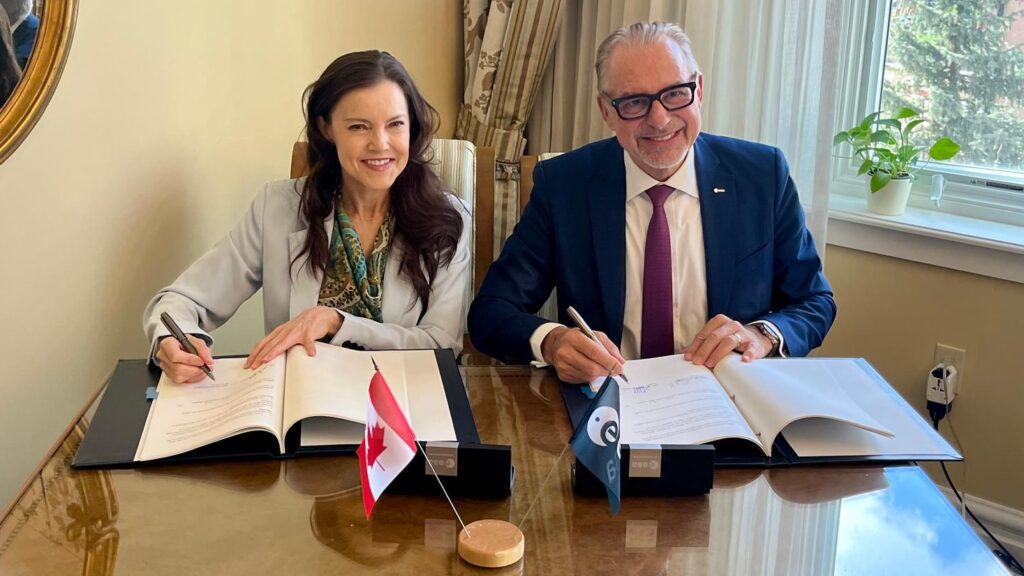
The Canadian Space Agency (CSA) and the European Space Agency (ESA) have signed a General Security of Information Agreement (GSOIA), establishing the legal framework required to securely exchange classified information between the two agencies.
CSA President Lisa Campbell and ESA Director General Josef Aschbacher signed the agreement on April 14 at the Space Symposium in Colorado Springs. While the legally binding framework establishes how the agencies will handle classified data, its real significance lies in enabling Canada’s growing focus on dual-use space capabilities alongside its European allies.
Historically, the lack of a formalized security framework restricted Canadian aerospace and technology companies from accessing or bidding on sensitive, high-value ESA contracts. Canada is ESA’s only non-European cooperating state, a status it has held since 1979.
“This agreement marks another important milestone in the evolution of Canada’s partnership with Europe,” said CSA President Lisa Campbell following the signing. “By deepening our ability to work together in exchanging classified information with ESA, we are creating new opportunities for innovation, supporting Canadian industry, and advancing shared objectives in space.”
Because the CSA operates strictly as a civilian agency, participating in programs that overlap with national security requires careful navigation. The GSOIA acts as that bridge. It provides the legal foundation for Canada’s late-2025 announcement of a $528.5 million investment targeting dual-use technologies with Europe.
The agreement also clears the way for Canada’s newly formalized subscriptions to ESA initiatives like the European Resilience from Space for Earth Observation (ERS-EO) and FutureNAV programs. Both of these multilateral efforts rely on secure situational awareness and jam-resistant navigation. To build components for these networks, a binding security agreement was a prerequisite for Canadian participation.
The practical need for this framework is already evident as Canadian firms increasingly operate in sensitive European domains. Recently, Toronto-based Kepler Communications secured a $30.1 million prime contract for ESA’s HydRON optical network, while Dominant Information Solutions Canada (DISC) was selected to participate in ESA’s Cybersecurity Makerspace Program.
Moving forward, the GSOIA ensures that as the European Space Agency continues to procure next-generation classified and dual-use space infrastructure, Canadian companies will have the necessary security clearances to integrate into the supply chain as an important partner.
“In today’s geopolitical context, secure and trusted cooperation is not only essential – it is strategic,” Aschbacher stated. “By enabling the exchange of classified information, we are unlocking new opportunities to advance critical technologies, strengthen our industrial ecosystems and reinforce our collective capacity to act.”
Related