
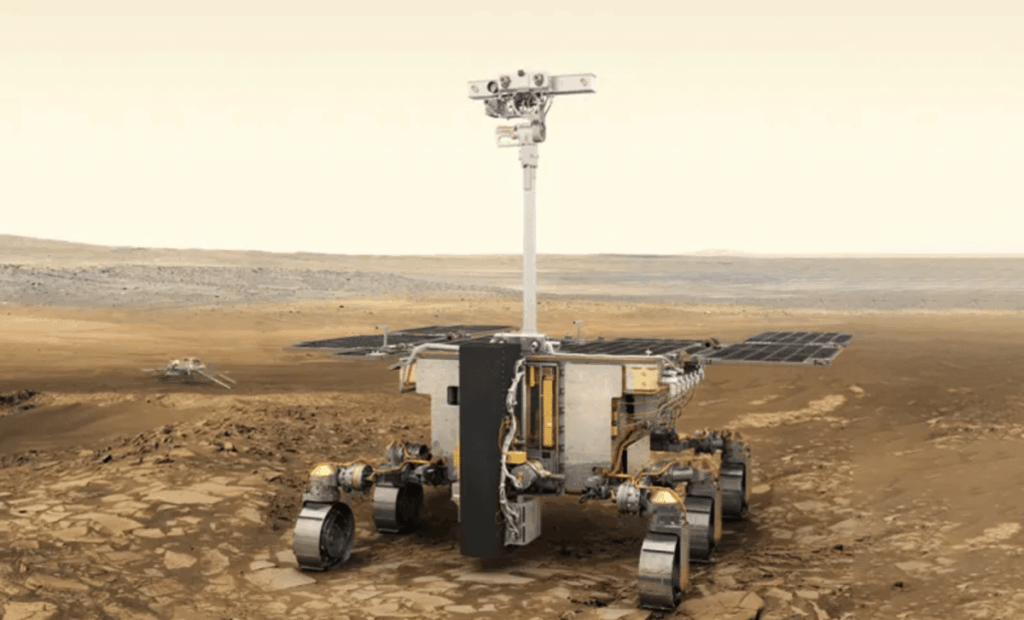
NASA has officially launched the implementation of its support for the European Space Agency’s (ESA) Rosalind Franklin mission to Mars, slated to launch in 2028. This mission holds the promise of being the first to search beneath Mars’ surface for signs of life, past or present. As NASA provides vital components and advanced technology for the mission, this collaboration could open the door to groundbreaking discoveries, possibly answering one of humanity’s most enduring questions: Is there life beyond Earth?
The Rosalind Franklin Mission: A Giant Leap for Mars Exploration
Scheduled for launch in late 2028, the Rosalind Franklin rover will be the first to embark on a journey to Mars with a singular, life-altering goal: to explore the planet’s subsurface for evidence of life. While the surface of Mars has been extensively studied, the search for life beneath its dusty crust is an unexplored frontier.
NASA’s commitment to supporting this mission reflects a deep investment in understanding the Red Planet’s geology, atmosphere, and, most significantly, its potential for sustaining life. The mission, led by ESA, will focus on Oxia Planum, a region of Mars believed to hold clues to the planet’s past environmental conditions and potential for habitability.
And here I am, at New Scientist Live, a few years ago with a spare of the camera from the top of the mast on Rosalind Franklin, and Mars scientist Catherine Regan from @eyesonmars_uk can’t wait to see the mission launch @esa @NASA https://t.co/64YXCuC1Ed pic.twitter.com/tWFlQY68he
— Dan Roach 🛩️ FRAS 🔭 (@dannydenfisch) April 17, 2026
NASA’s Role in the Mission: Providing Vital Technology and Support
NASA’s role in the Rosalind Franklin mission is both extensive and vital. Through the Rosalind Franklin Support and Augmentation (ROSA) project, NASA will provide crucial components that ensure the rover’s success. This includes the launch service, braking engines for the rover’s lander, and radioisotope heater units that will help keep the rover’s internal systems operational in the harsh Martian environment.
One of the most exciting contributions from NASA is the Mars Organic Molecule Analyzer (MOMA), a mass spectrometer designed to detect organic molecules. These molecules could reveal the building blocks of life, offering profound insight into whether Mars ever supported life forms.
This collaboration marks a significant milestone for NASA and ESA, demonstrating the strength of international cooperation in tackling the most challenging scientific questions. In 2024, NASA and ESA formalized their partnership with a Memorandum of Understanding, which laid the groundwork for the ROSA project’s initiation. The project has since passed all necessary reviews and is now moving into the final stages of preparation ahead of launch.
SpaceX’s Falcon Heavy: The Rocket That Will Carry Rosalind Franklin
As part of the mission, NASA has selected SpaceX’s Falcon Heavy rocket for launch. The massive rocket, capable of carrying heavy payloads to distant destinations, will take off from Launch Complex 39A at NASA’s Kennedy Space Center in Florida. This launch is set to be a major milestone not only for NASA but for private space companies like SpaceX, which continue to play a key role in facilitating space exploration missions.
The choice of Falcon Heavy reflects NASA’s strategic approach to working with private entities to achieve the shared goal of deep space exploration. With its proven success in delivering payloads to space, Falcon Heavy stands as the perfect candidate to deliver the Rosalind Franklin mission to Mars.
The Road to Mars: A Timeline of Key Milestones
The road to launching the Rosalind Franklin mission has been a long one. After the signing of the Memorandum of Understanding in 2024, the project moved through its Preliminary Design Review and successfully entered Phase B. This phase involves refining the design and ensuring that the mission’s components are ready for the challenging conditions of space travel and Martian exploration.
As we approach 2028, NASA and ESA are working in tandem to finalize the hardware and prepare for launch. The next few years will be crucial as both agencies continue to collaborate on one of the most ambitious Mars missions ever undertaken.