
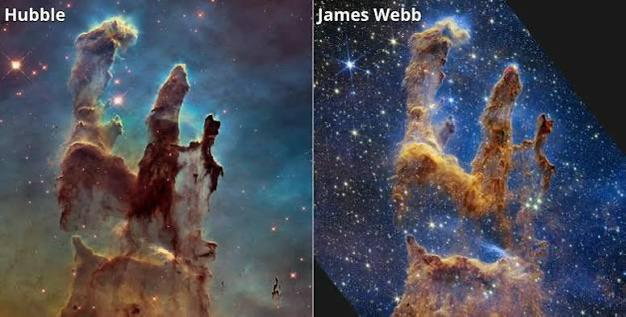
So the title pretty much sums it up. Is the universe older than we thought or do galaxies simply form differently than we previously thought?
I can’t seem to get a straight answer without bias but curious on an analytical standpoint as I’m not well versed like some here. I saw something about how far back the James Webb telescope can actually see and it had me asking “Will we eventually see the big bang”. Proving or disproving the Bible. I found my answer. Sort of… (Strictly here for the title question).
But, left questioning this on my quest down the rabbit hole. Curious on your stance for the title question though.
by Illustrious-Path4005
19 Comments
many stars are older than the predicted age of universe by CMB
Why do you think it’s either of those things?
Honestly probably both. We are just toddlers trying to make sense of the universe.
By far the most straight foward answer can be that it is simply older then we thought (i’d say)
Neither.
Bias? What bias?
Proving or disproving the Bible? Lmfao
It seems to be the case that structure formation occurs much more rapidly than predicted by LCDM in the early universe. You get this naturally in modified gravity theories as the typical acceleration in early times is well into the regime where gravity is boosted, though these have other problems.
>Galaxies in the early Universe appear to have grown too big too fast, assembling into massive, monolithic objects more rapidly than anticipated in the hierarchical Lambda cold dark matter (ΛCDM) structure formation paradigm. The available photometric data are consistent with there being a population of massive galaxies that form early (z ≳ 10) and quench rapidly over a short (≲1 Gyr) timescale, consistent with the traditional picture for the evolution of giant elliptical galaxies. Similarly, kinematic observations as a function of redshift show that massive spirals and their scaling relations were in place at early times. Explaining the early emergence of massive galaxies requires either an extremely efficient conversion of baryons into stars at z > 10 or a more rapid assembly of baryons than anticipated in ΛCDM. The latter possibility was explicitly predicted in advance by modified Newtonian dynamics (MOND). We discuss some further predictions of MOND, such as the early emergence of clusters of galaxies and early reionization.
McGaugh, Stacy S., James M. Schombert, Federico Lelli, and Jay Franck. 2024. “Accelerated Structure Formation: The Early Emergence of Massive Galaxies and Clusters of Galaxies.” The Astrophysical Journal 976 (1). The American Astronomical Society: 13. doi:10.3847/1538-4357/ad834d.
There’s been a really good theory on the universe being like twice as old as we thought that also rids the garbage fucking placeholder particle that is dark matter.
I think we will find out shortly that our measurements at intergalactic distances, using redshift and the “standard candles” is giving us our errors.
There is/are many things in the intergalactic medium that we cannot yet detect, which greatly interferes with any distance or time measurements based on the redshift or luminosity of sources outside our own galaxy.
Check out PBS Spacetime on youtube—they have a great collection of videos that might help you go further down the rabbit hole
Link to specific big bang playlist: [the big bang and the early universe](https://youtube.com/playlist?list=PLsPUh22kYmNAV2T4af0Di7bcsb095z164&si=qaiS55IUp6qYQEwp)
Don’t worry about basing this stuff on Religion, that’s your own personal choice. How far back we can see depends on how long the light takes to get here. What are you asking about? The Big Bang is a theory so it’s hard to be sure what we will discover.
Scientists have an idea of how the Universe formed and a lot of clues of how old it is and the age of the Universe doesn’t seem to be in question, rather how galaxies form isn’t completely understood yet. JWST will not be able to see back to the Big Bang at all.
After the Big Bang happened, for a time the Universe was incredibly hot and all particles in it were bouncing around wildly, so light particles (photons) could not “shine” as such. Current models say once it expanded further and cooled down, the Universe went dark and gas and dust particles started to accumulate, and gravity made these clouds collapse in on themselves until nuclear fusion ignited inside of them and that’s how the first stars began to shine and there was light in the Universe for the first time.
Because telescopes (and humans) only make observations in all wavelengths of light (the electromagnetic spectrum) we could potentially see back to the first stars, but not beyond that time since there’s no light to observe.
All this information is based on many years of observations of the Universe with several telescopes, and many mathematical models and computer simulations. It’s not complete but so far it’s the best idea we have of how the Universe formed.
You can see the big bang right now! Or rather the echoes of the Big Bang. The cooled off embers of it, if you will.
We measure all that quite often.
It’s called the Cosmic Microwave Background Radiation.
What does it have to do with the bible? Why would anything out there prove the bible? The very existence of anything more than 6,000 years old (which is virtually everything in existence) disproves the entire book.
The pictures shown don’t seem relevant. These star-forming nebulas (nicknamed “the pillars of creation”) are within our own galaxy. We’re not seeing them far back in time. Maybe they’re there to show the improvement by the JWST?
The point of view of most astronomers is that the early formation of galaxies is surprising but does not require a major re-thinking of our whole framework.
We can’t see back further than 380,000 years after the Big Bang, because the Universe was not transparent back then. It’s like looking through a fog. There WILL be some ways around that, studying neutrinos, studying the polarization of the radiation from 380,000 years after the Big Bang, building better theories of matter and gravitation.
The Bible and astronomy don’t really mix. The Bible is not a work of science. What exactly would the Bible predict that any telescope would see?
Webb is not really the instrument to see furthest back, we’ve had telescopes to see the CMB, the radiation from 380,000 years after Big Bang, like Planck or WMAP. Webb is probing the first stars to form and the first galaxies to form. That was millions of years after the Big Bang.
Right now the frontier in the origin of the universe is the inflationary phase of the Big Bang. Don’t look to science to answer ultimates. Look to science to carefully go one step after the other into the unknown.
Look like the hand of god.
That’s a nebula, not a galaxy.
Probably Yes and Yes, probably.
it just goes on forever in bubbles.