
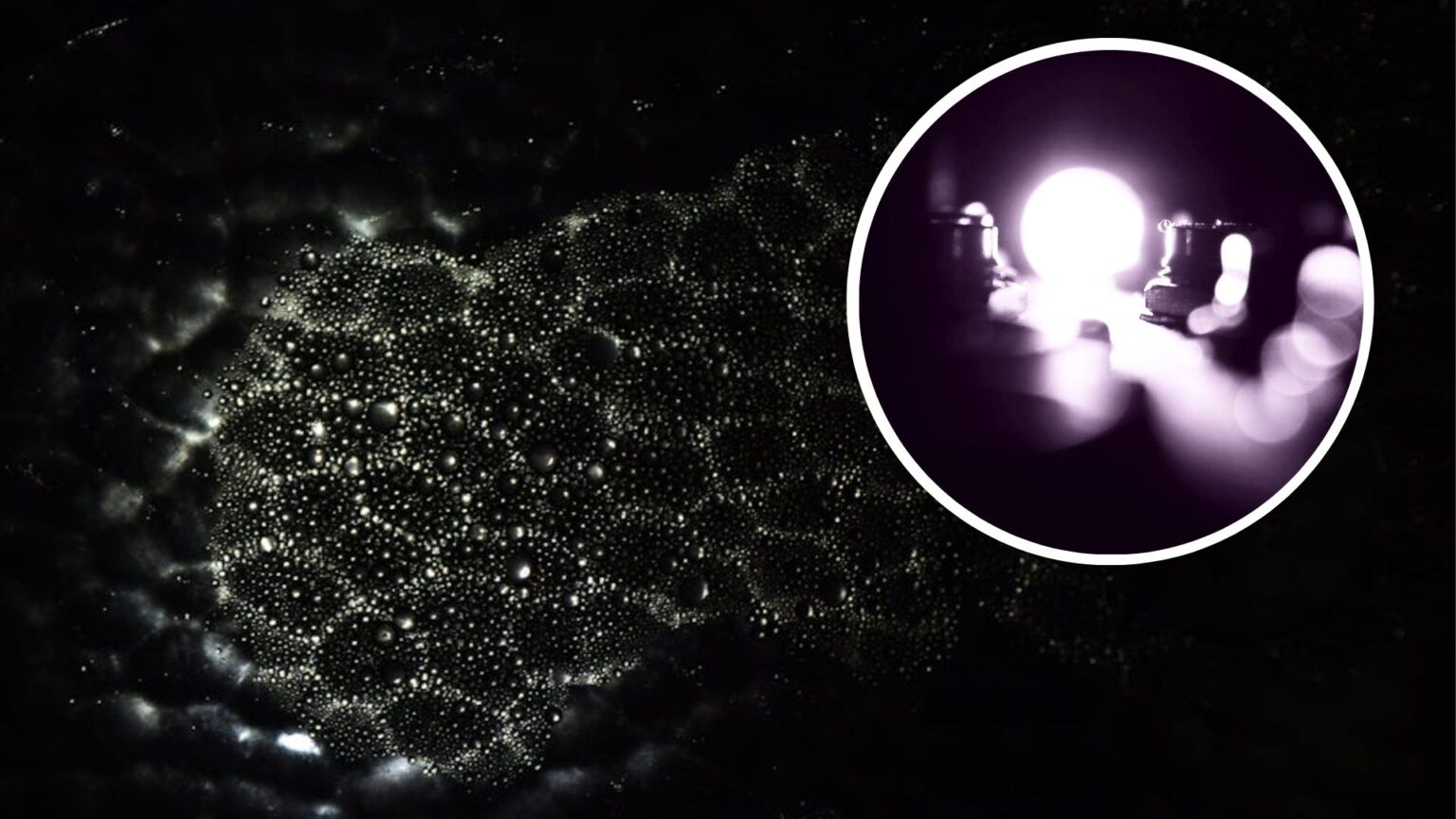
A team of researchers from the Technion-Israel Institute of Technology has achieved a major breakthrough in the field of electron microscopy. They provided the first direct experimental evidence of so-called “dark points” within light waves.
Their findings, published in Nature, confirm a decades-old theoretical prediction that these points—also known as optical vortices—can move faster than the speed of light under specific conditions.
First proposed in the 1970s
The research was led by Prof. Ido Kaminer along with a multidisciplinary team of scientists and international collaborators from institutions including MIT, Harvard, and Stanford.
At the heart of the discovery are tiny regions within a light wave where the intensity drops to zero. These regions, referred to as vortices or “null points,” behave like holes embedded in the wave structure. Similar vortex patterns can be observed in everyday phenomena such as swirling water or air currents, but their existence in light waves—and their unusual motion—has long intrigued physicists.
The idea that such vortices could exceed the speed of light was first proposed in the 1970s, though it remained unproven experimentally until now. At first glance, this appears to contradict Theory of Relativity, which establishes the speed of light as the ultimate cosmic speed limit.
However, the researchers clarify that this principle applies only to objects with mass and to signals that carry energy or information. The vortices observed in this study do neither; they are simply points of zero intensity within a wave, meaning their superluminal motion does not violate fundamental physical laws.
Highly advanced experimental setup
To observe this phenomenon, the team developed a highly advanced experimental setup at the Technion’s electron microscopy center. By combining a laser system with a specialized electron microscope and a precise opto-mechanical arrangement, they achieved unprecedented levels of spatial and temporal resolution. This allowed them to track the rapid movement of these dark points with remarkable accuracy.
The experiments were conducted using a material known as hexagonal boron nitride (hBN), where light behaves in an unusual way. In this medium, light forms hybrid excitations called polaritons—often described as “light-sound” waves—which travel significantly slower than light in a vacuum. This slowing effect creates the conditions under which the vortices can appear to move faster than light itself, effectively “jumping” across the wave.
Beyond confirming a long-standing theoretical prediction, the discovery has far-reaching implications. It reveals underlying principles that apply broadly across different types of wave systems, from fluid dynamics to quantum materials. More importantly, it introduces a powerful new method for studying ultrafast and nanoscale phenomena. By tracking these vortices, scientists gain a new way to map processes that were previously too fast or too subtle to observe directly.
The breakthrough could influence a wide range of fields, including advanced microscopy, nanophotonics, superconductivity, and quantum information science. By enabling researchers to visualize and analyze the most fleeting interactions in nature, this work opens the door to deeper insights into how complex physical systems behave at their smallest and fastest scales.