
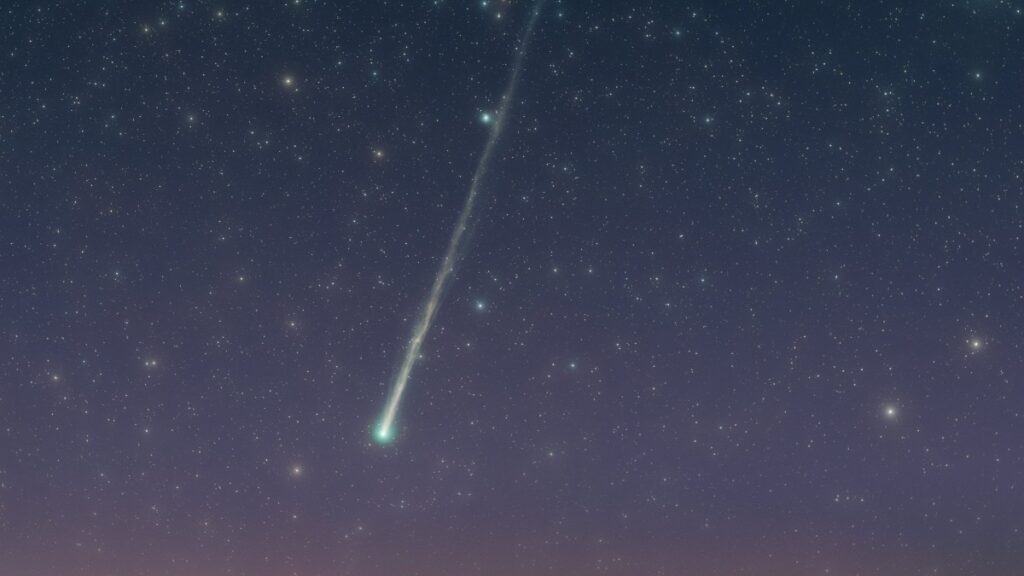
If you’ve ever wanted to spot a comet without a telescope, this is your week.
For those interested more in the skies than the ground you stand on, look up at Comet C/2025 R3 (PANSTARRS), a visitor from the far edges of our solar system that’s putting on a show in the predawn sky.
It’s already bright enough for binoculars or small telescopes, and by April 18 it could reach magnitude 4, which is a brightness level that means many people might see it with just their eyes from a truly dark spot.
COMET TRAVELLING FOR ALMOST 2 LAKH YEARS
Comets are icy lumps left over from the birth of our solar system.
When they swing close to the Sun, they heat up, grow glowing tails, and become visible from Earth.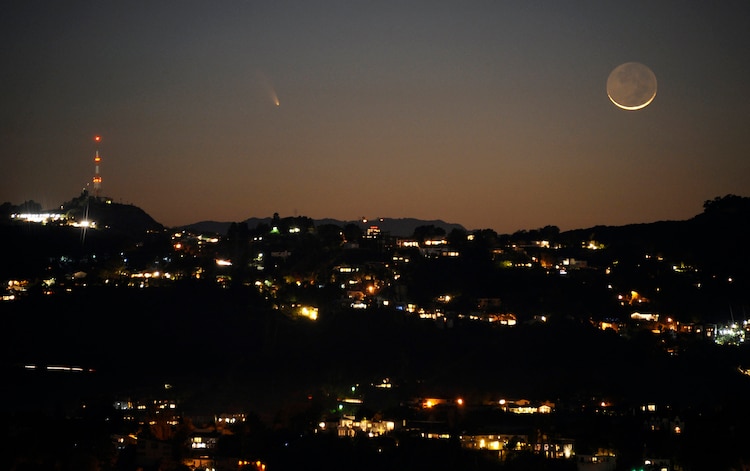
The comet PANSTARRS is seen next to the waxing crescent moon. (Photo: Reuters)
This one is special because it’s a long-period comet, taking roughly 1,70,000 years to complete one giant loop around the Sun. This makes the opportunity to catch a glimpse of it even more valuable.
The comet is now racing toward its closest point to the Sun, called perihelion, which arrives on April 19.
A week later, around April 25–26, it will pass nearest to Earth. That’s when it should shine its brightest.
But, as the comet gets closer to the Sun, it will also drift lower in the sky and become harder to see from the north.
HOW TO WATCH THE COMET IN INDIA?
Right now, skywatchers in the Northern Hemisphere, including those in India, have the clearest view.
The comet is low in the eastern sky about 90 minutes before sunrise, near a simple square of four bright stars called the Square of Pegasus.
Star Walk, a mobile app used for stargazing, has photos and finder charts which can help show the comet’s exact path from April 17 to 24 around 5:30–6:00 am IST.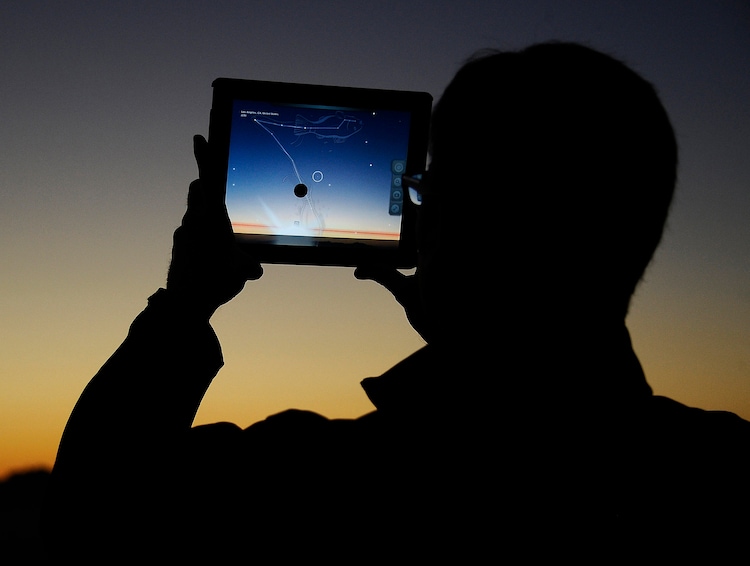
A man using an app on an iPad to line up the passing comet. (Photo: Reuters)
In places like Delhi, Mumbai, or Bengaluru, sunrise is typically around 6:00–6:15 am in mid-April, so set your alarm for 4:30–5:00 am IST.
To catch it, find a dark spot away from city lights, such as rooftops or open fields outside major towns, and face east. Binoculars make it much easier to spot it, but under clear, moonless skies you might see it using just your eyes.
Keep in mind that by the end of April the comet will shift south and slip into the Sun’s glare, ending prime viewing for the north.
After that, the southern skies will get the best show. Whether you snap a quick photo with your phone or simply stand in awe, this is one of those rare moments when the universe puts on a free show. Set your alarm and stay ready to enjoy the comet while it’s here.
– Ends
Published On:
Apr 17, 2026 12:11 IST