
When I built my first telescope, a 15cm reflector, it was in my back garden! Location was the least of my problems but imagine trying to do the same thing with a somewhat larger telescope at an altitude of 18,400 feet above sea level! The summit of Cerro Chajnantor in Chile’s Atacama Desert is higher than the Everest base camp, in air so thin that every visitor must carry supplemental oxygen and pass a medical examination before being allowed up. The road to the top is unpaved, the weather brutal, and the temperature unforgiving. And yet, on April 9th, more than a hundred scientists, engineers and dignitaries made the ascent to celebrate the inauguration of the Fred Young Submillimeter Telescope (otherwise known as FYST, pronounced “feast”) and it’s a 6 metre instrument that has been three decades in the making.
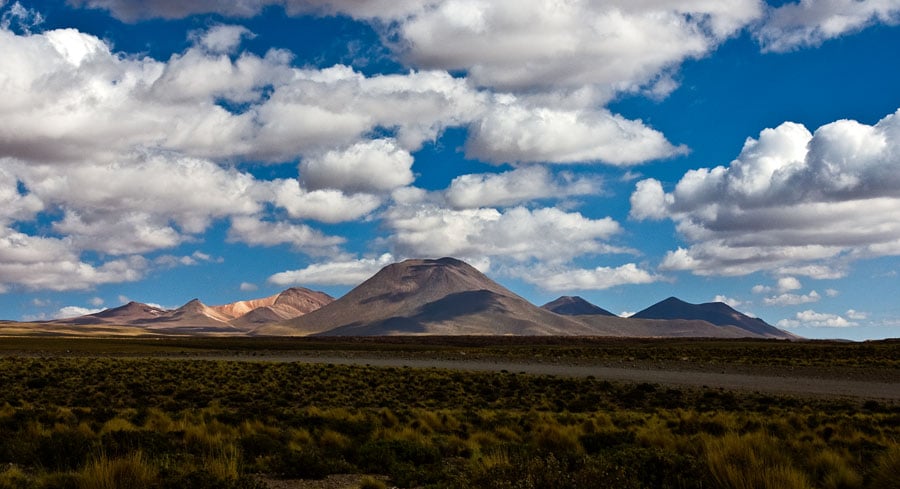 A new telescope has been installed atop the summit of Cerro Chajnantor in Chile’s Atacama Desert (Credit : Gerard Prins)
The altitude is not an accident however. Submillimeter light, wavelengths shorter than a millimetre, sit between infrared and radio waves on the electromagnetic spectrum and are almost completely absorbed by water vapour in the atmosphere before it can reach instruments on the ground. The Atacama Desert is one of the driest places on Earth, and at nearly 5,600 metres the air above Cerro Chajnantor is exceptionally thin and dry. It is, quite simply, one of the best places on the planet to observe at these wavelengths and FYST has been designed to exploit that advantage to the fullest.
The telescope is built for speed. Its innovative Crossed-Dragone optical design (two mirrors are tilted at angles to each other rather than aligned along a single axis, eliminating obstructions and delivering exceptionally clean images across a wide field) allows it to sweep large areas of sky rapidly in each exposure. Its primary instrument, Prime Cam, can hold up to seven interchangeable detector modules and will field over 100,000 superconducting detectors giving it a mapping speed more than ten times faster than any previous submillimeter observatory. That makes FYST less like a traditional telescope pointed at individual targets and more like a celestial movie camera, building up deep, wide surveys of the sky in a part of the spectrum that has never been systematically filmed before.
 Temperature map of the cosmic microwave background measured by the Planck spacecraft (Credit : ESA/the Planck Collaboration)
The science agenda is correspondingly ambitious since FYST will probe the cosmic microwave background in the search for the fingerprint of primordial gravitational waves predicted by inflation theory. It will map galaxy clusters across the history of the universe, trace the formation of stars hidden behind dense clouds of dust and study the epoch of reionisation. Submillimeter light passes straight through dust that blocks visible wavelengths, revealing structures that are otherwise completely invisible.
The telescope is a project of the CCAT Observatory, an international collaboration led by Cornell and including institutions from Germany, Canada and Chile. It was built in Germany from a specially formulated steel alloy called Invar which was chosen because, unlike ordinary steel, it barely expands or contracts with temperature changes. The entire structure was then disassembled, shipped across the Atlantic and trucked 300 miles across the Andes before being reassembled at the summit. When first light comes, FYST will begin repaying thirty four years of patience and hard work with a view of the universe that no telescope has offered before.
Source : Major new telescope on Chilean summit opens window on universe
https://news.cornell.edu/stories/2026/04/major-new-telescope-chilean-summit-opens-window-universe