
First Proof That Solar Maximum Reduces Radiation by 40%
Securing Key Data for Astronaut Safety Standards
The low Earth orbit space radiation detector “LEO-DOS,” developed with independent Korean technology, has successfully completed its 2-year and 9-month mission. This marks Korea’s full-fledged entry into the stage of independently securing high-precision space radiation observation data.
In particular, the mission is significant in that it has provided observational evidence showing that as solar activity intensifies, the influx of space radiation from outside the Earth actually decreases. This confirms with real data the role of the Sun as a “natural shield” protecting the Earth.

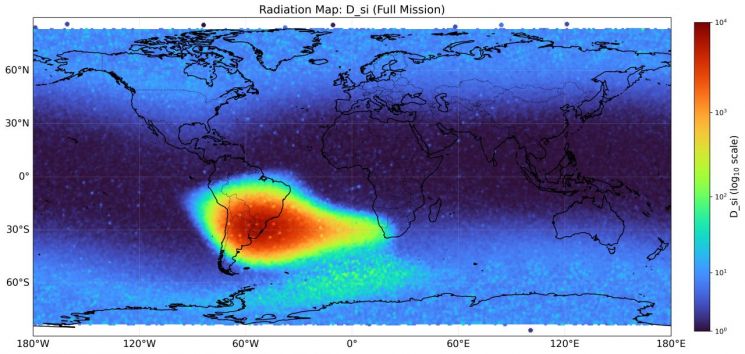
Cumulative Charged Particle All-Sky Map. All-sky map of global space radiation (charged particles and neutrons) observed by Leodos during its mission period (closer to red indicates higher cumulative radiation dose). By conducting a detailed investigation of the radiation environment above the polar regions, where observations from the International Space Station (ISS) orbit were not possible, it filled the global observation gap. Provided by Korea Aerospace Administration (KASA)
On April 15, the Korea Aerospace Administration (KASA) and Korea Astronomy and Space Science Institute (KASI) announced that LEO-DOS, the scientific payload on the Next-Generation Small Satellite No. 2 launched aboard the third flight of the Nuri rocket in May 2023, has completed all missions and officially ended operations. LEO-DOS is a device that distinguishes between charged particles and neutrons to measure radiation levels in low Earth orbit, and was independently developed by a research team led by Dr. Nam Wookwon at KASI.
The initial target mission period was two years, but after beginning full-scale observations in June 2023, the system operated stably for an extended period of 2 years and 9 months, nine months longer than originally planned.
The Sun’s ‘Natural Shield’… Key Data for Astronaut Safety Standards
The most significant achievement was the completion of a global low Earth orbit space radiation map. At an altitude of approximately 550 kilometers, LEO-DOS precisely measured radiation levels and neutron distribution, accumulating data that serves as the foundation for satellite design and astronaut exposure standards.

Location of Leodos attached to Next-Generation Small Satellite No. 2. Provided by the Korea Aerospace Administration (KASA)
Notably, it was confirmed that low Earth orbit space radiation levels decreased by about 40% during the solar maximum from 2024 to 2025. This observational evidence supports the theory that as solar activity becomes more intense, stronger solar wind and magnetic field disturbances block the influx of galactic cosmic rays from outside the solar system.
Additionally, LEO-DOS captured in real time the GLE 75 (Ground Level Enhancement 75) event that occurred in May 2024. This was the most intense solar flare since 2003, leading to significant solar-terrestrial environmental disturbances, and demonstrates that Korea has secured the capability to monitor changes in the space environment with domestic technology.

Real object of Leodos. Provided by the Korea Aerospace Administration (KASA)
The results of this mission are expected to be widely utilized for future manned spaceflight radiation safety standards, radiation-hardened satellite electronic component design, and studies on high-altitude radiation exposure for airline passengers.
Hot Picks Today!["It's Great to Make Quick Profits Again Today," But... The Problem of Identical ETFs Flooding the Market [ETF 400 Trillion Era]](https://www.ufofeed.com/wp-content/uploads/2026/04/2026033110173797170_1774919857.png)
“It’s Great to Make Quick Profits Again Today,”…
Kang Kyungin, head of the Space Science and Exploration Division at KASA, stated, “The observation results from LEO-DOS represent a core research achievement that can be utilized for satellite design and astronaut safety standards through low Earth orbit radiation measurements. Moving forward, we will further expand our technological capability to directly understand the space environment, not only in low Earth orbit but also throughout the heliosphere.”
This content was produced with the assistance of AI translation services.
© The Asia Business Daily(www.asiae.co.kr). All rights reserved.