
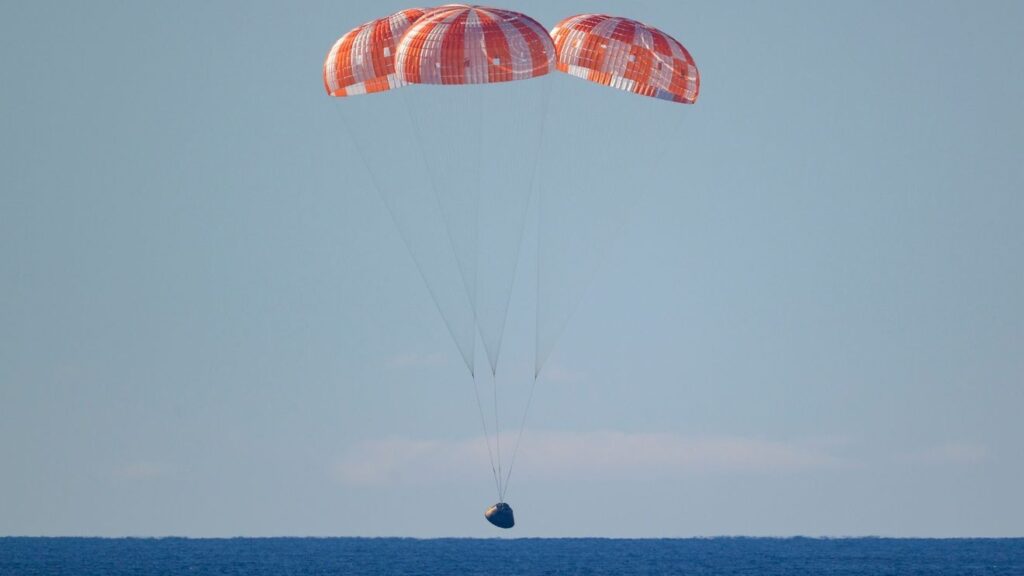
CINCINNATI (WKRC) – Astronomy enthusiasts packed the historic Cincinnati Observatory in Hyde Park to watch a spacecraft splashdown as part of a gathering that mixed a major NASA moment with a personal connection for one local professor.
The Kentucky Area Astronomical Society held its annual conference at the observatory, drawing attendees across generations, from undergraduates seeing their first moon mission to a professor who worked on 33 space shuttle flights.
Astronomy enthusiasts packed the historic Cincinnati Observatory in Hyde Park to watch a spacecraft splashdown as part of a gathering that mixed a major NASA moment with a personal connection for one local professor. (WKRC)
Dr. Wes Ryle, an astronomer at the observatory, said the Integrity traveled at its fastest speeds as it fell to Earth, reaching about 25,000 miles per hour and temperatures of about 5,000 degrees Fahrenheit.
For Dr. Tim Hamilton of Shawnee State University, the communications blackout during re-entry was especially tense because he knew astronaut Christina Koch when they were both engineers at NASA.
“When she had her first flight to the space station, we thought that was the biggest thrill we were going to see for her, but it was just so incredible that she got picked for Artemis II. First woman to the moon, or at least near the moon,” Hamilton said.
Ryle said the moment could help spark interest in science and space-related careers.
“I think this could be a great inspiration for a whole new generation of young students to go into industries that support the space race, support the sciences, and that’ll be something that’s really exciting for us,” Ryle said.
Ryle also said he is excited about the possibility of landing on the moon and that NASA hopes to have moon bases in the future, adding that he may one day be able to see that progress through the observatory’s telescope.
Comment with Bubbles
BE THE FIRST TO COMMENT
NASA said the mission is setting up future space exploration and eventually putting people back on the moon. Artemis 3 is set to launch next year and will take a crew into low Earth orbit.